Good news from Florida International University: scientists have figured out a cheaper, more sustainable way to wrestle those notorious "forever chemicals" (PFAS) out of our drinking water. And it all comes down to a little acidity — or, rather, alkalinity.
For those unfamiliar, PFAS are the chemical equivalent of that guest who just won't leave. They don't break down in the environment, earning them the charming moniker "forever chemicals," and they're lurking in everything from non-stick pans to waterproof jackets. Definitely not something you want in your morning coffee.
FIU chemistry professor Kevin O'Shea and Ph.D. candidate Rodrigo Restrepo Osorio have developed a reusable method that's less of a fight and more of a clever trick. They're using the water's pH level to act like a tiny, chemical trapdoor.
We're a new kind of news feed.
Regular news is designed to drain you. We're a non-profit built to restore you. Every story we publish is scored for impact, progress, and hope.
Start Your News DetoxThe pH-Powered Handcuffs
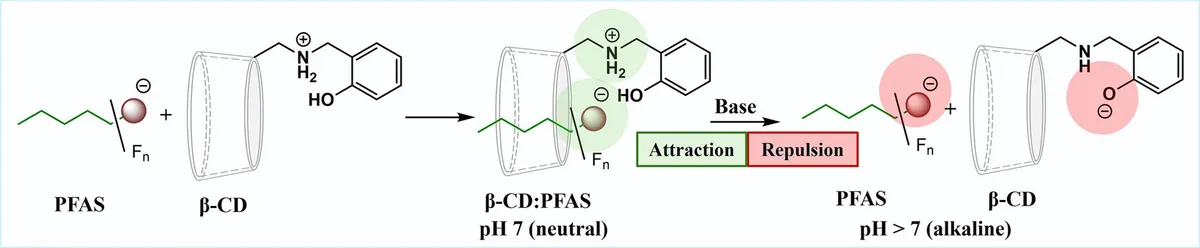
Turns out, donut-shaped sugar molecules are pretty good at cuffing PFAS. Scientists already knew this, but the problem was getting the chemicals out of the sugar traps for disposal, and then reusing the traps themselves. Imagine catching a bunch of tiny, invisible bad guys, but then realizing your handcuffs are single-use. Not ideal.
O'Shea's lightbulb moment? pH. At a neutral pH, these sugar traps hold PFAS tighter than a toddler to a juice box. But crank up the alkalinity — think adding baking soda to water — and suddenly both the PFAS and the sugar trap become negatively charged. Like attracts like? Not here. Opposites repel? Also not here. Same charges repel. And just like that, the PFAS chemicals are jettisoned, freeing up the sugar traps to go catch more.
O'Shea likens it to a door: closed at neutral pH to trap, open at basic pH to release. Which, if you think about it, is both impressive and slightly terrifying in its simplicity. This research, by the way, just landed in the Journal of Hazardous Materials Advances.
So, next time you're thinking about the endless fight against environmental pollutants, remember the pH-controlled trapdoor. Because sometimes, the most elegant solutions are also the most acidic... or, you know, basic.