Fifty-two years passed between Haiti's last two World Cup goals and the two scored against Morocco. For Murielle Lodvil, 52, this wait spanned her entire life.
She watched the match in New York's Little Haiti. Bars and restaurants fell silent as fans watched the game. The first half was frantic, with an equalizer, a goal, and another equalizer.
Haiti was already out of the tournament before their last group match against Morocco. They had lost to Scotland and Brazil in Group C. Haiti gave up two more goals against Morocco, but this did not lessen the joy for Murielle.
We're a new kind of news feed.
Regular news is designed to drain you. We're a non-profit built to restore you. Every story we publish is scored for impact, progress, and hope.
Start Your News DetoxAs a birthday gift, she bought tickets for herself and her sister, Barbara Albert, 41. They watched Haiti play Brazil.
"Haiti being on this world stage was so special to me," Murielle said. "Every moment counts, ending with two goals, even with the outcome."
Ms. Albert said the Brazil match showed the pride many fans felt. They were happy to see Haiti back in the World Cup.
"The representation was really good. We're proud of our Haitian community. We really showed up for them," she said.
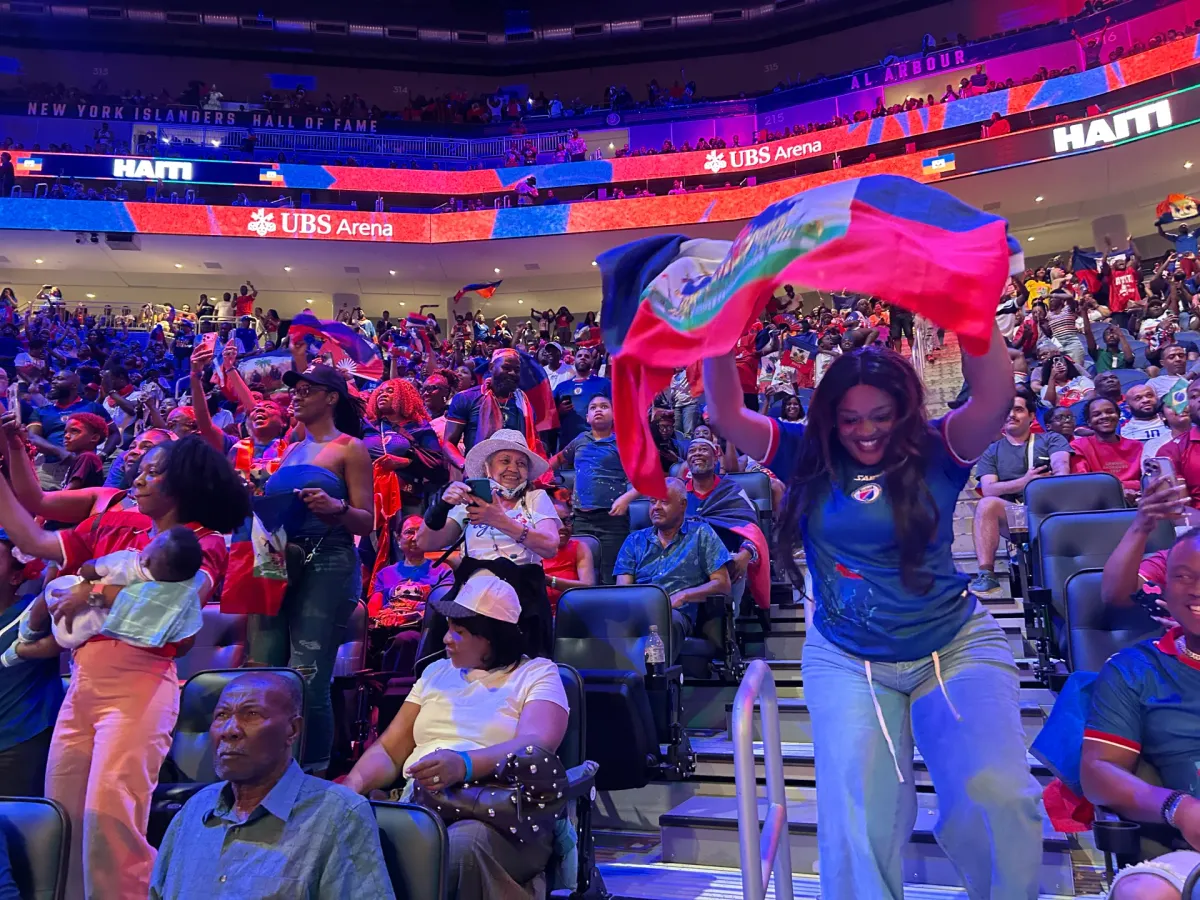
This pride was also clear at the UBS Arena in Elmont, New York. New York has the second-largest Haitian community in the US, with about 113,000 Haitian residents. This is according to the 2024 US Census Bureau.
An hour before Haiti played Brazil, Haitian flags were already gone. Brazil flags, given out at the same time, were still on tables.
Thousands of fans filled the nearly sold-out 19,000-seat stadium. They wore wigs, Haitian jerseys, and flags. Only a few wore Brazilian yellow and green. Maude Schwartz, 58, waved a Haitian flag and danced with her family.
Maude owns a Pilates studio. She moved to the US from Haiti in 1990 on a student visa. She wanted to experience the World Cup atmosphere. Her twin sons were at the match. She was happy with a $10 ticket to the watch party.
"My entire family is here," she said, pointing to the crowd.
However, not everyone who wanted to be there could make it. "I have a niece who has repeatedly been denied a visa to come to the United States," Maude said.
Her experience shows the challenges Haitian fans face. A travel ban, started last year and expanded in January, kept some supporters from attending.
Even players were affected. Woodensky Pierre, a defensive midfielder who lives in Haiti, could not travel to the US. He joined the national team only 10 days before Haiti's first match against Scotland on June 13.
"This is a world event and people should not be denied entry to this country," said Jean-Marc, 55. He is a former player in the Long Island Football League. He wore a Haitian jersey and a wig in the national colors. Born in the US to Haitian parents, he lived in Haiti as a child. He returned in 1986 after the Duvalier regime fell.
Watching Haiti compete in the country he has lived in for decades was a "momentous event for all Haitians."
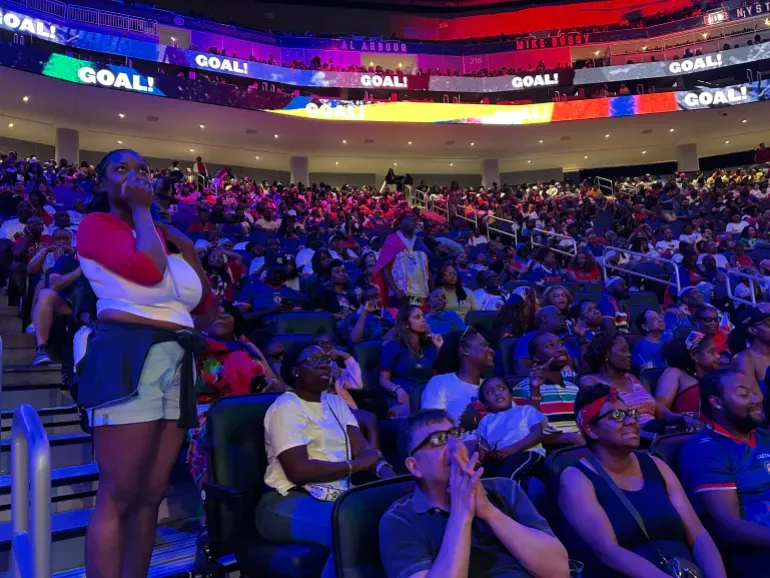 An arena full of gasps and sighs as Brazil scored three goals before half-time: Lauren Ong/Al Jazeera
'Afraid of a raid'
In Flatbush, Brooklyn, also known as Little Haiti, Nadege Fleurimond opened her Haitian-Caribbean restaurant, BunNan. She did this for every Haiti match. This offered a way for those who could not afford stadium tickets to watch.
Nadege came to the US from Haiti when she was seven. She has seen immigration issues affect almost every Haitian family she knows. Watching Haiti's World Cup run in the country where she built her life carried special meaning.
"I am Haitian, and I am also American," she said. "The United States gave me opportunities, education, and the ability to build businesses and create jobs. Haiti gave me my roots, my values, my resilience, and my culture."
"It's a reminder that immigrants don't have to choose one identity over the other," she added.
Nadege grew up hearing more about what Haiti could not do than what it could. For her, the team's appearance in the World Cup was enough.
"It was proof that we belong in rooms and on stages people often count us out of," she said.