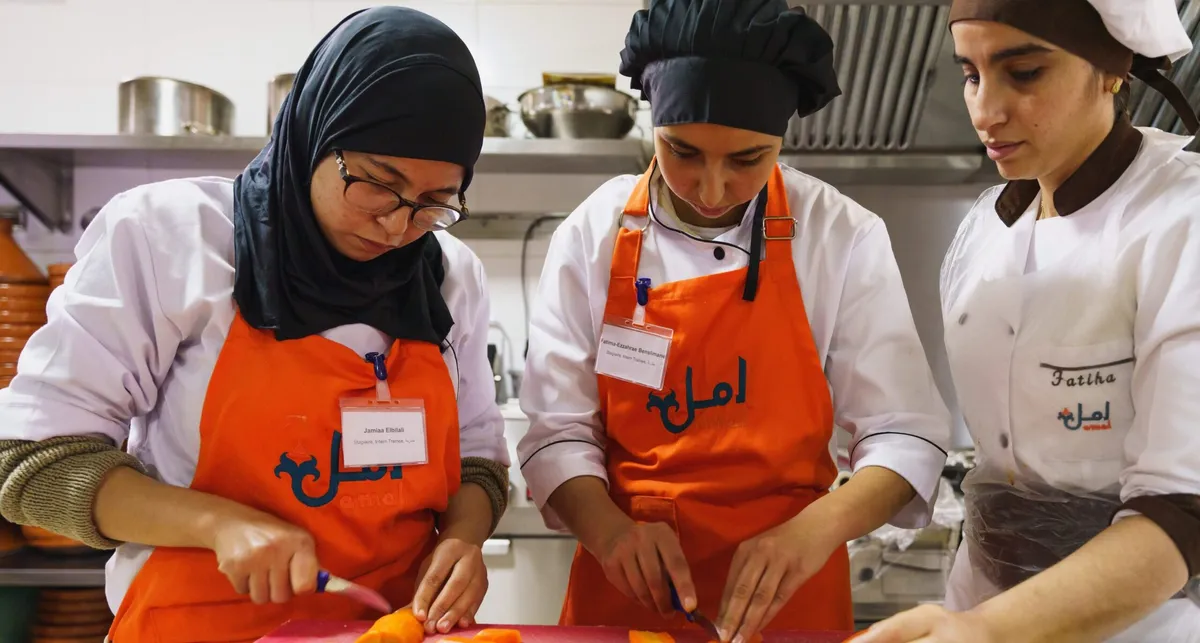
At the Amal Targa Center in Marrakesh, half a dozen young women were running a pop-up kitchen during Africa's biggest soccer tournament. While crowds watched Egypt play Benin on a projection screen, they were plating burgers, merguez sandwiches, and chocolate waffles. The real match, though, was happening in the kitchen.
Oumaima Elhiba, 27, had been training as a chef for three months. "I've learned a lot of things when it comes to the art of cooking," she says. What started as a nonprofit cooking program has become something more: a pathway out of poverty for women in a country where gender inequality runs deep.
Amal was founded in 2012 by Nora Fitzgerald Belahcen, an American-Moroccan who started small—two women, some brownies, a need to survive. Today, more than 350 women have graduated from the nine-month program. The organization runs a flagship restaurant in the Gueliz district, cooking classes in the Targa neighborhood, and a sign language cafe staffed by deaf women.
We're a new kind of news feed.
Regular news is designed to drain you. We're a non-profit built to restore you. Every story we publish is scored for impact, progress, and hope.
Start Your News DetoxThe numbers tell why this matters. Morocco ranked 137th out of 148 countries in the World Economic Forum's 2025 Gender Gap Report. Women make up roughly half the population but just over 22 percent of the workforce. Single mothers face particular rejection—community taboos make it nearly impossible for them to find work, pushing them into severe poverty.
Amal's approach is deliberately holistic. Each year, about 30 women are selected from hundreds of applicants. They receive free cooking training, language lessons, life coaching, health insurance, a monthly stipend for living expenses and transportation, plus extra support if they have children. Some trainees arrive unable to read or write. Some have never made bread.
"The first week can be very difficult," says Ismail El Batalani, one of Amal's trainers. But something shifts. Sana Ait Lamallame, 22, dropped out of university to support her mother. When she started the program in 2023, she didn't know how to cook. Now she works as a server at the Gueliz restaurant. "I started seeing life in a different respect," she says. "I have dreams. I want to be financially independent."
For many, that's not a dream anymore. Amal reports that 87 percent of graduates are currently employed in the culinary sector. On average, they've increased their earning capacity two to five times. The organization helps with job applications, resume writing, interview prep—the unglamorous work that actually gets people hired.
"It's not just giving jobs to women, it's giving them back their dignity," says Fatima-Zohra Iflahen, a gender expert and professor at Cadi Ayyad University. "This holistic approach gives them autonomy. If they lose their job, they will be able to find another."
Amal has also become a crisis responder. During the pandemic, it delivered thousands of meals to families and frontline workers. After the 2023 earthquake, it distributed meals, tents, and solar lamps, and continues supporting residents with beehives for honey production. The organization is also working toward zero food waste and circular composting, sourcing fresh ingredients from local farmers.
Yet Iflahen is clear: there's a limit to what any nonprofit can do alone. Morocco has failed to meet state policies like a pledge to reach 30 percent female employment by 2026. Equal rights for men and women, enshrined in the 2011 constitution, remain far from reality. "There is a limit to what NGOs can do," Iflahen says. "They cannot substitute the state."
But in Marrakesh, one woman at a time, something is shifting. Elhiba now cooks sushi—her new favorite—and her mother asks her to make it at home. "For me, I am happy to not be counting on a man," she says. "I should have my own money, my own income. I have been given that opportunity."