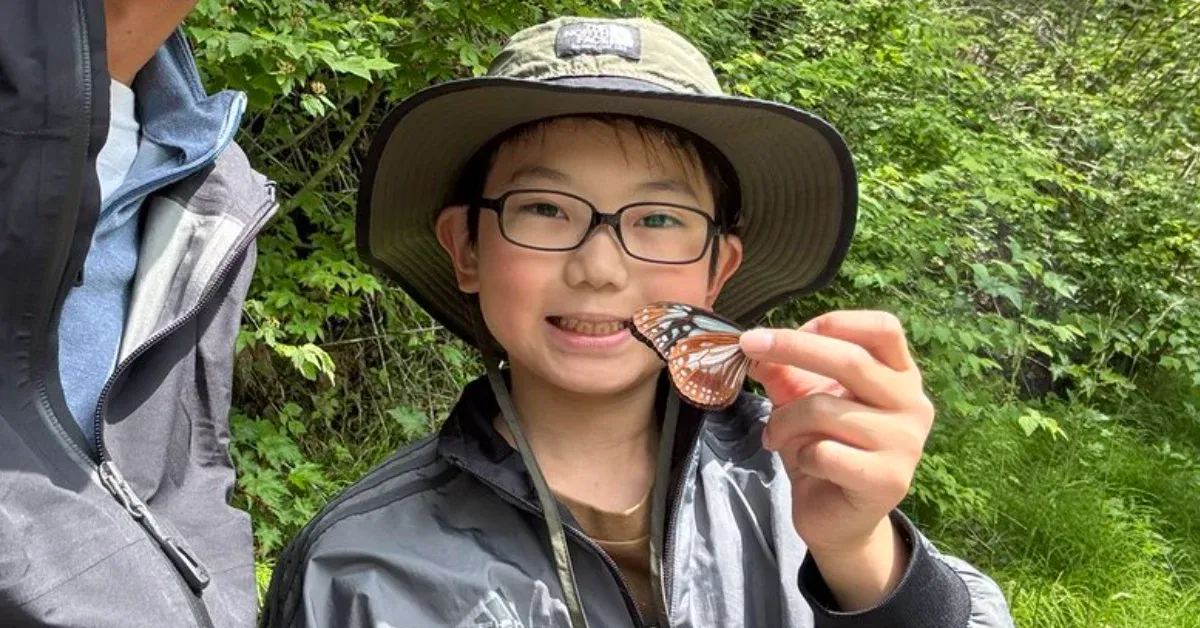
Jo Nagai from Kobe, Japan, started raising swallowtail butterflies in second grade. He noticed something strange when he released them: the butterflies often stayed nearby, sometimes even flying back to him. This made him wonder if his caterpillars remembered him after they became butterflies.
A Young Scientist's Big Question
Nagai reached out to Dr. Martha Weiss, an entomologist at Georgetown who studies insect memory. He was inspired by her 2008 study showing that adult moths could keep memories even after their bodies changed. Nagai sent her a four-page letter.
Weiss later read the letter on the Signal Hill podcast. Nagai wrote, "To Martha Weiss. Hello. Nice to meet you. My name is Jo Nagai. I'm from Japan. I live in Kobe, Japan. I'm in the second grade at Ibuki Elementary School. When I found your research on the internet, I was so delighted!!"
We're a new kind of news feed.
Regular news is designed to drain you. We're a non-profit built to restore you. Every story we publish is scored for impact, progress, and hope.
Start Your News DetoxAnnie Rosenthal, an editor for Signal Hill and Weiss’ daughter, pointed out the "two exclamation marks." Weiss confirmed, "Two bold exclamation marks."
Nagai asked Weiss about her moth memory study and how he could apply it to his butterflies. Weiss was unsure if an elementary student could do such an experiment. She and her graduate student, Doug Blackiston, had done their original work in a secure lab.
Weiss first suggested Nagai try something simpler, like "teaching butterflies to learn colors." But Nagai was determined.
"I really want to prove it’s possible that my butterflies can remember what they learned as a caterpillar," he wrote back. "I don't want to give up now. I really need your help."
The Experiment and Surprising Results
Nagai's persistence led to a multi-year exchange of letters across continents. With Weiss's help, Nagai set up an experiment at home. He tried to recreate Weiss's 2008 study. He created a control group and a test group of caterpillars.
Instead of the chemical Weiss used, Nagai chose lavender oil. He introduced the caterpillars to the smell while giving them tiny shocks with a muscle therapy device.
After the caterpillars became butterflies, 80% of the test group avoided the lavender smell. He sent his 33-page findings to Weiss.

"I was flabbergasted and delighted," Weiss said. "And in this letter I thought, ‘Holy cow, he's a real scientist, and he's figuring out new stuff.’"
In 2022, the year he finished second grade, Nagai presented his research to scientists at several universities in Japan.
Beyond Memory: Inherited Traits
Nagai didn't stop there. A year later, he told Weiss he wanted to see if caterpillars could pass on memories. Inspired by a study on nematodes, Nagai repeated his experiment. He found something amazing: butterflies not only kept memories from their caterpillar stage, but they also seemed to pass these memories to their offspring.
Nagai and Weiss plan to present their findings to the Journal of the Lepidopterists’ Society. For now, Nagai is focused on graduating from fifth grade.
Last year, the 10-year-old finally met Weiss when she visited Japan. Weiss gave him a magnifying glass tied with a ribbon, just like the one she wears.
During the visit, Rosenthal asked Nagai what he wanted to be. She expected him to say entomologist, like her mother. Instead, he said he wants to be a vet.
"I can fix caterpillars and insects both," Nagai explained.
"Are there other insect veterinarians now?" Rosenthal asked.
"No," he said.
"So you might be the first insect vet," she replied.
"Yes!" he exclaimed.