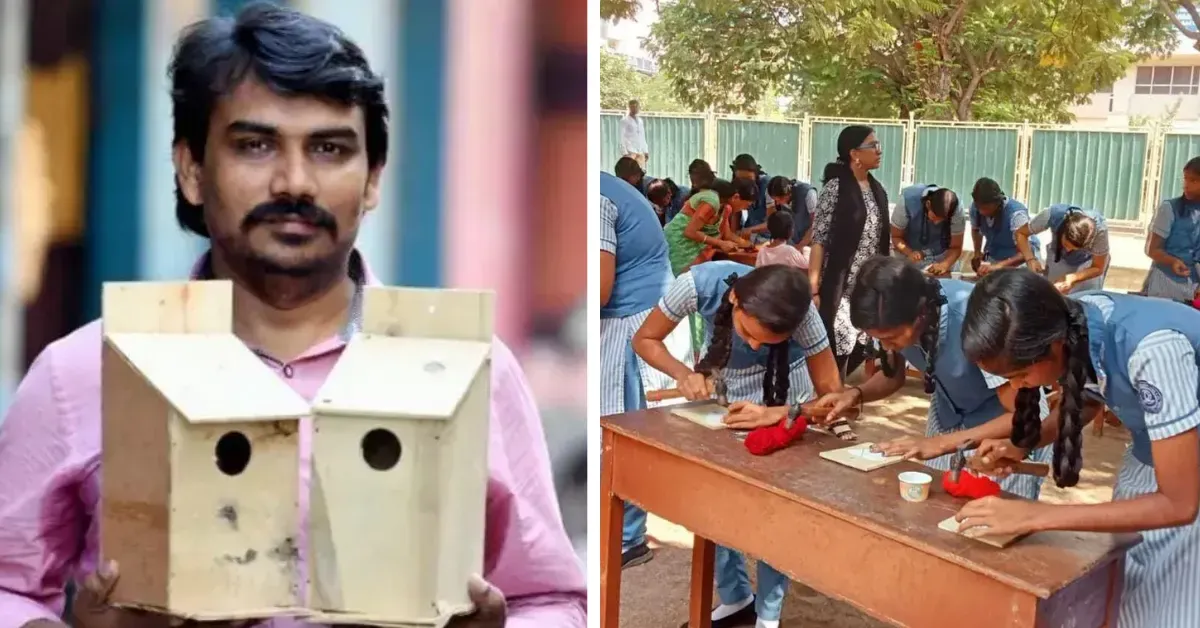
A year ago, Ganeshan D had a simple idea: give sparrows somewhere safe to nest in a city that had largely forgotten them. Today, northern Chennai's sparrow population has climbed by roughly 30 percent. The nest boxes—15,000 of them, distributed to schoolchildren across Tamil Nadu—are working.
Koodugal Nest, the trust Ganeshan founded, started as a conservation effort. It's become something quieter and more powerful: a way to teach kids that small actions matter, while actually bringing birds back to balconies and schoolyards.
How a nest box becomes a classroom
The genius of the model is how it collapses the distance between learning and doing. A student doesn't just read about sparrows. They build or receive a nest box, install it, monitor it, record what they see. They watch eggs hatch. They understand, in their hands, why this matters.
We're a new kind of news feed.
Regular news is designed to drain you. We're a non-profit built to restore you. Every story we publish is scored for impact, progress, and hope.
Start Your News DetoxGaneshan describes the feeling of seeing sparrows return to streets and schoolyards as "extremely satisfying." But he's careful about the framing: "It shows that our efforts are making a tangible difference." Not miraculous. Not revolutionary. Tangible.
The initiative has expanded to 10 additional districts across Tamil Nadu. Schools participate in a mobile app that lets students and volunteers log sparrow sightings, creating a real biodiversity dataset. Technology and grassroots action feeding each other.
The science catches up
Research published in Biotropica in November 2025 titled "The Price of Urban Living — Lower Fledging Success Despite Higher Parental Care in Urban House Sparrows" documents what Koodugal's work already suggested: urban sparrows face real challenges, and interventions like nest boxes matter. The paper gives the on-the-ground effort scientific weight. For Ganeshan, it's validation. For the movement, it's momentum.
The trust has drawn support from corporate partners—Chennai Willingdon Corporate Foundation, Genesys, SurveySparrow, Lennox India Technology—and recognition from India's Prime Minister. In March 2026, Ganeshan will present Koodugal's work at the British Ornithologists' Union conference at the University of Nottingham, carrying a local conservation story to a global stage.
What started in one city is quietly scaling. The question now isn't whether sparrows can come back to urban spaces—northern Chennai has already answered that. It's whether other cities will learn from what works.