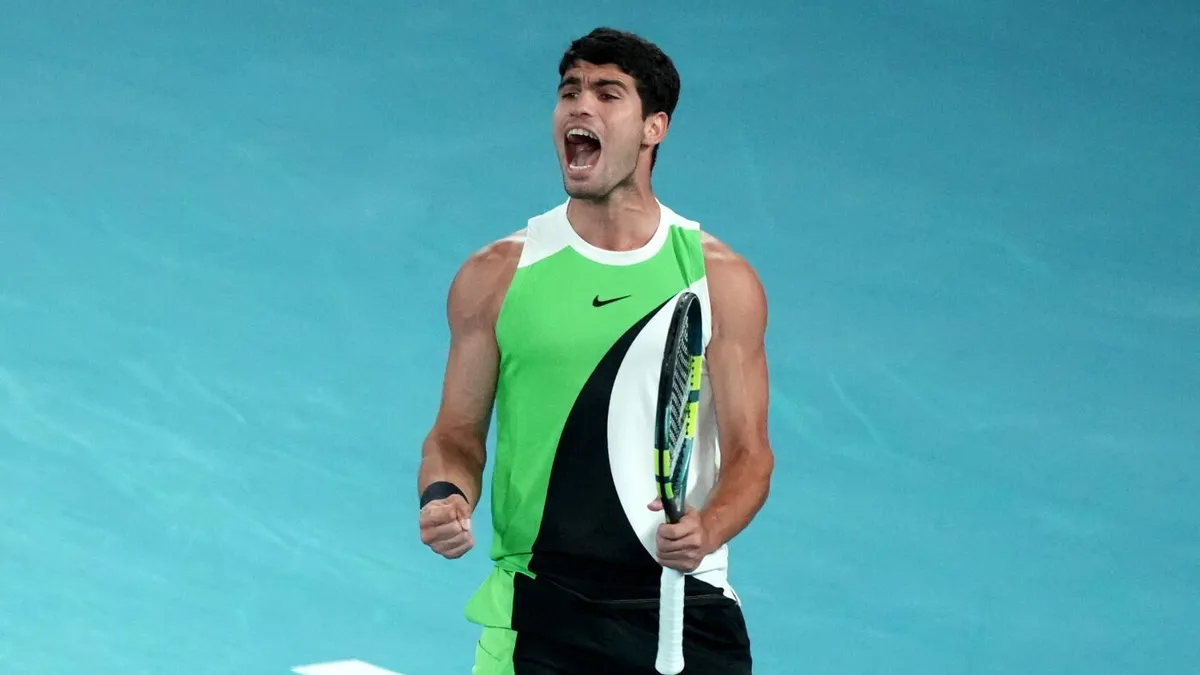
Carlos Alcaraz fell to the ground at Melbourne Park, hands to his head, racket abandoned on the court. The moment was the punctuation mark on something that hadn't happened in nearly a century: a 22-year-old completing a career Grand Slam.
The Spanish world number one had just beaten Novak Djokovic 2-6, 6-2, 6-3, 7-5 in a three-hour Australian Open final that felt like watching the old guard and new guard collide in real time. Djokovic, 38, came out fierce—he'd never lost a final at Melbourne Park in 10 previous appearances. But Alcaraz chased down shots that should have been winners, kept the pressure relentless, and wore down a champion who'd dominated for two decades.
At 22 years and 272 days old, Alcaraz broke the record Don Budge set in 1938. He now owns seven major titles across all four Grand Slams: the Australian Open, French Open, Wimbledon, and US Open.
We're a new kind of news feed.
Regular news is designed to drain you. We're a non-profit built to restore you. Every story we publish is scored for impact, progress, and hope.
Start Your News DetoxWhat makes this feel less like a historical footnote and more like a changing of the era is what's happened since. Djokovic's hunt for a 25th Grand Slam title has now been blocked by either Alcaraz or Jannik Sinner in nine consecutive majors. These two young players—Alcaraz at 22, Sinner at 23—aren't just winning tournaments. They're reshaping what the sport looks like at its highest level.
For context: when Alcaraz won his first major at the US Open in 2022, it felt like an upset. Two years later, it feels inevitable. The generational shift in tennis has moved from "coming soon" to "already here." Djokovic's semifinal win over Sinner showed he can still beat anyone on his best day, but the final revealed something harder to ignore: the next decade belongs to someone else now.
Alcaraz will likely add more Grand Slams to his collection. The question isn't whether he'll win more—it's how many before he reaches 30.