When Alexander Calder was 11, he made his parents two small animal figures for Christmas. He sculpted a dog and a duck from brass sheets. The dog stood still, but the duck rocked when tapped. Art historians see this duck as Calder's first kinetic sculpture.
This was in 1909. The idea of adding movement to sculpture was new. It would later define Calder's art. These two early works are now part of a major exhibition at the Fondation Louis Vuitton in Paris. The show celebrates 100 years since Calder came to France in 1926 and 50 years since he passed away in 1976.
Bernard Arnault, the museum's president, noted that Calder's work is special in 20th-century art. He said Calder's sculptures are abstract and act like nature, growing, moving, and having their own rhythm.
We're a new kind of news feed.
Regular news is designed to drain you. We're a non-profit built to restore you. Every story we publish is scored for impact, progress, and hope.
Start Your News DetoxDreaming in Equilibrium
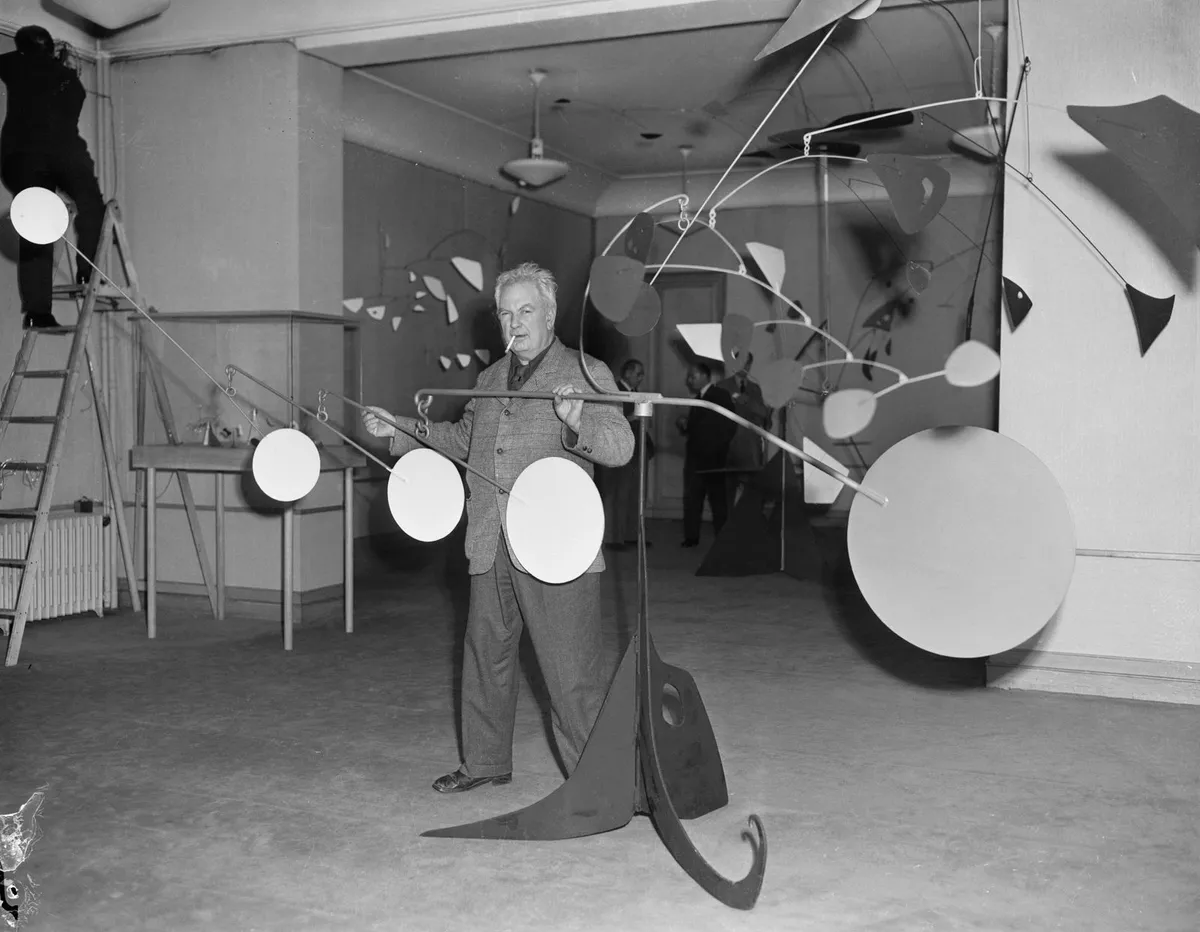
The exhibition, "Calder: Dreaming in Equilibrium," features 300 pieces. These include mobiles (moving sculptures), stabiles (stationary sculptures), paintings, drawings, wire portraits, carved wooden figures, and jewelry. The display covers over 30,000 square feet. Two large stabiles, Black Flag (1974) and Five Swords (1976), are also on the museum's lawn.
The show also highlights art by Calder's friends and fellow artists. These include Barbara Hepworth, Pablo Picasso, and Paul Klee. Visitors can also see photos of Calder by famous photographers like Man Ray, Agnès Varda, and Gordon Parks.

The exhibition is set up in time order. It starts downstairs with the small dog and duck sculptures, each just over four inches long. However, visitors first see Calder’s 19-foot-long mobile Triumphant Red (1963) hanging in the lobby. Emily LaBarge of the New York Times noted that this placement suggests Calder's career was not straightforward.
From Engineering to Art
Calder was born in Philadelphia in 1898. He came from a family of artists. Both his grandfather and father were sculptors, and his mother was a well-known painter. His parents supported his early art interests. But as he finished high school, they encouraged him to think about a stable career.
Calder followed their advice at first. He earned a mechanical engineering degree from the Stevens Institute of Technology in 1919. He knew he was good with his hands and hoped this skill would help him in engineering. A few years later, he felt unhappy with his work. He then enrolled in art classes at the Art Students League in New York City.

In 1926, Calder moved to Paris. This city was a hub for artists, writers, and thinkers, sparking a creative boom. There, Calder began working on Cirque Calder, a miniature circus. It featured dozens of tiny wire sculptures of animals and performers.
Calder would put on detailed shows, sometimes lasting two hours, by moving his creations by hand. The exhibition shows these sculptures along with videos of Calder's performances. Harry Bellet of Le Monde called It is on loan from the Whitney Museum in New York and this is its last trip to France due to its delicate nature.
The Birth of Mobiles
Calder's big artistic moment came in 1930. He visited the studio of Piet Mondrian, a Dutch artist known for paintings with red, blue, and yellow rectangles. Calder later wrote that he suggested to Mondrian it "would be fun to make these rectangles oscillate."
Mondrian wasn't convinced. But the meeting gave Calder "a shock that started things." He realized he wanted to work in abstract art.
In 1931, artist Marcel Duchamp called Calder's moving abstract works "mobiles." Around the same time, artist Jean Arp named his stationary pieces "stabiles." Today, Calder is most famous for his mobiles, which move with natural air currents. Unlike Cirque Calder, they don't need the artist to bring them to life.
One mobile in the exhibition is Small Sphere and Heavy Sphere (1932-1933). It has two balls swinging from a horizontal rod. Viewers watch to see if the balls will hit objects like a wooden crate, glass bottles, and a cymbal on the ground.
Suzanne Paget, artistic director of the Fondation Louis Vuitton, told Galerie magazine that Calder "revolutionized sculpture." She explained that before Calder, sculpture was about volume, mass, and heavy materials. With his mobiles, it became about emptiness and lightness.
Later in the exhibition, visitors will see another sculpture Calder made for his mother. It's an abstract birthday cake. When the candle in the middle is lit, aluminum shapes hanging by wires begin to move. Calder gave it to his mother for her 93rd birthday, almost 50 years after the small duck first set his art in motion.
"Calder: Dreaming in Equilibrium" is on view at the Fondation Louis Vuitton in Paris until August 16, 2026.