An ancient protein that fights infections might hold the key to making cancer immunotherapy work better. Researchers at Nagoya University in Japan found that a protein called complement C3 helps keep certain immune-suppressing cells out of tumors. This only happens when the protein is made right inside the tumor.
The C3 protein that travels through the bloodstream, however, doesn't seem to affect how well cancer treatment works. These findings, published in Nature Communications, suggest that boosting C3 inside tumors could help treat cancers that don't respond well to current therapies.
Local C3 Strengthens Immune Defenses
C3 is a very old protein, found even in simple animals like sponges. Most C3 in the body is made by the liver and circulates in the blood to fight infections. But its role when made directly within tissues and organs has been less clear.
We're a new kind of news feed.
Regular news is designed to drain you. We're a non-profit built to restore you. Every story we publish is scored for impact, progress, and hope.
Start Your News DetoxYuki Miyai, an assistant professor at Nagoya University, explained that cancer tumors are surrounded by normal cells called fibroblasts. The team discovered that C3 made by these fibroblasts inside tumor tissue stops harmful myeloid cells from entering the area around the cancer cells. By keeping these cells out, local C3 gives the immune system a better chance to attack the cancer.
This discovery shows that C3 is an important, but previously unknown, factor in how well cancer immunotherapy works. Immunotherapy is a treatment that helps the body's own immune system find and destroy cancer cells.
Blood C3 Does Not Drive the Response
To see if C3 in the blood also affected immunotherapy, the researchers used mice. They wanted to tell the difference between C3 made by the liver and C3 made inside tumors. Reducing liver-made C3 by 90% did not weaken the effects of an anti-PD-1 antibody, a drug that helps immune cells attack tumors.
However, when the researchers stopped fibroblasts inside tumors from making C3, the same immunotherapy became less effective. This happened even though blood levels of C3 only dropped by 9%.
Miyai noted that the effectiveness of immunotherapy depended on the C3 made at the tumor site, not the C3 in the blood. When this local C3 breaks down, it forms a piece called iC3b. 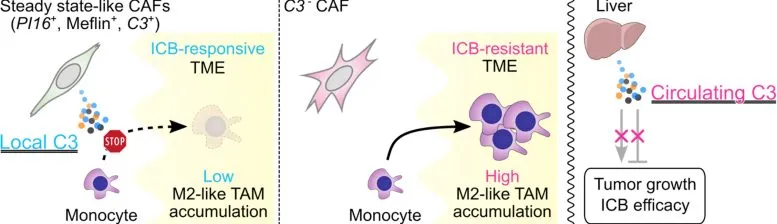
Mimicking C3 Revives Resistant Treatment
The researchers then tried to recreate C3's protective effect in cancers that didn't respond to immunotherapy. They used a drug that acts like C3, blocking myeloid cells from entering tumors.
This combination made previously resistant tumors respond to immunotherapy and significantly extended the lives of mice. These findings could help identify which patients might benefit most from immunotherapy. It could also lead to new treatment options for tumors that are currently resistant.
The team also looked at lung cancer samples from patients. They found a similar pattern: patients with higher C3 levels in the tissue around their cancer had better treatment responses and lived longer. About half of these patients responded to treatment, while none of those with lower C3 levels did. Again, C3 levels in the blood did not affect the outcome.
The researchers now plan to test ways to increase C3 specifically within tumors. They also believe studying C3's local activity could help us understand other immune processes, like wound healing and inflammation.
Deep Dive & References
Local, but not circulating, complement C3 shapes immune checkpoint blockade efficacy by controlling myeloid cell infiltration - Nature Communications, 2026