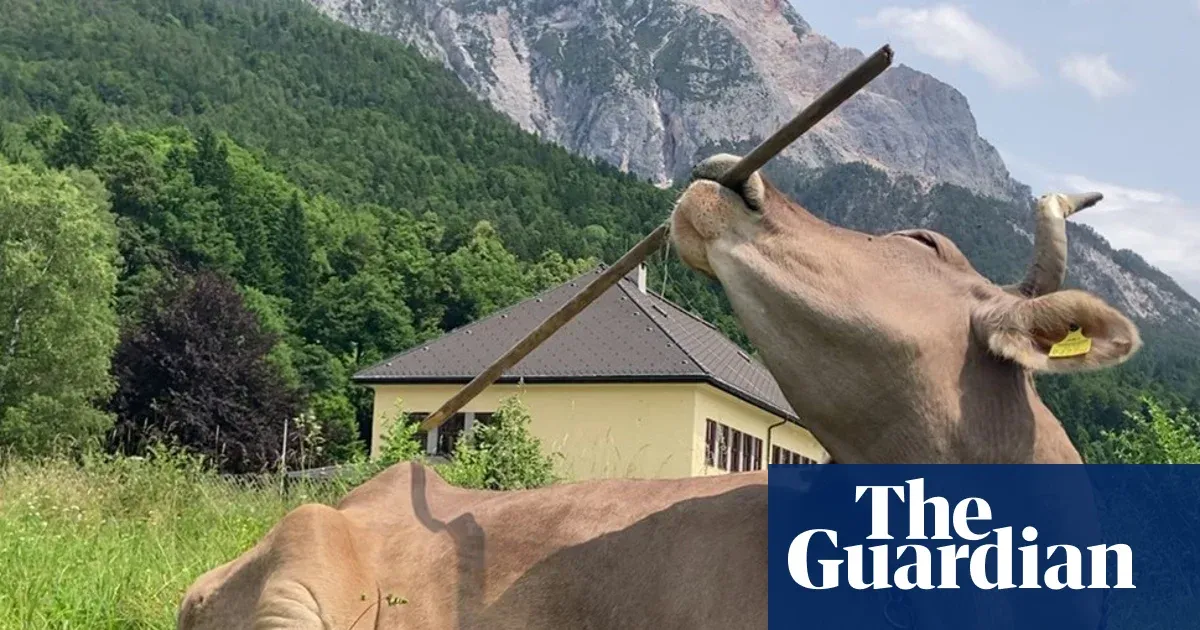
A brown Swiss cow named Veronika has done something scientists didn't think cattle could do: she picked up a broom, figured out which end worked best for different body parts, and used it to scratch herself. And she did it deliberately, not by accident.
Veronika lives on an organic farm in the Austrian Alps, where her owner Witgar Wiegele noticed years ago that she played with sticks and used them to groom herself. When a video of her behavior reached animal intelligence researchers at the University of Veterinary Medicine in Vienna, they recognized something significant. "It was a cow using an actual tool," said Dr. Antonio Osuna Mascaró. "That's not supposed to happen."
Osuna Mascaró and his colleague Alice Auersperg traveled to Veronika's home in Nötsch im Gailtal to test what they'd seen. Over seven sessions, they watched her pick up a deck brush and get to work. She had preferences. The bristled end worked better for scratching her tough back. When she needed to groom more sensitive areas like her udders and belly, she switched to the smooth handle and applied gentler pressure. She even repositioned the broom with her tongue when the angle wasn't right, then clamped it with her teeth.
We're a new kind of news feed.
Regular news is designed to drain you. We're a non-profit built to restore you. Every story we publish is scored for impact, progress, and hope.
Start Your News DetoxThis matters because it's rare. Tool use shows up in chimps, crows, dolphins, and octopuses. Livestock have never made the list. The 1982 Gary Larson cartoon "Cow Tools"—which shows a bewildered cow surrounded by nonsensical objects—became famous partly because the idea seemed so absurd. But across 76 instances of tool use recorded by the researchers, Veronika demonstrated what scientists call multi-purpose tool use: selecting different parts of the same object for different jobs. That's extraordinarily rare outside humans and chimpanzees.
"What this tells us is that cows have the potential to innovate tool use, and we have ignored this fact for thousands of years," Osuna Mascaró said. "It's shocking that we're only discovering this now."
The research, published in Current Biology, doesn't suggest we're on the cusp of a super-cow uprising. Instead, it points to a simpler truth: we've underestimated the minds of animals we've lived alongside for millennia. Veronika didn't invent the broom or fashion a new tool. But she selected one, adjusted it, and used it with notable skill. As the researchers note in their paper, "Perhaps the real absurdity lies not in imagining a tool-using cow, but in assuming such a thing could never exist."
Wiegele, who keeps Veronika as a pet and watches her recognize family members' voices and hurry to greet them, put it differently: "I was naturally amazed by her extraordinary intelligence and thought how much we could learn from animals: patience, calmness, contentment, and gentleness."
The discovery raises a quiet question about what else we might be missing about the animals around us.