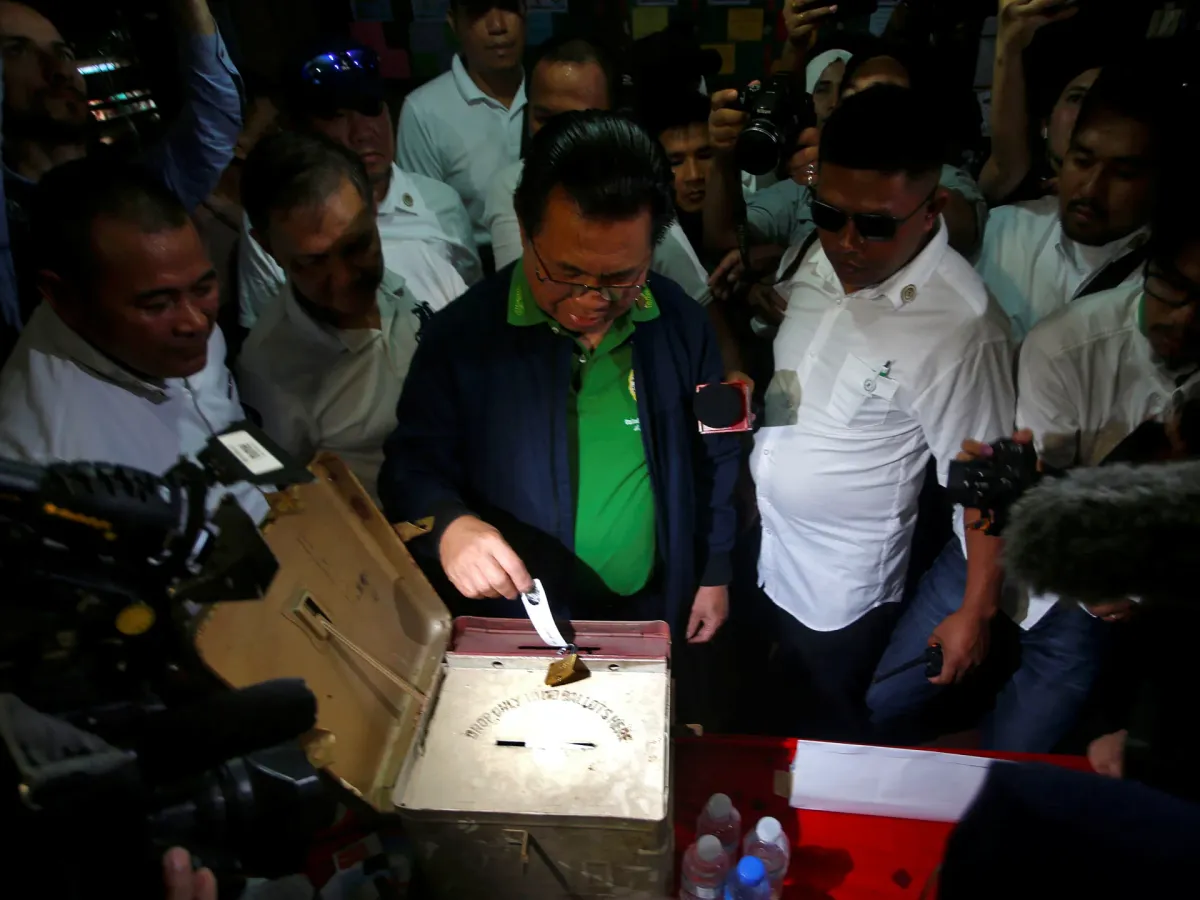
After decades of conflict, negotiations, and a rather complicated political divorce, the Bangsamoro Autonomous Region in Muslim Mindanao (BARMM) in the Philippines is finally getting its first parliamentary election this Monday. It's a pretty big deal, marking the official end of a transition period that began way back in 2018. Think of it as a grand finale, but with potentially more fireworks than a typical political send-off.
This vote isn't just about picking new leaders; it's a litmus test. For the Philippine government, it's a chance to prove its commitment to peace. For the Moro Islamic Liberation Front (MILF), a group that spent years in armed struggle, it's a moment to show they're all in on democracy. No pressure or anything.
The Long Road to Self-Rule
BARMM sits on Mindanao, the Philippines' second-largest island, and is home to the Moro people, a Muslim-majority group with a long history of self-governance. They resisted Spanish rule, then continued their fight for self-determination after the Philippines gained independence in 1946. Because apparently, some habits die harder than others.
We're a new kind of news feed.
Regular news is designed to drain you. We're a non-profit built to restore you. Every story we publish is scored for impact, progress, and hope.
Start Your News DetoxManila's first attempt at local autonomy in 1989, the Autonomous Region in Muslim Mindanao (ARMM), was, to put it mildly, a flop. It had about as much real power as a paper umbrella in a typhoon and didn't do much for the local economy. The MILF, naturally, kept up their armed struggle.
Fast forward to 2012, when President Benigno Aquino III called ARMM a "failed experiment" (ouch). This led to a framework agreement with the MILF for a whole new political entity. Six years later, President Rodrigo Duterte signed the Organic Law for BARMM, giving the region more financial independence, its own government, parliament, and even a justice system. Because if you're going to do it, do it right.
All these efforts culminated in the Comprehensive Agreement on the Bangsamoro, which detailed the transition from ARMM to BARMM, managed by the MILF-led Bangsamoro Transition Authority (BTA). Now, after all that, it's time to elect the first official lawmakers.
A Challenging Election
This election is happening during a period of high tension, even within the MILF itself. Two factions have emerged, one backing MILF Chair Al Haj Murad Ebrahim, and the other supporting Chief Minister Abdulraof Macacua. Because nothing says unity like a good old-fashioned internal political spat.
Last month, Macacua joined the new Bangsamoro Federalist Party (BFP), which is now going head-to-head with the MILF's political arm, the United Bangsamoro Justice Party (UBJP). Shortly after this move, Macacua's convoy was attacked (he was unharmed, thankfully). Then, in early September, Macacua and 40 commanders were removed from the MILF's military wing for "disobedience." Which, again, doesn't exactly scream "smooth sailing."
These tensions have people worried about potential unrest post-election. Plus, there's the usual election baggage: vote-buying, violence, and fraud have been common in the past. If those issues resurface, the results might not reflect the will of the people, or their satisfaction with the transitional government.
The MILF, which prides itself on "moral governance," is now in a tricky spot. They need to avoid widespread vote-buying and manipulation, and keep internal rivalries from escalating into violence. However, some prominent MILF figures have already hinted that if the UBJP detects fraud, its members are "ready to fight." They've also suggested that since the MILF led the transition, they should naturally stay in power. On social media, some citizens have called these threats "un-Islamic." So, that's going well.
Manila has sent military forces to key areas, escalating fears of potential clashes with the MILF and possibly leading to low voter turnout. Given this rather delicate situation, the future of Bangsamoro is, shall we say, a bit up in the air.
Regardless of what happens, everyone involved — the Philippine government, the Bangsamoro parties, and the citizens themselves — needs to remember that this peace, hard-won after a long and difficult conflict, is a shared responsibility. And probably worth more than a few political squabbles.