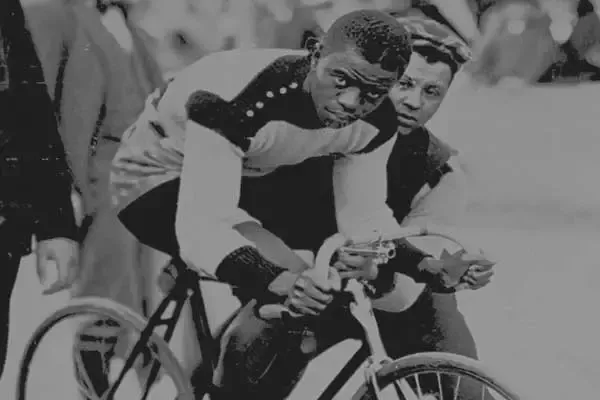
Marshall "Major" Taylor was probably the first globally famous athlete most people have never heard of. In 1899, he became the world champion cyclist—a title that should have cemented his place in sports history. Instead, he spent his final years selling his own autobiography door-to-door in Chicago, and when he died in 1932 at 53, he was buried in a pauper's grave.
Taylor's story isn't just about one man's fall from grace. It's about how racism, changing technology, and plain bad luck can erase even the most extraordinary achievements from collective memory.
The Bicycle Boy Who Became "The Black Cyclone"
Born in 1878 in Indianapolis to a formerly enslaved father, Taylor got his first bicycle from a wealthy family his father worked for. He was soon riding barefoot for miles delivering newspapers, mastering tricks that caught the attention of a local bike shop owner. Dressed in a military uniform to perform stunts outside the shop, Taylor earned his first nickname: "Major."
We're a new kind of news feed.
Regular news is designed to drain you. We're a non-profit built to restore you. Every story we publish is scored for impact, progress, and hope.
Start Your News DetoxBy the 1890s, as America experienced a bicycle boom, Taylor was racing—and winning. But he couldn't officially join any riding clubs. When "whites only" races were held, friends would smuggle him in. At 17, he broke the world record held by professional racer Ray MacDonald, shaving two-fifths of a second off the time. The watching crowd knew what they'd witnessed. Taylor's second nickname arrived: "The Black Cyclone."
As a professional, Taylor won 29 of his first 49 races. By 1899, he'd claimed the cycling world championship officially, earning widespread fame. The problem was that fame didn't protect him. In the South, racist spectators threw ice and nails at him. White cyclists would jostle him, shove him, box him in. At a one-mile race in Massachusetts, cyclist W.E. Becker pulled Taylor to the ground after losing to him. "Becker choked him into a state of insensibility," the New York Times reported. "It was fully fifteen minutes before Taylor recovered consciousness." Becker was fined $50.

The Champion Who Raced Away
Taylor made a choice: he moved to Europe. There, a Black athlete could race without fear of racially motivated violence. Promoters shifted events from Sundays to accommodate his refusal to race on the Sabbath. In 1902, Taylor dominated the European Tour, winning the majority of races he entered and cementing his reputation as the fastest cyclist in the world. He was reportedly earning $30,000 a year—making him one of the wealthiest athletes of his era, Black or white.
But the world was changing. As automobiles emerged as a more exciting mode of movement, mass interest in cycling began to collapse. In 1910, at 32, Taylor retired. He'd built a sizable fortune. It should have been enough.
Then came 1929. The Wall Street crash and some bad investments wiped out nearly everything. Taylor self-published his autobiography, The Fastest Bicycle Rider in the World, and spent his final years selling it door-to-door in Chicago. When he died in 1932, he was buried in a pauper's grave at Mount Glenwood Cemetery.
Former racing stars eventually learned of this indignity and convinced Frank Schwinn, owner of the Schwinn Bicycle Company, to have Taylor's remains exhumed and moved to the cemetery's Memorial Garden of the Good Shepherd. A bronze tablet was placed marking his grave: "Worlds champion bicycle racer who came up the hard way—Without hatred in his heart—An honest, courageous and God-fearing, clean-living gentlemanly athlete."
Taylor's story matters not because it ends in redemption, but because it shows how easily excellence can be erased. He was faster than his competitors, more disciplined than his peers, and more resilient than anyone had the right to ask. And still, history had to be reminded to remember him.