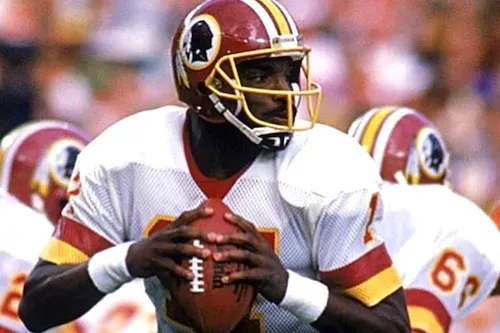
On January 31, 1988, Doug Williams threw four touchdown passes in a single quarter and became the first Black quarterback to win a Super Bowl. The Washington Redskins beat Denver 42-10, and Williams walked away with MVP honors. But the real significance wasn't just what he did on the field—it was what his presence there meant, and what it opened up.
Williams grew up in Zachary, Louisiana, in an era when a Black quarterback leading an NFL team seemed like science fiction. He went to Grambling State, where he played under legendary coach Eddie Robinson from 1974 to 1977, throwing for over 8,000 yards and 93 touchdowns. He finished fourth in Heisman Trophy voting in 1977. In 1978, the Tampa Bay Buccaneers drafted him 17th overall—the first Black quarterback taken in the first round of an NFL draft.
For five seasons in Tampa, he led the team to the playoffs three times, including an NFC Championship Game appearance in 1979. And yet he was paid significantly less than white quarterbacks in comparable roles. It was racism, plain and simple, and Williams knew it.
We're a new kind of news feed.
Regular news is designed to drain you. We're a non-profit built to restore you. Every story we publish is scored for impact, progress, and hope.
Start Your News DetoxAfter a brief detour to the USFL, Williams joined Washington in 1986 as a backup. When head coach Joe Gibbs named him the starter for the 1987 playoffs, few expected what came next. In Super Bowl XXII, Williams threw 340 passing yards and four touchdown passes in the second quarter alone. When a reporter asked him at Media Day, "How long have you been a Black quarterback?" he had a ready answer: "I've been a quarterback since high school, and I've been Black all my life."
What came after
Williams played through 1989, though injuries limited his time. He moved into coaching and returned to Grambling as head coach twice (1998-2003, 2011-2013), winning four conference championships. In 2010, he helped establish the Black College Football Hall of Fame—a deliberate act of ensuring HBCU athletes got the historical record they deserved.
The through-line matters. In 2024, he received the American Football Coaches Association's Trailblazer Award. He's now senior advisor to the Commanders. And in January 2026, his son D.J. was named the team's quarterbacks coach. Full circle doesn't capture it—it's more like a door that stayed open.
Williams didn't just break a barrier in 1988. He made it harder to ever put it back.