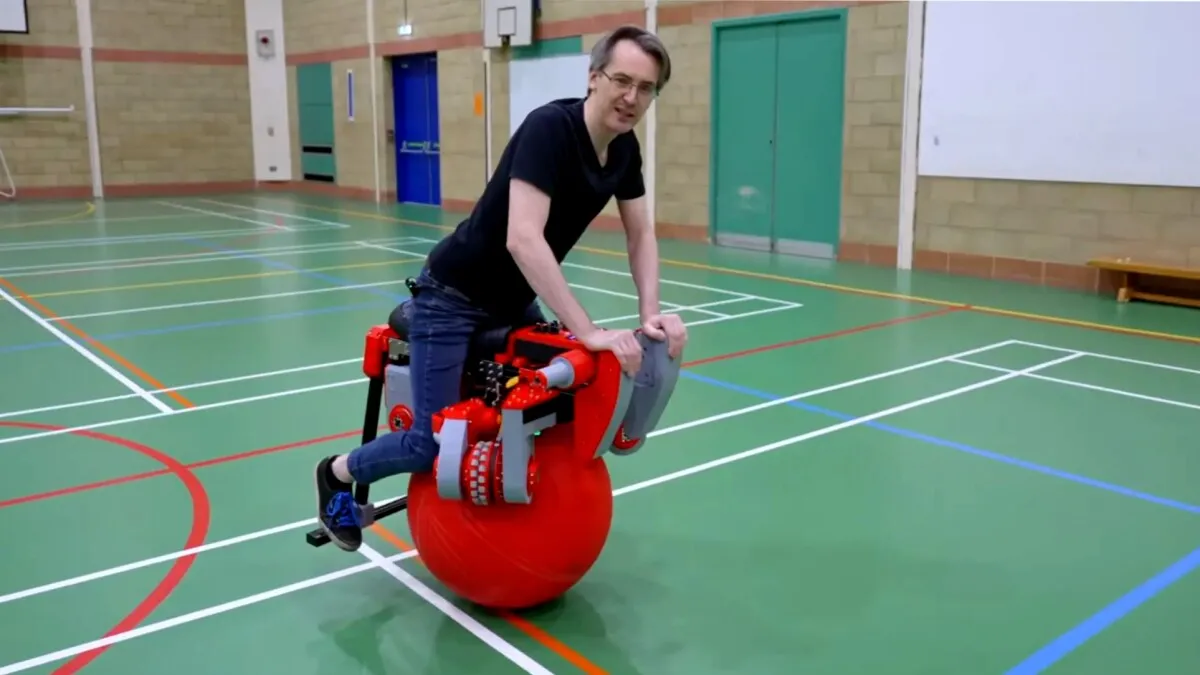
James Bruton has built a lot of improbable things — a motorcycle that runs on spinning cylinders, a rideable electric Lego skateboard — but his latest project might be the most gloriously pointless: a full-size electric bike that stays upright on a single giant red ball.
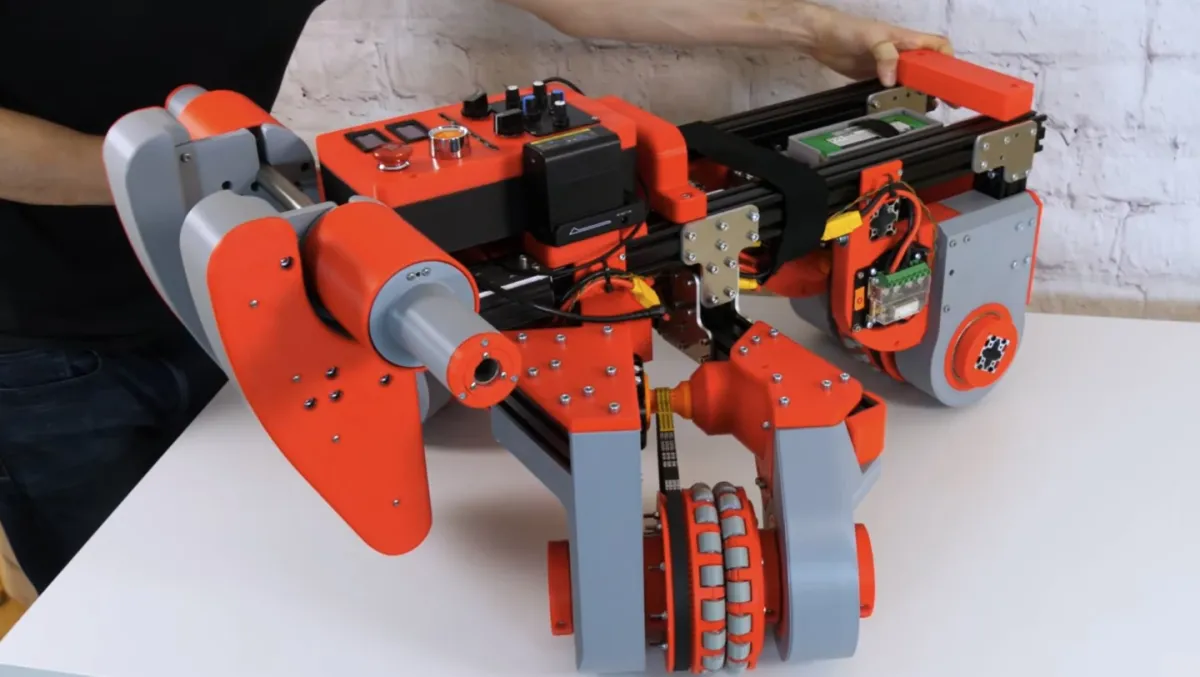
The machine works because three custom-built omni-wheels (wheels with small rollers arranged around their edge) sit on top of the ball at equal distances. By spinning these wheels at different speeds and directions, the bike can move in any direction and, crucially, keep itself balanced. It's the kind of engineering that asks "can we?" instead of "should we?" — and then proves the answer is yes.
How One Ball Does the Work of Two
Bruton's earlier version used two balls, one under each end of the frame. That bike steered by spinning each ball in opposite directions. A single ball removes that trick entirely, which meant he had to solve the steering problem from scratch. His solution: a large foam fin hot-glued to the frame, angled like the wings on a Star Wars speeder bike, that catches air to bias which direction the bike travels. It sounds absurd. It works.
We're a new kind of news feed.
Regular news is designed to drain you. We're a non-profit built to restore you. Every story we publish is scored for impact, progress, and hope.
Start Your News DetoxThe three motors driving the wheels are each rated up to 2 kilowatts and controlled by a PID algorithm — a closed-loop system that reads tilt data from an inertial measurement unit (basically a chip that always knows which way is down) and adjusts all three motors simultaneously to keep the bike balanced in both directions at once. The math is straightforward trigonometry: when traveling straight, the two wheels angled at 60 degrees spin at half the speed of the forward-facing wheel. Change direction, and those ratios shift.
The engineering details are obsessive. Each of the three omni-wheels carries 36 small barrel-shaped rollers (18 per row, two rows each) — 216 rollers total across the whole system. Every single one runs on its own bearing, with custom aluminum hubs and flexible 3D-printed rubber tires. The frame is aluminum extrusion with 3D-printed structural parts. Power comes from six lithium-polymer battery packs wired to deliver 50 volts.
What makes this genuinely interesting beyond the stunt is that Bruton publishes all his code and CAD files open-source. Other engineers now have a working foundation to build on — they can study how he solved the balance problem, the motor control, the structural design. It's the opposite of gatekeeping innovation.
The remaining problems are real. Static electricity builds up between the plastic ball and rubber rollers, scrambling the electronics and causing unexpected shutdowns (Bruton's hair literally stood on end during testing). Steering still feels like a workaround rather than a solution. But these are solvable engineering challenges, not fundamental flaws.
His next video will tackle steering directly. That's when we'll know if this wonderfully absurd machine has a future beyond his workshop floor — or if it stays exactly what it is: proof that sometimes the best engineering projects are the ones nobody needed.