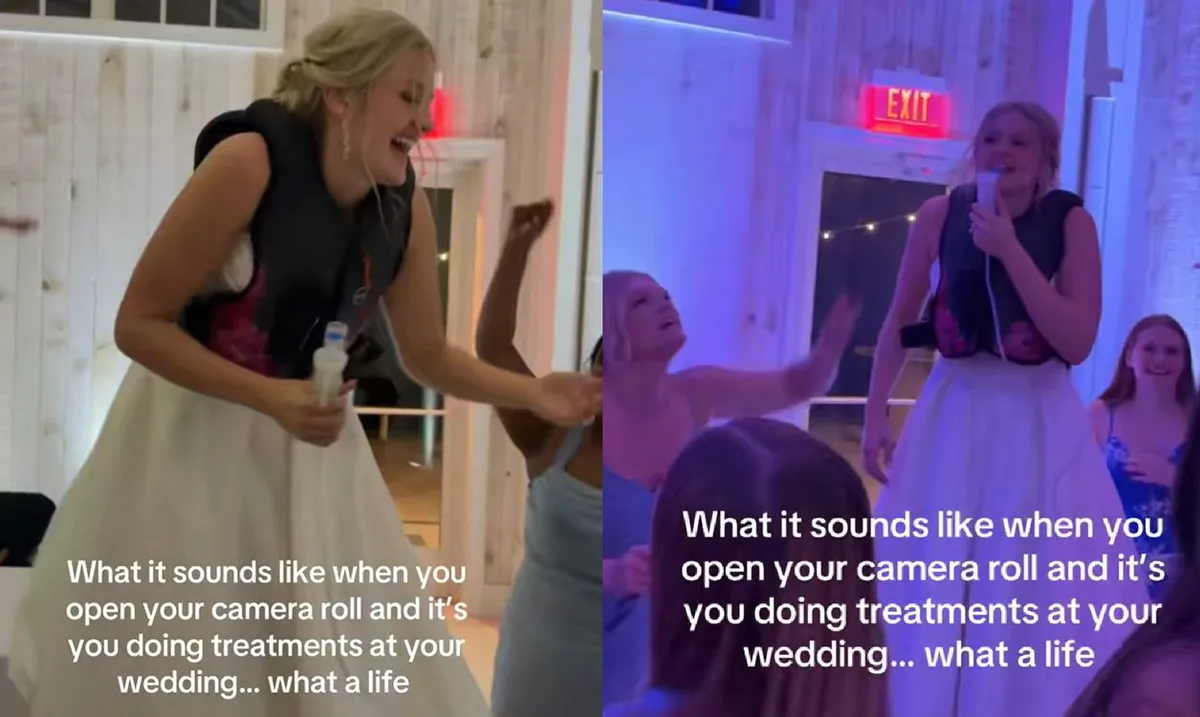
Dannika Evans was 20 years old, newly married, surrounded by everyone she loved—and her lungs needed clearing. So she did what made sense: she danced.
It was June in Sioux Falls, South Dakota. Evans had married Bo Evans that day, and during the reception, she wore a special oscillation vest designed to help her lungs shed the thick mucus that cystic fibrosis leaves behind. A nebulizer sat between her teeth. Twice daily, she does this. On her wedding night, she decided to do it on the dance floor, moving to music with her new husband and their guests watching.
Someone filmed it. She posted it to TikTok with a caption: "CF doesn't stop no party ✨" The video accumulated 2.2 million views.
We're a new kind of news feed.
Regular news is designed to drain you. We're a non-profit built to restore you. Every story we publish is scored for impact, progress, and hope.
Start Your News DetoxWhat Cystic Fibrosis Actually Means
Cystic fibrosis is a genetic disease that thickens the secretions in the lungs, making them prone to infection and increasingly difficult to breathe through. It's serious—historically, most people with CF didn't reach adulthood. But medical advances have changed that trajectory. Now many CF patients, like Evans, build full lives. They work, they marry, they dance at their own weddings.
Evans's treatment is high-frequency chest wall oscillation therapy—the vest vibrates at a specific frequency to help loosen and clear the mucus. She needs it twice daily, every day, for the rest of her life. On her wedding night, she had already done her morning session. Evening was approaching. She had a choice: skip the party, do the treatment alone somewhere quiet, or incorporate it into the celebration.
"Knowing that I had to do treatments the night of my wedding, doing them on the dance floor with everyone I love surrounding me seemed like the best option," she told PEOPLE Magazine. "While energy was high, we had the time of our lives dancing the night away while I was shaking."
Why This Moment Mattered
The video resonated across the cystic fibrosis community in ways that surprised even Evans. Thousands of comments came from fellow CF patients, respiratory therapists, and parents of children with the disease. Many said the same thing: seeing someone with CF living joyfully, refusing to hide or apologize for their medical reality, gave them hope.
"As a CF patient myself I feel so much joy seeing other CF people sharing the happy parts of their life," one commenter wrote.
Evans reflected on what the response meant to her: "Most of the comments are from 'CFers,' respiratory therapists, or parents of CF patients. Knowing that I can reach people just like me, gives me hope to keep posting my life journey with CF. I hope it gives people a new perspective of the disease. Cystic fibrosis can take, take, and take, but you can fight back. With joy, patience, and doing EVERYTHING you can to stay as healthy as possible."
That's the thing about living with a chronic illness that requires constant, visible management: you can either hide it or integrate it. Evans chose integration. Her wedding dance wasn't inspiring despite the medical vest. It was powerful because of it—a moment where treatment and celebration weren't separate things, but the same thing. A young woman, married one day, dancing through her necessary medicine with the people she loved watching. No apology. No performance. Just life, exactly as it is.