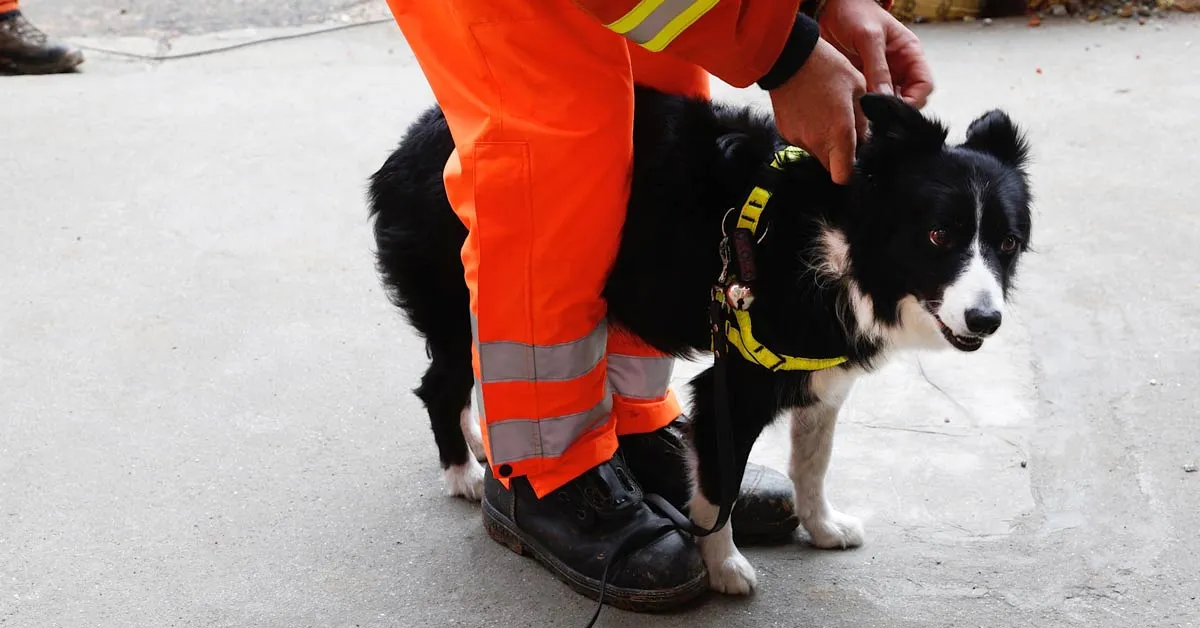
Search-and-rescue dogs have always been the gold standard for finding people in crisis. Their noses can detect a scent trail no machine has come close to matching. But what if you gave them a digital co-pilot.
That's the idea behind COSMIC-T (Collaborative Intelligence for Olfactory Search Missions Integrating Canines and Technology), a system built by Scientific Systems that pairs dog handlers, their dogs, AI software, and drones into a single coordinated search operation. After three years of testing with fire departments, the results are striking: mock victims were located five to ten times faster than traditional search methods alone.
Here's how it works in practice. As a dog moves across terrain, a drone tracks its position and feeds real-time environmental data—wind patterns, temperature, geography—into an AI system. That software makes predictions about where a missing person might be based on scent behavior, weather, and terrain. Meanwhile, the handler watches a tablet displaying color-coded maps built from infrared sensors. The AI either guides the dog toward the highest-probability zones or, if speed matters more than four legs can deliver, an autonomous drone heads in that direction first.
We're a new kind of news feed.
Regular news is designed to drain you. We're a non-profit built to restore you. Every story we publish is scored for impact, progress, and hope.
Start Your News DetoxThe system also monitors the dog's physiological state—heart rate, stress levels, fatigue—ensuring the search doesn't push an animal beyond safe limits. For handlers, this is meaningful. Scott Olsen, Fire Chief of Boone County Fire Protection District, called it "a privilege" to contribute data to the program. "Canine Search Teams are one of the most important components of our disaster response capabilities," he said.
But the developers are careful about one thing: they're not trying to replace dogs or the experienced humans who work with them. "We've spent hundreds of millions of dollars trying to make a sensor as good as a dog's nose, and we've never gotten close," said Mitchell Colby, group lead for AI and machine learning at Scientific Systems. "AI is making great strides, but I have not seen any AI that can compete with the intuition of an operator with a lot of experience."
The breakthrough isn't one technology outperforming another. It's the three working as a team—each covering what the others can't. The dog brings intuition and olfactory capability. The human brings judgment and experience. The AI brings speed and pattern recognition across massive datasets. Together, they're finding people faster than any single approach could manage.