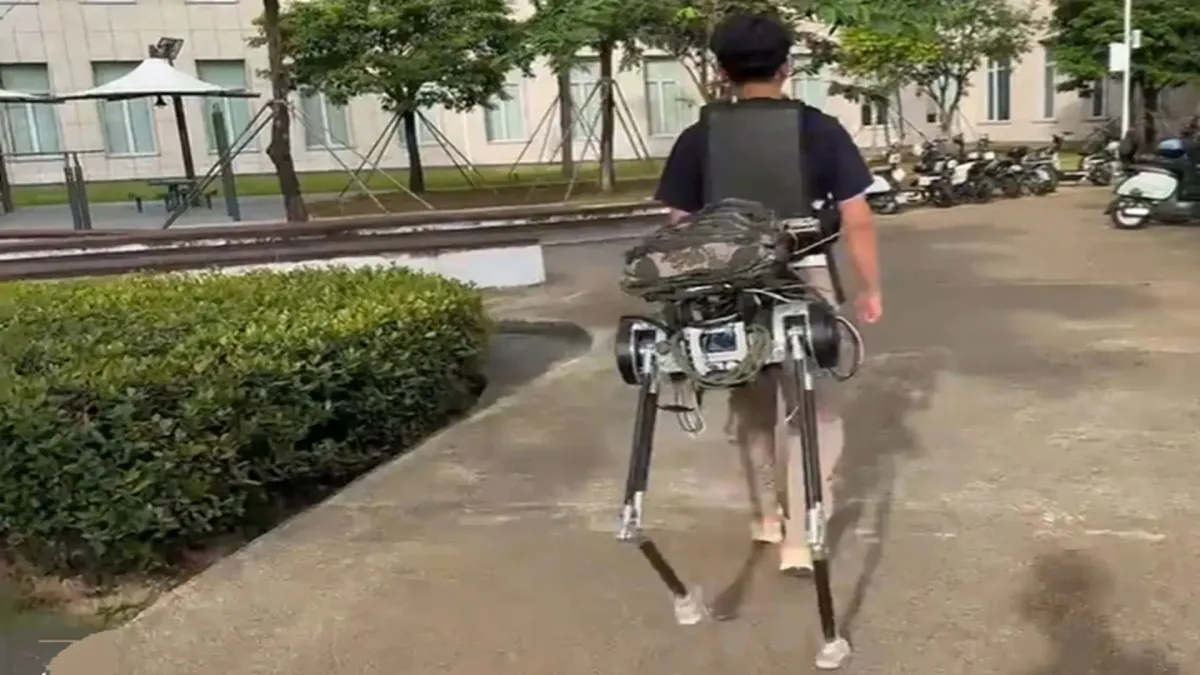
Researchers in China have created a new wearable robot. It adds two mechanical legs behind a person. This helps carry heavy loads and makes walking easier.
The system turns a human into a "centaur-style" hybrid. It moves like a four-legged creature.
The robot was developed by a team at the Southern University of Science and Technology in Shenzhen. It walks in sync with the user. It also supports part of the load usually carried in a backpack.
We're a new kind of news feed.
Regular news is designed to drain you. We're a non-profit built to restore you. Every story we publish is scored for impact, progress, and hope.
Start Your News DetoxThe robot legs move with the wearer. They share the weight and help with forward movement.
This system is different from typical exoskeletons. Exoskeletons attach to human legs. This robot works as a separate pair of limbs. It connects to the user's back with an elastic interface.
This design lets the robot handle most of the weight. The human still focuses on balance and steering.
Tests showed the robot greatly reduced physical strain. When people carried a 44-pound load, their energy use dropped by about 35%. Foot pressure also went down by about 52% compared to walking without help.
How the Robotic Legs Work
This robot's design is unique. Most wearable robots, like exoskeletons, run along a user's legs. They mainly help with joint movement.
The centaur-style robot creates a hybrid walking system. Its robotic legs provide power and support the weight.
The researchers added an elastic connection between the human and the robot. This connection has a special stiffness. For lighter loads, the connection stays firm, helping coordination.
As the load gets heavier, the system becomes more flexible. This allows the robot to absorb forces and carry more of the weight.
This division of tasks makes the human and robot work better together. The human steers and balances. The robot does most of the heavy lifting.
The team also created ways for the robot legs to match the user's walking speed and direction. The robot uses advanced control to move steadily in different walking conditions.
Built for Tough Jobs
During trials, the system moved steadily with heavy loads. The robotic legs could support over half of the carried weight. They also allowed for natural walking patterns.
The robot also made walking with a load more stable. Steps became more consistent. The walking pattern stayed similar to normal walking without extra weight.
Researchers believe these wearable robots can help workers who often carry heavy gear. This includes military logistics, disaster rescue, and industrial tasks. Workers in these fields often move heavy supplies over rough ground.
The system helps by both redistributing weight and assisting with forward movement. This means users can walk farther with less tiredness while carrying large loads.
The study on the wearable centaur robot was published in The International Journal of Robotics Research.