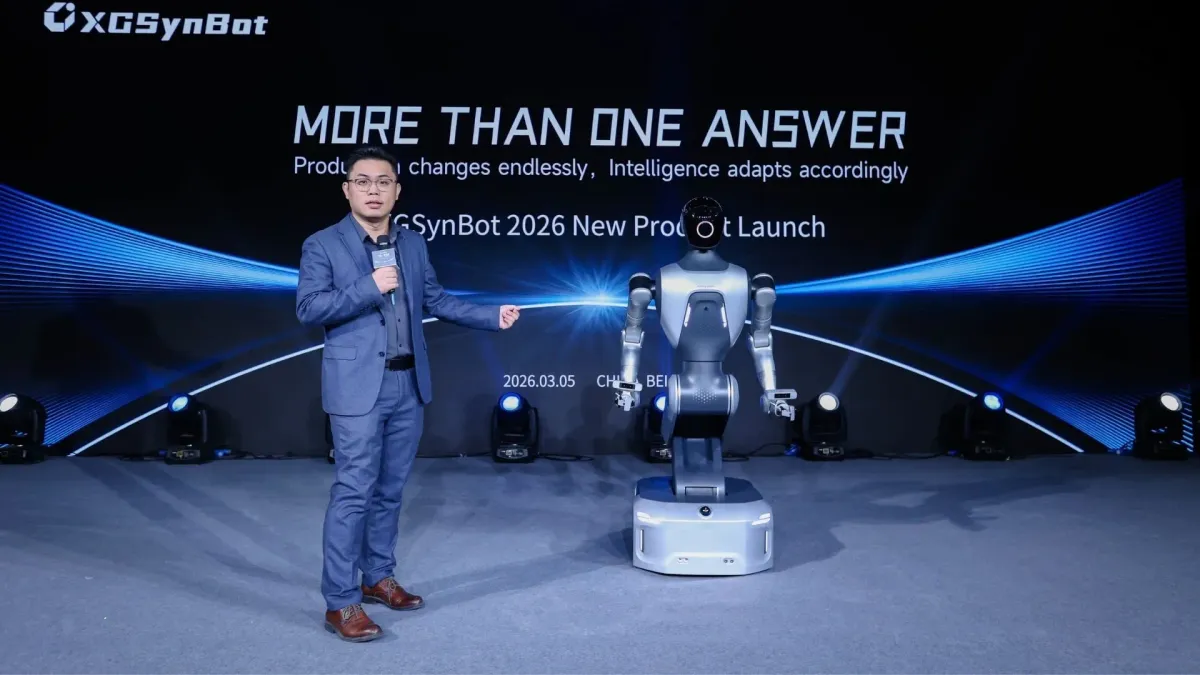
A Chinese robotics company, XGSynBot, has introduced a new humanoid robot called Z1. This robot is designed to work in factories and can switch between different tools very quickly.
The Z1 was unveiled at a special event held in both Silicon Valley and Beijing.
Built for Factory Work
The Z1 is a wheeled humanoid robot. It features a unique system for quickly changing its tools and uses special high-performance joint modules developed by XGSynBot.
The company also announced its "STARFIRE" strategy. This plan aims to speed up how embodied AI, which means AI that exists in a physical body like a robot, is used in tough industrial settings.
We're a new kind of news feed.
Regular news is designed to drain you. We're a non-profit built to restore you. Every story we publish is scored for impact, progress, and hope.
Start Your News DetoxFactories often face a challenge: advanced automation is expensive and inflexible, but while many new humanoids are appearing, few can handle harsh factory conditions.
The CEO of XGSynBot noted that while they've built flexible robots, these robots are often stuck in rigid processes. He emphasized that the Z1 is not just a lab project. It's a "blue-collar worker" made for real-world factory environments from the start.
The Z1 robot is built with hardware and software specifically for reliability and adaptability in factories. Unlike robots made for just one task, the Z1 can swap out different tools.
These tools can include grippers, welders, or suction cups. The robot can change them in less than six seconds. This means factories might not need many specialized robots for different jobs.
The Z1 robot combines motors, reducers, and sensors into one unit. This improves how precise, stable, and strong its joints are. In simple terms, it makes the robot more stable, faster, and tougher in industrial settings.
XGSynBot gave the robot a dual-system "brain." One system, the Slow System, plans tasks and thinks through problems. The other, the Fast System, works at 100Hz for real-time motor control and quick reactions.
These systems help the robot understand complex human commands and stay stable on an assembly line.
The STARFIRE Strategy
The STARFIRE ecosystem aims to work with global industry partners. The goal is to set up large-scale robot solutions in areas like electronics, automotive, and renewable energy.
The program plans to open its hardware interfaces. This means other companies can easily connect their tools and components, creating a "plug-and-play" system for factories.
STARFIRE also intends to gradually make parts of its data, scenario models, and software development kits (SDKs) open-source. This will allow researchers and developers to collaborate and advance embodied AI technologies even further.
A Look at the Bigger Picture
This robot launch comes as embodied AI is gaining a lot of interest and investment worldwide. Many startups and big tech companies are competing to bring smart robots into real workplaces.
Even with fast progress in AI, getting these robots widely used in businesses is still a big challenge. The Z1's development shows that humanoid robotics is moving closer to being used in factories commercially.