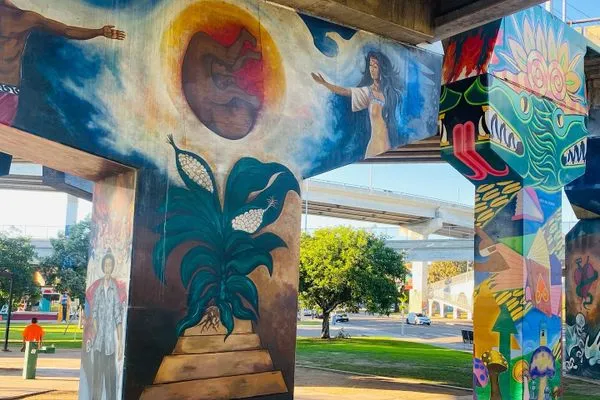
Drivers crossing the Coronado Bay Bridge to reach San Diego's beaches rarely notice what lies directly beneath them: Chicano Park, home to over 100 murals—the largest concentration of Chicano art in the world. Each painting carries a story that begins not with artistic vision, but with a broken promise and a community that refused to accept it.
In the late 1960s, the state of California used eminent domain to displace 5,000 residents from Barrio Logan to build the I-5 freeway and the Coronado Bay Bridge. Officials assured the neighborhood that a community park would replace what was taken. When the bridge opened in 1969, that promise evaporated. Instead of green space, the city planned to build a California Highway Patrol office under the bridge.
The Occupation That Worked
On April 22, 1970, Barrio Logan resident Mario Solis discovered bulldozers already positioned to begin construction. By midday, Mexican American students had walked out of class to join neighbors gathering at the site. What followed was a 12-day occupation that mixed quiet resistance with symbolic acts of reclamation. Protesters formed human chains around the equipment. Others planted trees and sang peace songs. Someone raised the flag of Aztlán—a symbol of Chicano identity—on an old telephone pole.
We're a new kind of news feed.
Regular news is designed to drain you. We're a non-profit built to restore you. Every story we publish is scored for impact, progress, and hope.
Start Your News DetoxThe city negotiated. On July 1, 1970, officials allocated over $20,000 to develop the park as promised. The land under the bridge, once slated for law enforcement, became a canvas for community expression.
A Monument That Keeps Growing
Today Chicano Park holds a playground, picnic areas, and gardens, but its real power lies in the murals that cover every pillar and wall. They're painted in vivid Aztec Revival styles, blending indigenous and Spanish heritage to tell the story of Mexican American history—folklore, revolutionary struggles, civil rights. Throughout the 1970s and 1980s, artists from across California and beyond contributed. The work didn't stop at the park's edges; nearby homes and businesses display their own murals, turning the entire neighborhood into a living gallery.
On weekends, the scene deepens. Lowrider vehicles gather in the adjacent parking lot, adding another layer of cultural expression—chrome and custom paint joining the murals in a conversation about identity and pride.
The city eventually recognized what the community had always known. Chicano Park was designated a historic site in 1980, added to the National Register of Historic Places, and named a National Historic Landmark in 2016. What began as resistance to erasure became an official monument to survival and creativity.