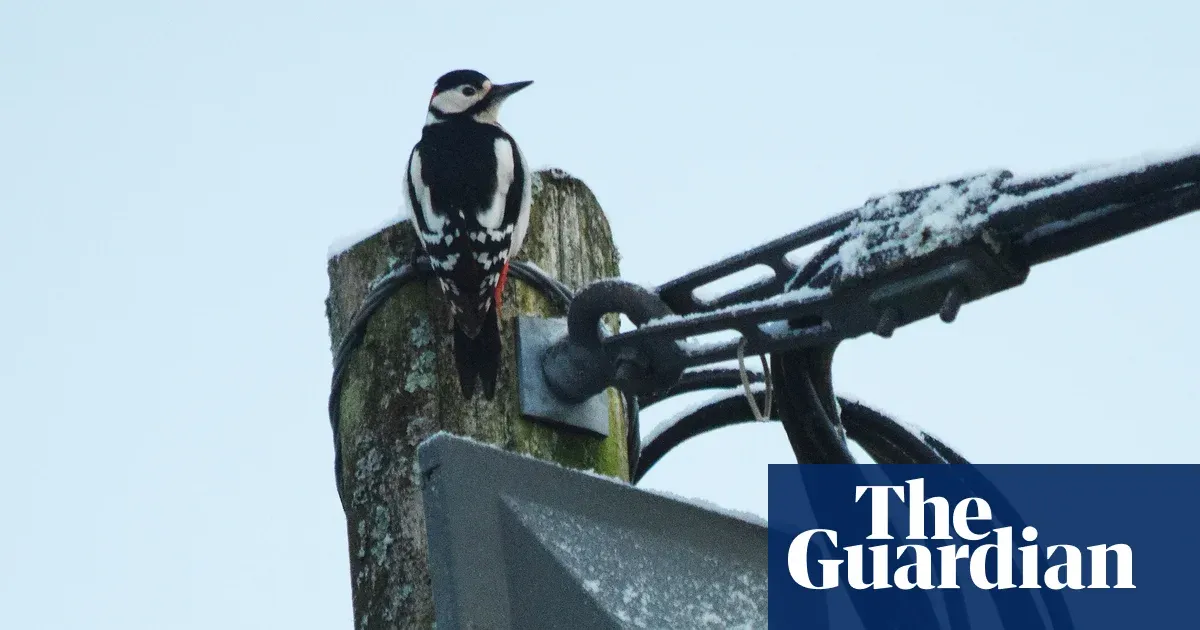
A male great spotted woodpecker has discovered something most of his kind never find: better acoustics than a hollow branch. On a snowy January morning near Brentor church in Devon, the bird began drilling against a plastic electrical wiring cover outside a window—and he's been back every dawn since, hammering out territorial calls with the precision of a snare drum.
It's a small moment, but it reveals something worth noticing about how wildlife adapts. Great spotted woodpeckers are built for percussion. Their skulls don't absorb shock the way scientists once thought; instead, their heads and beaks work as a perfectly calibrated hammer, allowing them to drum up to 20 times per second without injury. Males use this rapid-fire noise to claim territory and attract mates—it's their version of a dawn chorus.
Normally, they choose hollow branches or dead wood for these performances. But this individual found that plastic resonates differently, carrying the sound further and clearer. Whether that's an advantage or just a novelty, the woodpecker seems convinced. He returns faithfully, turning someone's gutter into an impromptu concert venue.
We're a new kind of news feed.
Regular news is designed to drain you. We're a non-profit built to restore you. Every story we publish is scored for impact, progress, and hope.
Start Your News DetoxA bird learning on the fly
What's interesting isn't the woodpecker's ingenuity—animals have always exploited their environments in small ways. It's that we notice it. Great spotted woodpeckers have been spreading northward and westward across Britain for decades, moving into gardens and suburban areas where they once stayed in forests. They're flexible birds, adapting to new landscapes, new food sources, new surfaces. A plastic gutter is just one more thing to discover.
The bird itself is unmistakable: black and white with bold markings, a flash of crimson under the tail, and a red square at the back of the head that marks it as male. There's something almost cartoonish about them—the way they hitch up tree trunks, the pointed features, the gravity-defying scramble. But that appearance masks a creature precisely engineered for its work.
For now, the woodpecker will keep returning to his plastic stage. And someone in that house will keep waking to the sound of a bird that decided, one winter morning, that his usual percussion section wasn't quite loud enough.