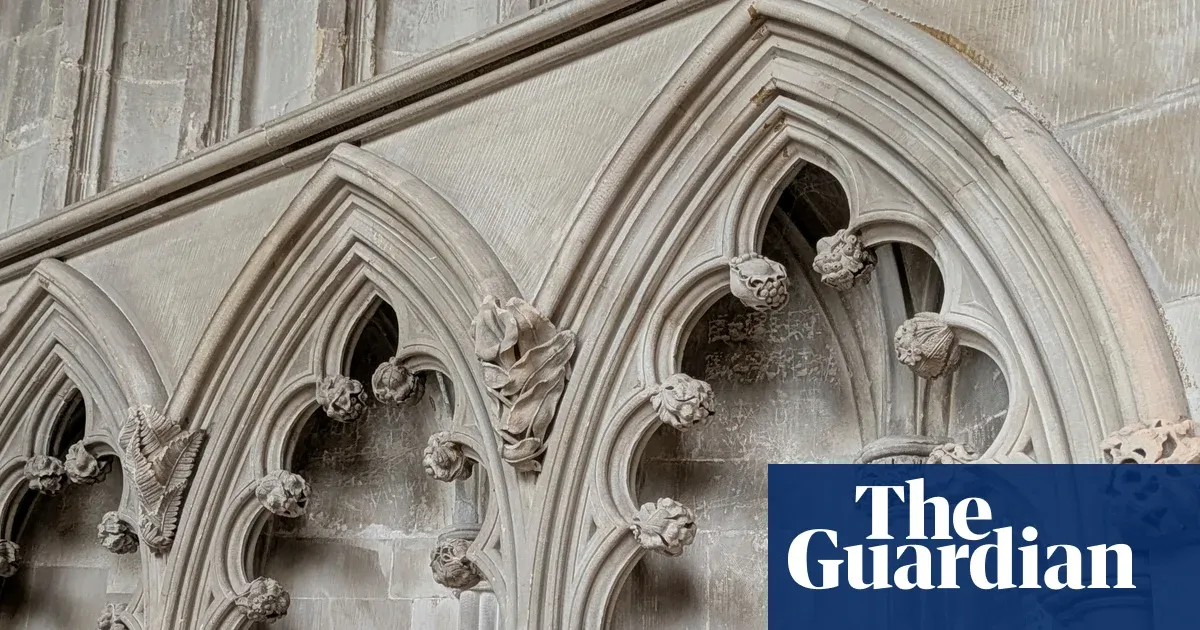
In the Lady Chapel of St Albans Cathedral, surrounded by 14th-century limestone walls, there's a story written in stone that most visitors walk past without noticing.
By the 1880s, the chapel had fallen into disrepair. The ornamental stonework that once decorated the arches was nearly gone. A restoration project brought in John Baker, a London sculptor known for his naturalistic carving, to recreate the decorative capitals and corbels. But Baker did something unusual: he asked the women of the parish to bring him plants as models.
What he carved into those arches became a living record of 19th-century St Albans.
We're a new kind of news feed.
Regular news is designed to drain you. We're a non-profit built to restore you. Every story we publish is scored for impact, progress, and hope.
Start Your News DetoxA Flora Frozen in Time
Walking the chapel today, you can read the botanical choices like a diary. There are elm seeds, polypody ferns, passion flowers, and the dramatic spathes of cuckoo pint. Plums, pears, pomegranates, and peaches from local Hertfordshire orchards climb the stonework. But the most striking carvings are the orchids — Coelogyne cristata, Odontoglossum vexillarium, and Cattleya mendelii, with its ruffled lip and closed upper-petal eyes.
These weren't random choices. All three orchids were grown in St Albans at the time by Frederick Sander, the man who supplied exotic plants to Queen Victoria. The women who brought their specimens to Baker weren't just helping with a repair job — they were documenting what their city looked like, what grew in their gardens and greenhouses, what mattered enough to preserve in stone.
There's something quietly powerful about that. More than a hundred plant species, selected and modeled by local women, carved by a London sculptor, set permanently into the chapel walls. It's not a grand statement. It's intimate — a conversation between the women of the parish and everyone who walks through that space afterward.
As you leave the chapel, you pass a cedar of Lebanon planted outside the Chapter House in 1803. Baker carved pine cones nestled in cedar needles into the stonework. It's tempting to wonder if he modeled that from this very tree — if the plants women brought him came from the same grounds where visitors still walk today.