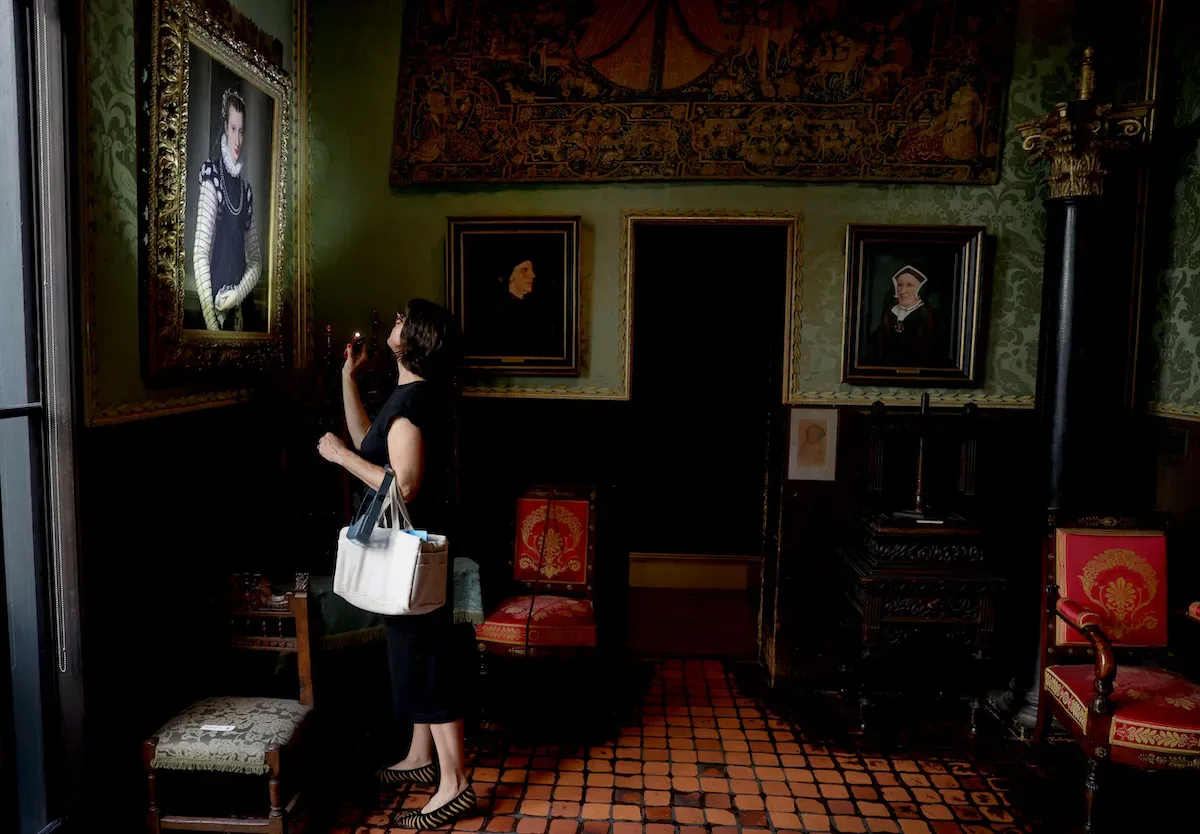
The Isabella Stewart Gardner Museum in Boston has spent the last three years restoring its Dutch Room—the space where, in 1990, thieves stole three priceless paintings by Vermeer, Rembrandt, and Manet in one of history's most audacious art heists. Those works have never been found. But the museum just solved a different mystery entirely: what color the room's 17th-century chairs were supposed to be.
It's the kind of problem that sounds simple until you actually face it. The chairs had been reupholstered so many times over centuries that no one knew what Isabella Stewart Gardner, the museum's founder, had originally chosen. Archival photographs showed a striped pattern, but they were in black and white—no help at all.
Anna Rose Keefe, the museum's textile conservator, approached it like detective work. She pinned photographs and fabric samples to bulletin boards, studying every clue. "A lot of the visuals around this feel very Law and Order to me," she told WBUR. The breakthrough came from an unlikely combination: AI software that colorizes old photographs, paired with a single tiny piece of faded thread discovered during conservation. Together, they revealed that Gardner had chosen red upholstery with pink stripes—bold, deliberate, designed to catch the light.
We're a new kind of news feed.
Regular news is designed to drain you. We're a non-profit built to restore you. Every story we publish is scored for impact, progress, and hope.
Start Your News DetoxWhat makes this restoration matter beyond the chairs themselves is what it says about how museums work now. Rather than guessing or defaulting to "period appropriate" (a vague concept), the team at Gardner Museum treated restoration as historical investigation. They weren't just fixing furniture. They were trying to understand what one woman's specific, distinctive taste looked like, and why she'd made those choices. Holly Salmon, the museum's director of conservation, put it plainly: "We try to really think about what she intended us to see."
That philosophy shapes everything in the Dutch Room. Gardner was particular about textures—she wanted silk that was shiny, fabrics that would "pop in the space." The restored chairs now reflect that vision. They're brighter, more alive than they'd been in decades, which means visitors will see the room as Gardner imagined it rather than as it gradually faded into beige uniformity.
The broader restoration wraps up by early 2027. When it does, the Dutch Room will be closer to its original state than it's been in a century. The museum hasn't given up hope that the stolen paintings will someday return to the space where they belong. Until then, at least the chairs will be waiting in the colors Gardner chose.