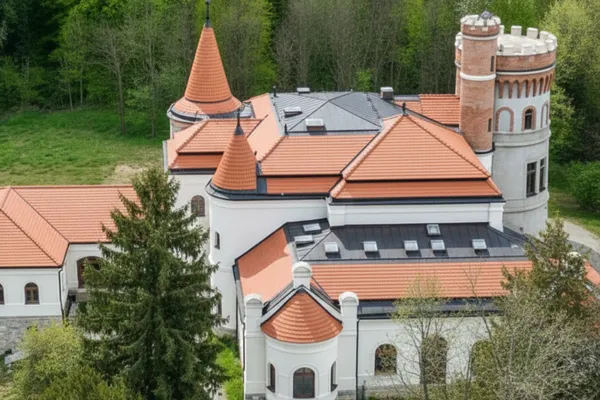
A century ago, a wealthy Hungarian couple named Alajos and Paula Tüköry decided their daughter Marija deserved something extraordinary. Not a hunting lodge or summer villa—Paula was explicit about that. She wanted a "lordly house," something that announced itself to the world.
What rose from the hilltop in 1904 answered that demand. Dvorac Dioš, set among ancient chestnut and walnut groves in what is now Croatia's Slavonia region, became exactly what Paula envisioned: a striking facade with complex rooflines, pointed towers, and ornate brickwork that refused to be modest.
From family seat to shelter
The castle's trajectory mirrors the region's own turbulent century. After decades as a noble residence, the Salesian order purchased it in 1941 and renamed it "Marijin Dvor"—Mary's Court—turning the private family home into something more communal. The communist era brought nationalization and uncertainty, the kind of institutional limbo that has claimed countless European estates. But Dioš survived.
We're a new kind of news feed.
Regular news is designed to drain you. We're a non-profit built to restore you. Every story we publish is scored for impact, progress, and hope.
Start Your News DetoxToday, the castle has returned to the Salesians and serves as a center for youth, a quiet second act for a building that was always meant to shelter people. The walnut groves that gave the castle its name—"dioš" from the Hungarian word for walnut—still surround the estate, older than the building itself, older than the families who lived within it.
It's a small example of what happens when a structure survives long enough: it stops belonging to the people who built it and becomes something the community can use. The lordly house Paula insisted on now opens its ornate doors to young people who would never have crossed its threshold a century ago.