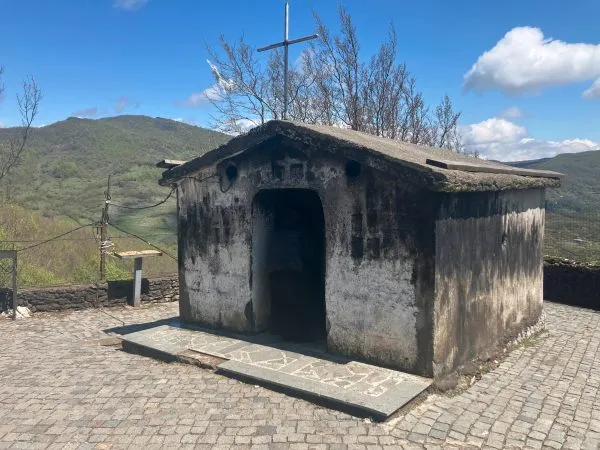
In Gogni, Georgia, there's a holy mountain with a rather stubborn secret. It's home to a place called "Karugdebeli," which, rather poetically, translates to "Door-thrown-off." And for centuries, that's exactly what's happened: no building on this mountain has managed to keep its doors. They just... don't stick around.
It all started with the first shrine, likely dedicated to St. George, back in the 7th or 8th century (though some whisper it was a pagan hotspot even earlier). Legend has it that every time villagers tried to give the shrine a door, it would politely decline by falling right off its hinges. The shrine got rebuilt multiple times, but the doors? Always a no-show. This open-air policy made it a prime location for St. George's Day festivals.
Fast forward to the early 1900s, when the Communist government, not big fans of religion or unexplained architectural defiance, tried to shut the place down. They built walls, they put up barriers, they tried everything to keep people out. But every St. George's Day, those barriers were found in a pile of rubble. Frustrated, they just destroyed the shrine entirely, hoping that would be the end of it. Turns out, a few walls and a roof are no match for a really determined local legend.
We're a new kind of news feed.
Regular news is designed to drain you. We're a non-profit built to restore you. Every story we publish is scored for impact, progress, and hope.
Start Your News DetoxThe shrine's spirit, or lack thereof for doors, lived on. In the 1980s, as Soviet rule began to loosen its grip, people from the Terjola and Tkibuli regions rebuilt it. Naturally, they built it without any doors. Because apparently, some lessons are learned the hard way.
The Door Dilemma Continues
After Georgia gained independence, the St. George's Day festivals roared back to life. Pilgrims flocked to Karugdebeli. In 2010, the locals decided to go big: a new, grand church at the mountain's peak, visible for miles. They poured money into fancy stone carvings and hired the best woodworker in the province to craft the main doors. What could possibly go wrong?
Well, the woodworker ordered his timber, and it warped overnight. Not just once, but twice. On his third attempt, he suddenly developed a nerve problem in his hands that made it impossible to hold his tools. Terrified (and probably a little superstitious), he told the project sponsors he was out. No doors from him, thank you very much. The message was clear: the new church would also be built doorless.
So, twice a year, on May 6th and November 23rd, tens of thousands of people, sometimes walking barefoot up the steep mountain, visit the doorless Karugdebeli shrine. They say if you walk around it three times, especially on St. George's Day, your wishes just might come true. Which, if you think about it, is a pretty good deal for a building that can't even keep a front door.