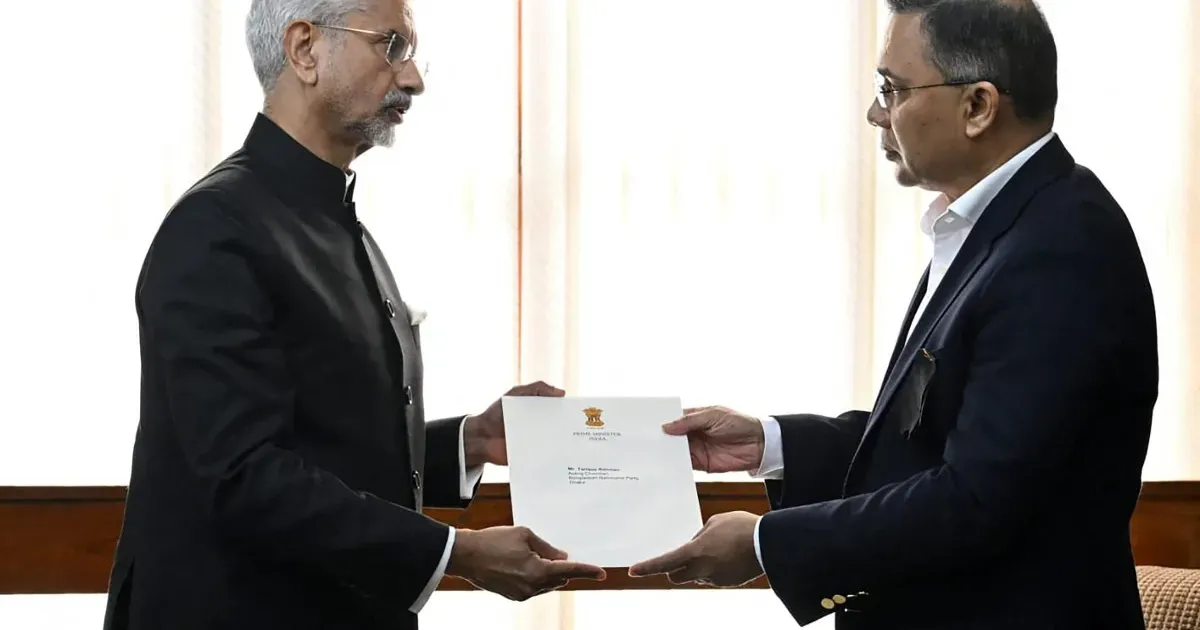
India's Foreign Minister S Jaishankar arrived in Dhaka in black, attending the funeral of Khaleda Zia, the former Bangladeshi Prime Minister who shaped a generation of politics in the region. His mission was delicate: hand-deliver a letter from Prime Minister Narendra Modi to Tarique Rahman, Khaleda's son, who now leads her Bangladesh Nationalist Party (BNP).
On the surface, this was a funeral courtesy. But the message mattered more than the moment. "Conveyed deepest condolences on behalf of the Government and people of India," Jaishankar posted on X. "Expressed confidence that Begum Khaleda Zia's vision and values will guide the development of our partnership."
For decades, India treated the BNP as an adversary. New Delhi favored Sheikh Hasina's Awami League, which held power for 15 years until a student-led uprising toppled her government in 2024. Hasina now lives in exile in New Delhi, and India has refused to extradite her to face charges—a decision that has fueled anti-India sentiment across Bangladesh.
We're a new kind of news feed.
Regular news is designed to drain you. We're a non-profit built to restore you. Every story we publish is scored for impact, progress, and hope.
Start Your News DetoxBut circumstances have a way of reordering priorities. With elections scheduled for February and the Awami League banned from competing, the BNP has emerged as the likely frontrunner. India suddenly faces a choice: remain adversaries with the probable next government of Bangladesh, or find a way forward.
The Calculation Shifts
Rahman, who spent years in exile, appears to understand the arithmetic. When Modi publicly wished Khaleda a speedy recovery during her illness, the BNP responded with genuine warmth. Jaishankar's meeting with Rahman was described as "very cordial," and Rahman's foreign affairs adviser, Humayun Kabir, spoke of "the potential of a new phase in the bilateral relationship."
This is significant because the old relationship was defined by what Harsh Vardhan Shringla, a former Indian foreign secretary, calls "mutual mistrust and animosity that is historic." During the BNP's previous rule from 2001 to 2006, Bangladesh tilted toward Pakistan and adopted an anti-India stance. Rahman himself wielded "disproportionate influence" in that era.
Yet people can change. Shringla notes that Rahman has "matured during his years in exile," and his current statements are far more palatable to New Delhi than his past positions. Sreeradha Datta, a professor at India's OP Jindal Global University, suggests Rahman is "saying all the correct things"—and his apparent popularity makes him the "safest bet" for India among the available political actors.
The logic is pragmatic rather than idealistic. Rahman needs India's support, or at minimum its non-interference, to govern effectively. India needs a Bangladesh that isn't hostile to its interests. Both sides recognize that the cost of continued antagonism has become too high.
The Harder Work Ahead
Still, handshakes and warm words are only the beginning. Kabir, Rahman's adviser, was careful to emphasize that real progress requires "a clean break from the past." Rebuilding trust between neighbors with such a fraught history takes more than diplomatic gestures—it requires sustained effort on trade, security cooperation, and the everyday ties between people that governments can either nurture or neglect.
As Bangladesh moves toward elections, India's outreach to the BNP marks a genuine shift in regional dynamics. Whether this new chapter can hold depends on whether both sides are willing to do the unglamorous work of reconciliation.