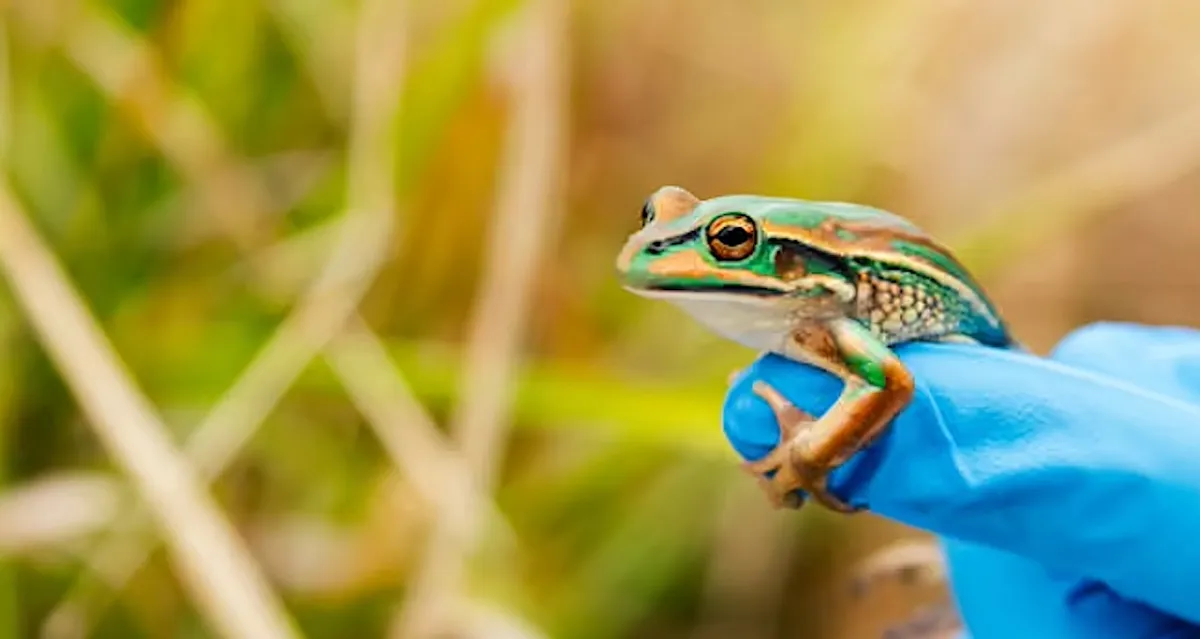
The green and golden bell frog vanished from the Australian Capital Territory around 1981, wiped out by chytrid fungus—a pathogen that has devastated amphibian populations across the globe. Now, after decades of absence, the species is coming home.
Over 300 captive-bred frogs are being released into ponds and wetlands around Canberra, each one immunized against the fungus that nearly erased them. But the real innovation isn't just the breeding program. Scientists have built what they're calling "frog saunas"—simple structures made from black bricks stacked in pyramids and covered with rigid plastic sheets. The gaps in the bricks create shelter, while the heat inside kills chytrid fungus. It's low-tech and elegant: 180 of these saunas now ring the release sites.
The fungus itself tells you why this matters. Chytrid has triggered extinctions and population crashes in amphibians worldwide, from Central America to Southeast Asia. It's one of the most destructive wildlife diseases on the planet. For decades, it seemed like a one-way street—frogs got sick, populations collapsed, and that was it. The green and golden bell frog's forty-year absence from the ACT felt permanent.
We're a new kind of news feed.
Regular news is designed to drain you. We're a non-profit built to restore you. Every story we publish is scored for impact, progress, and hope.
Start Your News DetoxWhat's shifted is the science. Associate Professor Simon Clulow at the University of Canberra and his team realized they could work with the frogs' own biology. They bred resistant populations in captivity. They discovered that warm, slightly saline water—conditions they now call "frog spas"—naturally suppresses the fungus. These refuges already exist in isolated pools beyond the ACT, where some frogs managed to survive. Now the team is recreating those conditions deliberately.
The numbers suggest momentum. Each female can lay around 8,000 eggs in a single breeding season. The goal is to reach roughly 200 frogs at each of 15 ponds—a threshold that should let populations sustain themselves. The offspring won't inherit immunity, so the saunas will keep working as a buffer, protecting new generations while they grow.
It's a reminder that "extinction" and "recovery" aren't always binary. Sometimes they're separated by the right intervention at the right moment.