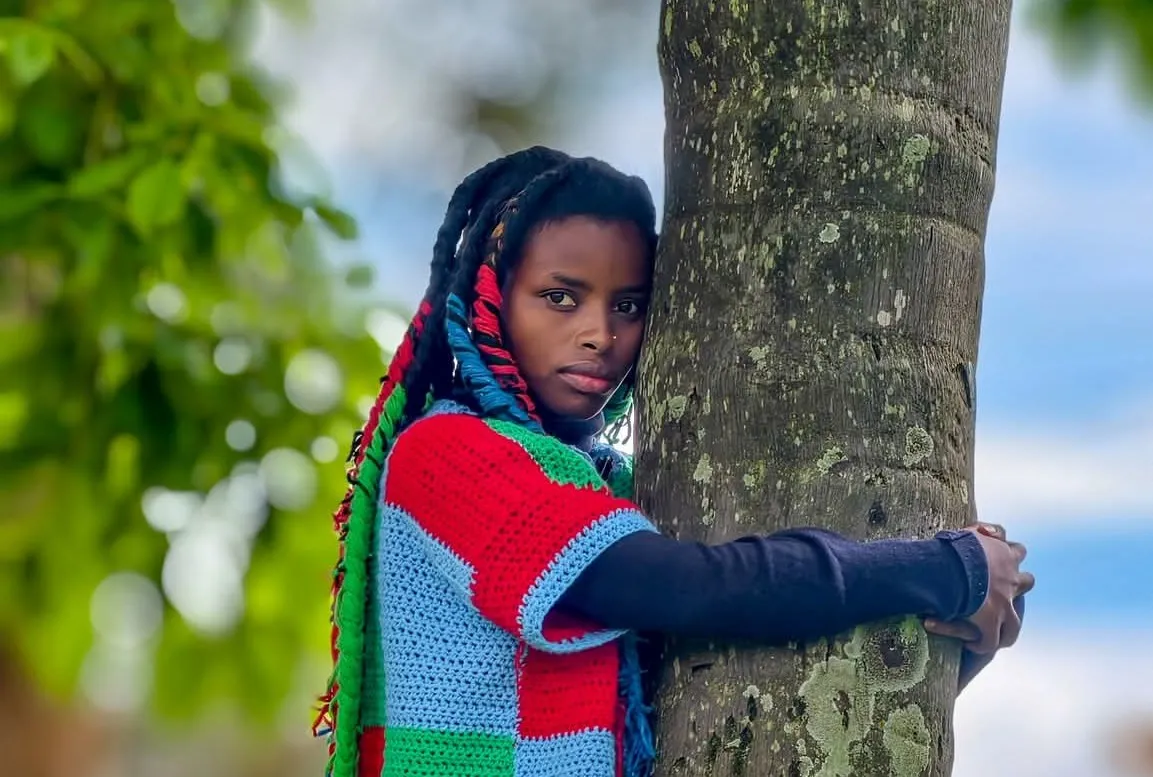
When Truphena Muthoni wrapped her arms around a royal palm in Nyeri, Kenya, few thought she'd stay there for three days. Fewer still expected her vigil to spark a national conversation about forests that are vanishing faster than most people realize.
Muthoni, 22, stood in the rain for 72 hours as a silent protest against unplanned development, shrinking tree cover, and neglected water catchment areas. Her embrace—now awaiting Guinness World Records verification—carried a quieter message too: that trees matter not just for survival, but for mental health, for grounding ourselves in something real when everything else feels uncertain. "The reason for hugging trees is that it is therapeutic," she said.
What started as one person's vigil drew county officials, police officers, and residents who came to stand beside her. Tree hugging, usually dismissed as the punchline to environmentalism, revealed itself as something else entirely: a language of resistance that has worked before.
We're a new kind of news feed.
Regular news is designed to drain you. We're a non-profit built to restore you. Every story we publish is scored for impact, progress, and hope.
Start Your News DetoxThe Long Arc of Bodies Between Trees and Axes
In 1730, more than 300 Bishnoi villagers in Rajasthan died protecting khejri trees at Khejarli. They stepped between the trees and soldiers sent by the maharaja of Marwar, and they didn't move. Their sacrifice echoed forward nearly 250 years to the Chipko women of Uttarakhand, who in the 1970s used their own bodies as a barrier between loggers and oak forests. They didn't have permits or lawyers—they had presence, persistence, and the refusal to leave.
The Appiko Movement carried the same logic into India's Western Ghats decades later. Each iteration of this resistance shared something fundamental: the understanding that some things cannot be negotiated. You either protect them with your body, or you lose them.
Muthoni's tree hug in Nyeri connects to this lineage. Kenya's forests are under pressure from development, agriculture, and climate stress. The country's forest cover has contracted significantly, and the water systems that depend on intact woodlands are failing communities that have relied on them for generations. When Muthoni embraced that palm, she wasn't performing activism—she was naming a crisis that official channels had largely ignored.
The crowd that gathered around her, standing in rain and cheering, suggested something important: people recognize the stakes, even if governments move slowly. Tree hugging, when done with intention and clarity, stops being a caricature and becomes what it always was—a refusal to accept loss as inevitable.
What happens next depends on whether this moment translates into policy shifts, forest protection, and the kind of sustained attention that turns a 72-hour vigil into lasting change.