When an ICE officer shot and killed Renee Macklin Good, a 37-year-old Minneapolis resident, the response was immediate and nationwide. Within days, thousands of people took to the streets in Minneapolis, Washington D.C., Hartford, Boston, and Pflugerville—not just to grieve, but to demand a reckoning with an agency they see as fundamentally broken.
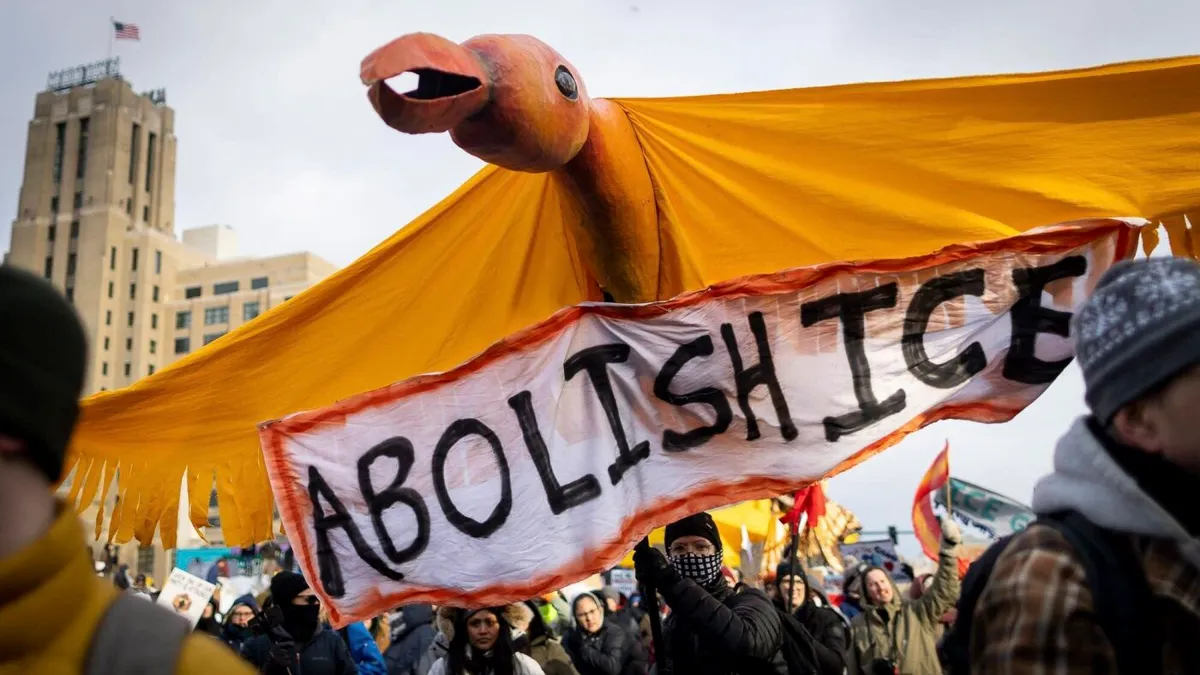
The scale was striking. On January 10th, thousands marched down Lake Street in Minneapolis carrying a massive bird puppet crafted by the In the Heart of the Beast Puppet and Mask Theatre. Two days later, protesters confronted U.S. Customs and Border Protection agents as they conducted immigration status checks on two men in a car in South Minneapolis.
In Washington D.C., demonstrators gathered near the White House on January 10th for an anti-ICE protest organized by Refuse Fascism. The message was consistent across all five cities: this agency's power to detain and use force without meaningful oversight had reached a breaking point.
We're a new kind of news feed.
Regular news is designed to drain you. We're a non-profit built to restore you. Every story we publish is scored for impact, progress, and hope.
Start Your News DetoxIn Hartford, hundreds gathered outside the federal courthouse on January 8th for a vigil that turned into a blockade. When protesters stopped cars from leaving the parking garage, a masked agent sprayed chemical irritants from inside the building. The confrontation was brief but telling: the state's apparatus defending itself against its own citizens.
In Texas, protesters held signs outside the Department of Homeland Security building in Pflugerville on January 8th, organized by the Austin chapter of the Party for Socialism and Liberation. Some spray-painted messages on the building's exterior. In Boston, demonstrators gathered at Park Street the same day.
Keeping her memory alive
Back in Minneapolis, the movement shifted from protest to remembrance. On January 11th, participants in a singing vigil left St. Paul's-San Pablo Lutheran Church to march through the Phillips neighborhood. Activists pasted posters of Renee Macklin Good on buildings throughout the city, a deliberate act of refusal—refusing to let her death become a statistic, refusing to let it fade from public memory.
What emerged across these five cities was something more durable than outrage. It was a network of people—organized and unorganized, local and nationwide—who decided that the current arrangement was unacceptable. They reclaimed streets that ICE had used to conduct enforcement operations. They turned federal buildings into spaces of public witness. The question now is whether this moment of collective defiance translates into the systemic accountability that activists are demanding.