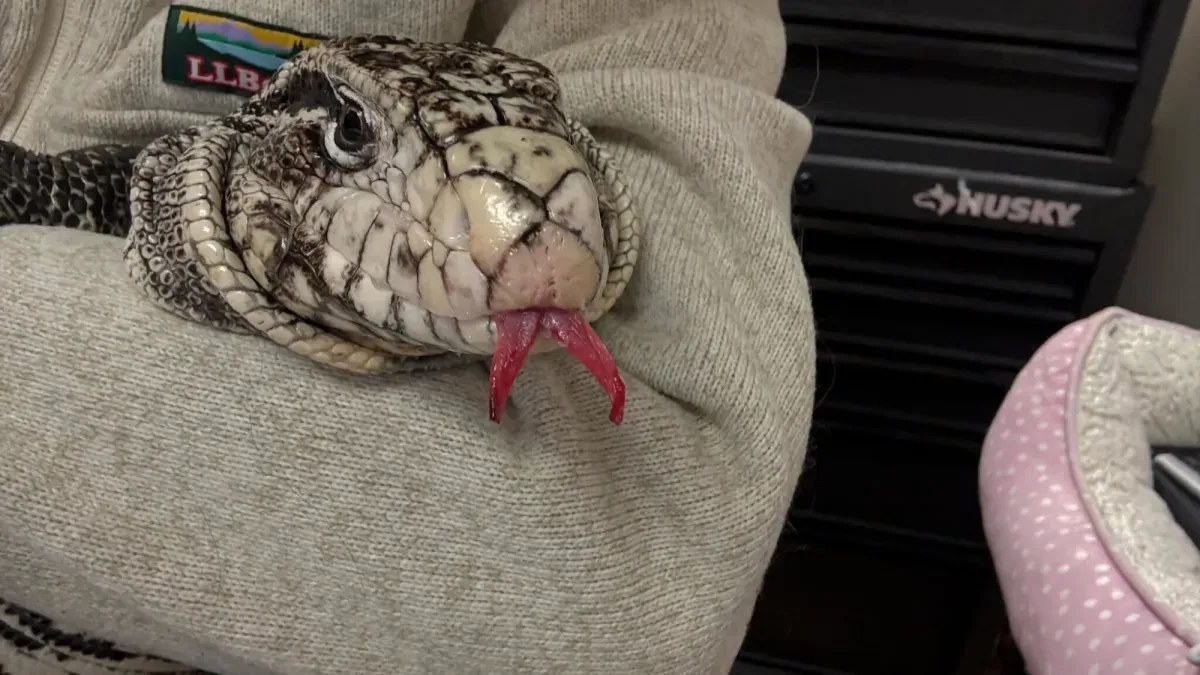
A woman shoveling her driveway in Providence during a winter storm found something that shouldn't exist in a New England blizzard: a female tegu, a South American reptile the size of a small dog, nearly frozen solid. Her name is Frankie, and her rescue sparked an unusual collaboration between veterinary and human medicine that may change how frostbite is treated across species.
Tegus are built for warmth. They're native to South America, which means Frankie almost certainly escaped from someone's home—tegus are popular exotic pets, often roaming their owners' houses like dogs. Somewhere in the warmer months, she got out. She might have survived the fall and early winter outdoors, but when the storm hit, she couldn't manage anymore.
The real crisis came when temperatures plummeted. Frankie's tongue, which she couldn't fully retract into her mouth, froze solid. The frostbite spread to her toes as well, but the tongue injury was the one that stumped veterinarians. "There are no published accounts of mucus membrane frostbite in reptiles," explains Tess Gannaway, a veterinarian at the New England Wildlife Center. The damage was severe enough that Frankie lost the distinctive V-shape that defines a reptile's tongue.
We're a new kind of news feed.
Regular news is designed to drain you. We're a non-profit built to restore you. Every story we publish is scored for impact, progress, and hope.
Start Your News DetoxCross-Species Learning
Faced with something no reptile veterinarian had treated before, Gannaway and her team did something simple but clever: they looked at human medical literature. They found a case where a patient's tongue had frozen during a medical procedure. The doctors' solution was elegant—remove the dead tissue every few weeks and let the tongue heal naturally, relying on its rapid regeneration.
The wildlife center adopted the same approach for Frankie. Every two to three weeks, staff remove dead tissue under sedation, then monitor her progress. She's already advanced from liquid food to solid food, a sign that her tongue is healing well enough to function.
What makes this case remarkable isn't just that it worked—it's what it reveals about medicine itself. "This is an example of 'one health,' the intersection between human and animal health," Gannaway explained. When veterinarians hit a wall, they borrowed from human medicine. That kind of cross-disciplinary thinking is increasingly common in conservation and animal care, but it's still rare enough to be noteworthy. It suggests that expertise in one field can unlock solutions in another, and that the boundaries between human and animal medicine are more permeable than we assume.
Frankie's prognosis is cautiously optimistic. Tegus can live full lives with partial tongues, so as long as the tissue stabilizes, she'll recover. She's on pain medication and antibiotics, and her future involves a warmer enclosure—somewhere far from Rhode Island winters. Her unexpected adventure in the snow may have ended badly, but the veterinary innovation it sparked could help other animals facing similar injuries.