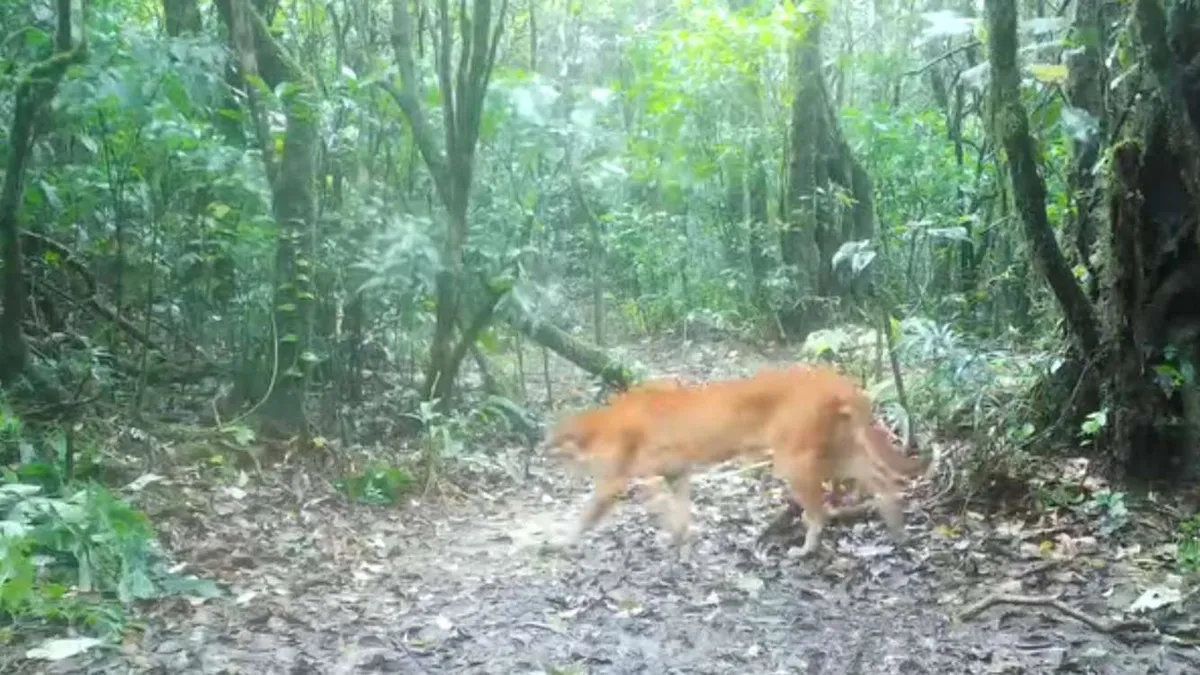
Thai conservationists had a moment most wildlife researchers never get: proof that an Asian golden cat exists in Khao Luang National Park in northern Thailand. Camera traps caught it on film in July—ten seconds of footage showing a creature so rarely seen that it's earned almost mythical status in local folklore.
The animal, known in Thai as the "fire tiger" for its tan-to-orange coat, is one of the world's most elusive wildcats. It diverged from the tiger family between 8 and 16 million years ago and is most closely related to the bay cat of Borneo and the marbled cat of the Himalayas. (In Chinese tradition, it's called the "metal cat" instead.)
A Ghost Perfectly Adapted to Invisibility
The Asian golden cat's elusiveness isn't accidental—it's evolutionary strategy. These cats are territorial and solitary, hunting across both day and night with no predictable patterns. They move through forests in ways that seem designed to avoid detection, which is why that ten-second sighting represents such a rare window into their lives.
We're a new kind of news feed.
Regular news is designed to drain you. We're a non-profit built to restore you. Every story we publish is scored for impact, progress, and hope.
Start Your News DetoxThe Karen people of southeastern Myanmar respect these cats so deeply they believe carrying a single hair will protect them from tigers. But respect hasn't protected the species from the usual threats: habitat destruction, poaching, and conflict with humans over livestock. The IUCN lists them as "Vulnerable."
The real puzzle is figuring out how many actually exist. A 2023 population estimate suggests somewhere between 1,000 and 12,000 mature individuals across their entire range—probably around 7,000 in the middle. That's more than the global populations of cheetahs, tigers, and snow leopards combined. The huge uncertainty itself is telling: these cats are so good at staying hidden that researchers can barely count them.
What gives conservationists hope is that intact populations seem concentrated in specific strongholds—Bhutan, western Myanmar, eastern Bangladesh, Thailand's west coast, the Malaysian Peninsula's forested hills, and Sumatra's south-facing slopes. The fact that camera traps caught one at all suggests these refuges are still working.