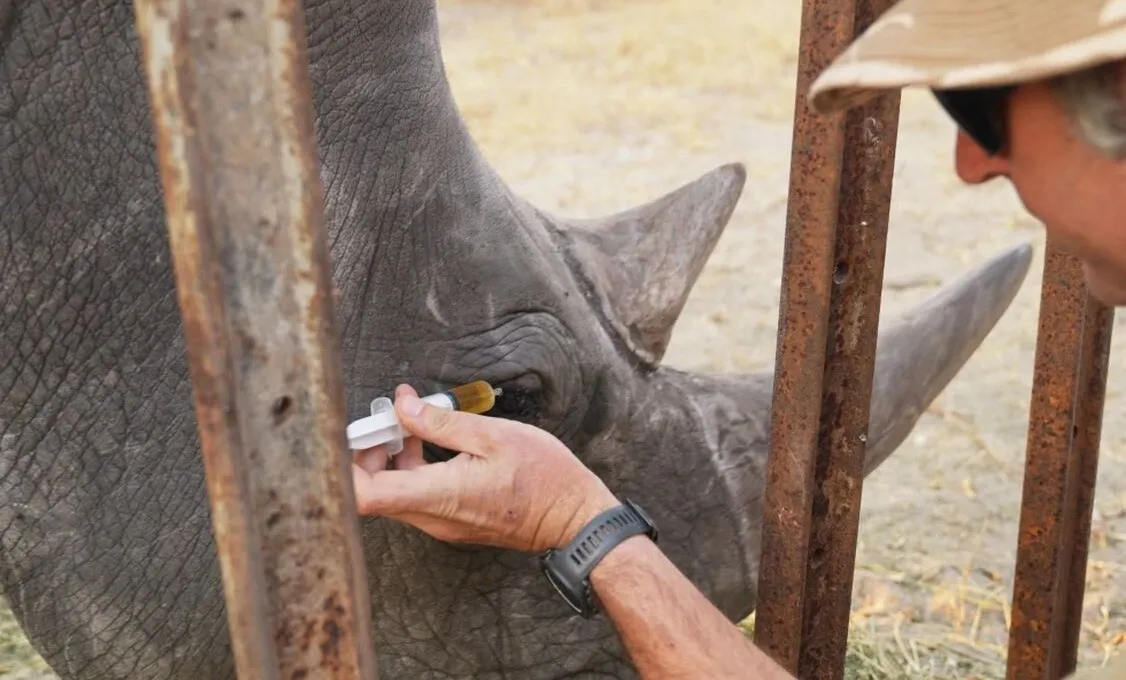
A male rhino named Thunza was bleeding from his eyes, rubbing them raw in the Zimbabwean bush. Without intervention, he'd go blind. The problem: he was wild, and wild rhinos don't sit still for medical care.
So the team from Palm Beach Zoo did something that sounded absurd. They decided to teach him to trust them the way you'd train a dog.
Earning Trust in the Bush
Margo McKnight, CEO of the Palm Beach Zoo & Conservation Society, was visiting Hwange National Park in August when she learned about Thunza's parasitic eye infection. The rhino was part of the Community Rhino Conservation Initiative, a pilot project reintroducing southern white rhinos onto communal lands in Zimbabwe—a way to give local communities a direct stake in the animals' survival. If Thunza lost his sight, the whole project's credibility would suffer.
We're a new kind of news feed.
Regular news is designed to drain you. We're a non-profit built to restore you. Every story we publish is scored for impact, progress, and hope.
Start Your News DetoxMcKnight and her team of animal behaviorists proposed an approach they'd developed with their own animals: gradual desensitization through positive reinforcement. The locals thought it was ridiculous. "We didn't think of it; it was a completely ridiculous idea to us," said Daniel Terblanche, a security manager at the safari lodge supporting the initiative. "But without trying all of the things that we could to rectify that situation, we would have been in trouble."
The method was simple in concept, demanding in execution. They lured Thunza into a corral using his favorite food. Then, over days and weeks, they began the slow work of desensitization: squirting water on his face, petting him, gently pulling his horns. Each small touch was a negotiation with a wild animal's instinct to flee or fight.
The Breakthrough
Within two weeks, Thunza was standing close enough for the team to administer eye drops directly into his infected eye. They trained the local security force to continue the treatment if the infection returned. The infection cleared. Thunza kept his sight.
What matters here isn't just that one rhino recovered—it's that the team proved a method that could work across a whole conservation landscape. The southern white rhino is the most numerous rhino species globally, but all rhinos face relentless poaching pressure. If this trust-building approach can be scaled, it opens a path for treating illness and injury in wild populations without the trauma of darting or capture.
The Florida team left Zimbabwe with something rarer than a successful surgery: a replicable model. The local team now knows how to do this themselves.