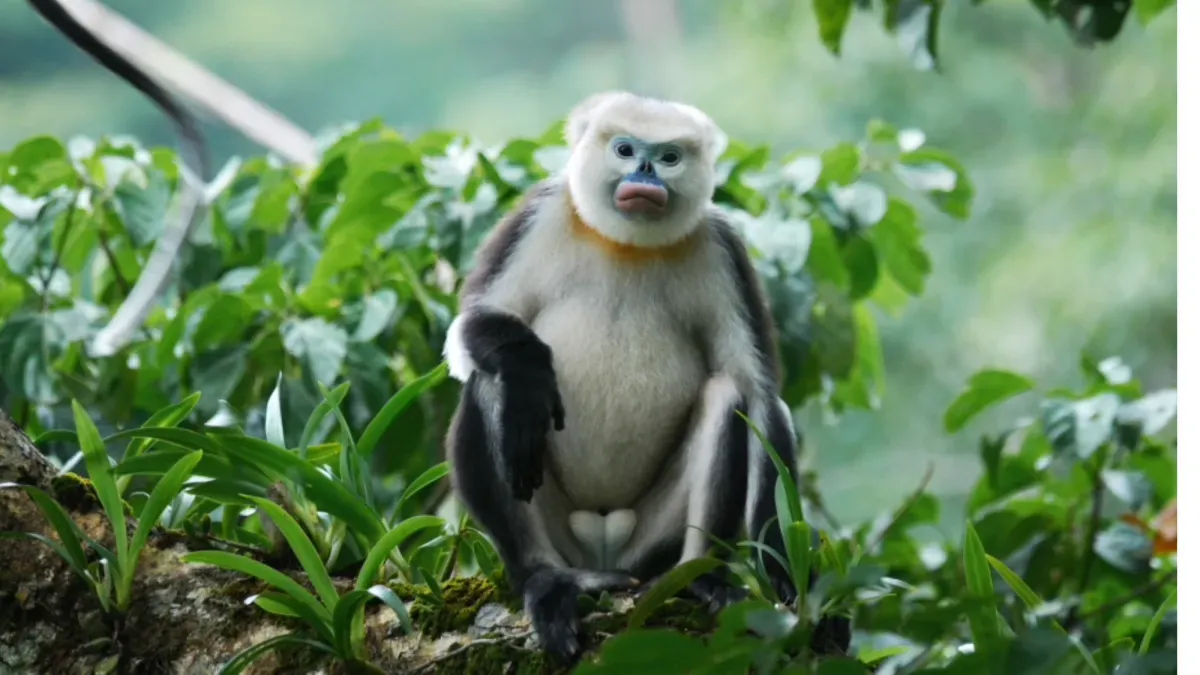
A population of Tonkin snub-nosed monkeys—primates with striking blue faces and prominent lips—is holding steady in northern Vietnam. For a species that once seemed headed toward extinction, this matters more than the numbers alone suggest.
Tonkin snub-nosed monkeys rank among the most endangered primates on Earth. Fewer than 250 individuals remain, nearly all confined to two patches of karst limestone forest in northern Vietnam: Quan Ba Forest and Khau Ca Species and Habitat Conservation Area. A decade ago, the future looked grim. Today, a new census by wildlife conservation charity Fauna & Flora has documented approximately 160 individuals in Khau Ca alone—and they're not declining.
The survey, conducted over 19 days outside breeding season, spotted several infants. That matters because it means reproduction is happening. But what's equally striking is what the researchers didn't find: no evidence of trapping or hunting. That's the real shift.
We're a new kind of news feed.
Regular news is designed to drain you. We're a non-profit built to restore you. Every story we publish is scored for impact, progress, and hope.
Start Your News DetoxHow a Species Gets a Second Chance
The census itself reflects how conservation has evolved. Fauna & Flora's team worked with local community groups using a hybrid approach—binoculars and thermal imaging drones alongside camera traps and a grid-based counting system that eliminated the confusion of overlapping surveys. It sounds technical, but the point is simpler: they got an accurate picture of what's actually there.
Canh Xuan Chu, the project manager, noted something crucial about what that picture reveals. "These numbers still aren't big," he said. "But it is reassuring that we have been able to identify various family groups in Khau Ca and that there is no evidence of trapping or hunting." The shift matters because it shows the intensive anti-poaching efforts actually worked. The monkeys' biggest threats now are habitat loss and deforestation from agricultural expansion—problems that are harder to solve, but at least they're different problems than they were.
What's changed is community engagement. Tran Van On, a member of the local Community Conservation Team, observed the shift firsthand. "Since the project began, I have observed a significant increase in awareness among local communities regarding the conservation of the Tonkin snub-nosed monkey," he said. "People are now not only more conscious about protecting this endemic species of Vietnam, but also more aware of the importance of safeguarding forest habitats and other wildlife species."
The project introduced livelihood activities that give local households additional income, reducing their dependence on forest resources. When conservation means protecting someone's livelihood instead of restricting it, the math changes.
Two hundred and fifty individuals is still a vulnerable number. But it's a number that's not shrinking. The Fauna & Flora team remains cautiously optimistic that these monkeys are steadily making a comeback—and that the approach that's worked here might offer a template for other species facing similar pressures.