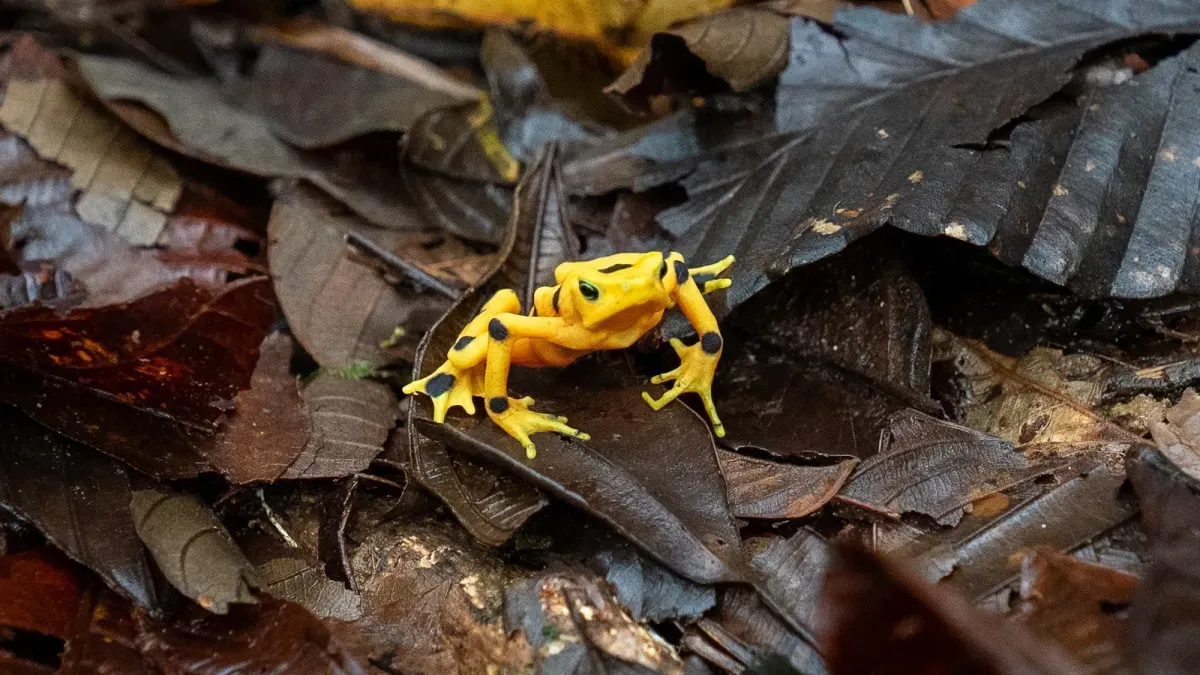
For nearly two decades, the bright yellow Panamanian golden frog existed only in laboratory tanks. Last year, conservationists finally released a new generation back into the streams where they once thrived—marking the first time in 17 years these fluorescent amphibians have hopped through their native habitat.
The frogs disappeared because of an invisible threat. In the late 1980s, an invasive fungus called Batrachochytrium dendrobatidis (Bd) swept through Central America, traveling easily through water. Since golden frogs live exclusively near streams, they had nowhere to hide. The fungus infects amphibian skin and disrupts the body's electrolytes, causing a disease called chytridiomycosis that leads to heart failure. By 2009, the species had vanished from El Valle de Anton, Panama's last stronghold population.
But extinction wasn't final. Wildlife biologists at the Smithsonian-affiliated Panama Amphibian Rescue and Conservation Project (PARC) began breeding golden frogs in controlled facilities, patiently waiting for lab populations to stabilize enough for rewilding. That took years of careful work—but it worked.
We're a new kind of news feed.
Regular news is designed to drain you. We're a non-profit built to restore you. Every story we publish is scored for impact, progress, and hope.
Start Your News DetoxThe Hard Part: Bringing Them Home
Reintroduction proved messier than breeding. During the initial 12-week soft release, about 70 of the 100 golden frogs died from chytridiomycosis. The fungus still exists in multiple regions around Panama, so survival wasn't guaranteed. But the deaths weren't a failure—they were data. Conservation biologist Brian Gratwicke and his team studied what killed the frogs and where they survived. "Our earlier modeling suggested there may be release sites we can select that will be climatic refuges—places that are suitable for the frogs but too hot for the fungus," Gratwicke said.
Many surviving frogs were eventually released into the wild, and the knowledge gained is reshaping the team's strategy. PARC director Roberto Ibañez described it as entering "a new phase of our work to study the science of rewilding." That science is already paying dividends beyond golden frogs. Last year, three other endangered Panamanian frog species were released back into their habitats: the crowned tree frog, Pratt's rocket frog, and the lemur leaf frog.
If you spot a golden frog near a Panamanian stream, admire it from a distance. These frogs produce some of nature's deadliest toxins—a defense mechanism that makes them one of the most poisonous creatures on earth.
The rewilding effort continues. Each release teaches conservationists more about how to protect amphibians in a world where fungal diseases move faster than we can respond.