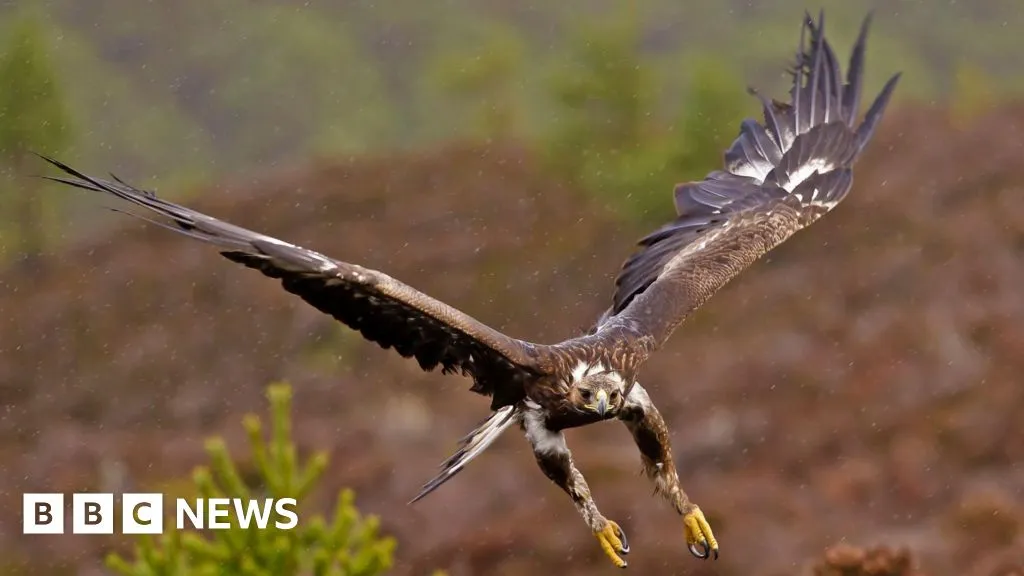
England is about to get a whole lot wilder, thanks to a cool £1 million from the UK government. Their mission? To permanently reintroduce golden eagles, those magnificent birds of prey that were, rather unfortunately, hunted out of existence in England back in the 1800s.
Yes, the second-largest bird of prey in Britain, capable of diving at 200 mph and spotting a rabbit from three miles away, was simply too much for our ancestors. They worried about livestock and grouse, and poof, no more golden eagles in England or Wales. But now, after years of research and a successful pilot program in Scotland, Forestry England is teaming up with the charity Restoring Upland Nature (RUN) to right that historical wrong.
The Return of the Sky-High Scavengers
Environment Secretary Emma Reynolds calls the golden eagle a "keystone species" — which, in plain English, means it's one of those animals whose presence helps the entire ecosystem recover. And recover it needs to. The UK is currently one of the most nature-depleted places on Earth, with one in six species staring down extinction, according to a 2023 study. So, bringing back an apex predator isn't just about looking majestic; it's about rebalancing a very wobbly natural world.
We're a new kind of news feed.
Regular news is designed to drain you. We're a non-profit built to restore you. Every story we publish is scored for impact, progress, and hope.
Start Your News DetoxEd Parr Ferris, a species recovery manager at Forestry England, explains that these eagles are fantastic at controlling "mesopredators" — basically, the middle managers of the food chain, like foxes and badgers. By keeping those populations in check, rarer, smaller animals get a better shot at thriving. It's a delicate ecosystem, and apparently, it really missed its top boss.
After scouting 28 potential locations, eight were deemed suitable, with Northumberland winning the top spot. Imagine the Pennines, the Lake District, and the Yorkshire Dales potentially getting a visit from these two-meter-wingspan beauties.
RUN, the charity that successfully reintroduced 28 golden eagle chicks from the Scottish Highlands into the Scottish Borders over the last eight years, will lead this new three-year, £1 million program. Dr. Cat Barlow, CEO of RUN, hopes that after a public consultation, the first chicks could arrive as early as next summer. Because nothing says "nature recovery" like an actual, you know, eagle.
Addressing the Elephant (or Eagle) in the Room
Now, not everyone is doing a happy dance. Farmers have, understandably, raised an eyebrow. When sea eagles were reintroduced in Scotland, some farmers reported lamb losses. The National Farming Union Cymru has voiced similar concerns about golden eagles.
But Ed Parr Ferris is quick to clarify: golden eagles are not sea eagles. They're far more likely to scavenge carrion (dead stuff) than hunt live lambs, which they only do rarely. A feasibility study estimated that golden eagles would be responsible for a mere 0.15% to 3% of lamb losses in their hunting grounds. Which, if you think about it, is a pretty specific and reassuringly low number.
Dr. Barlow notes that building trust is key. In Scotland, they hired a retired gamekeeper, which helped bridge the gap between conservationists and the shooting community. Now, estates are actually helping build artificial nests. Because apparently, even eagles need a little PR.
Professor Davy McCracken, an agriculture ecology expert, understands farmer worries, especially with talk of other predators like lynx possibly returning. He warns that looking at species in isolation might miss the bigger picture of cumulative effects. And he's got a point. After all, an eagle named Hamlet, recently relocated to the Scottish Borders, was found with pellet wounds. So, to keep these feathered friends safe, the government isn't sharing the exact release location in Northumberland. Because some secrets are best kept for the birds.