Chris Park, an organic farmer in Oxfordshire, England, has always considered bees “sacred creatures.” He’s got the kind of deep respect for them that comes from knowing they’ve been buzzing around for 40 million years, making us humans look like toddlers in comparison. But it was a recent video of his that made the internet collectively gasp, then cheer, racking up over 10 million views.
Most of Park’s Instagram content — beekeeping, basket weaving, original music — pulls in a respectable 10,000 to 100,000 views. But on May 31st, he dropped a clip that absolutely exploded.
The Unwinding
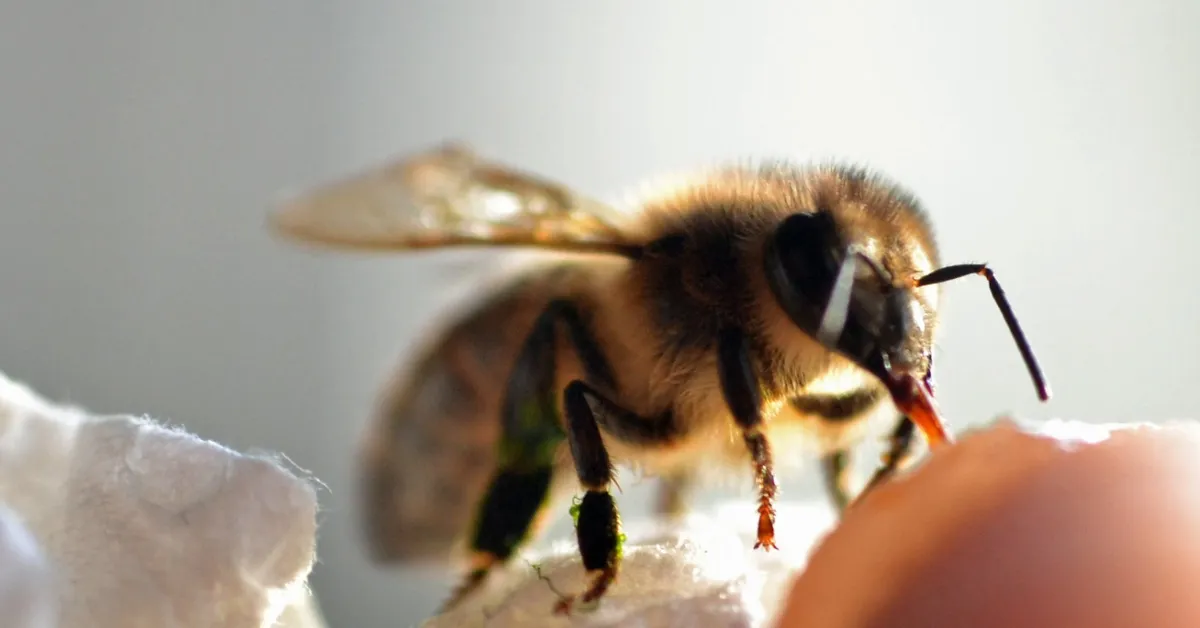
In the now-viral video, Park calmly, almost zen-like, allowed a honey bee to sting his arm. He explained that the bee was “unwinding her sting” from his wrist, venom already injected. Most of us, upon feeling that familiar prick, would instinctively swat. That reaction, Park notes, usually causes the bee to panic, try to fly away, and in doing so, rupture its gut. The stinger is left behind, still pumping venom, and the bee, sadly, dies.
We're a new kind of news feed.
Regular news is designed to drain you. We're a non-profit built to restore you. Every story we publish is scored for impact, progress, and hope.
Start Your News DetoxBut Park? He moved his arm to a sheltered spot, relaxed every cell in his wrist, and focused on calming his breath. He essentially created a safe space for the bee to chill out. And as the camera rolled, the bee rotated its tiny body, carefully freeing each barb of its stinger. Because apparently, that's where we are now: negotiating with stinging insects.
Park explains that bees can sting other insects and retract their stingers with no problem. Human flesh, however, is a different story – the stinger often gets stuck. Yet, early in his beekeeping days, Park learned that if given the chance, some bees can remove their stingers. He sees it as a metaphor: our first instinct when hurt is to lash out, but sometimes, enduring the pain and relaxing can save a life – in this case, a bee's.
By the end of the video, the honey bee flew off, stinger seemingly intact. The comments section, as you might imagine, was a whirlwind. “You are officially the nicest human to ever exist on the planet,” one user declared. Another echoed the sentiments of many: “I didn’t know they could survive this!” Of course, the internet wouldn’t be the internet without a few skeptics: “Nope,” and “Don’t try this at home,” also made appearances.
The Science of the Sting
So, what’s the buzz? A study in the National Library of Medicine clarifies that a bee’s stinger is connected to its lower digestive tract by three sets of muscles. This is precisely why leaving it behind is often a death sentence. To successfully remove it, a honey bee must rotate its body around the sting site, carefully prying it loose. It’s laborious, but possible, especially when stinging animals with thinner exoskeletons.
Conventional wisdom has long held that a honey bee cannot pull its stinger out of human skin because it gets too deeply lodged. But the idea that a bee can “unwind its stinger” is gaining traction among beekeepers. Mirabai Nicholson-McKellar, another beekeeper, shared a similar video, suggesting that if you stay calm and still, a bee might just be able to pull it out.
Kate Hinkens, who runs Stinglab (a center for bee venom therapy and research), backs this up, suggesting that letting a bee try to unscrew its stinger by spinning in circles is a better bet than swatting it. Park's video isn't just a fascinating peek into insect behavior; it’s a reminder that sometimes, a little patience and a lot of calm can change the outcome for everyone involved. And make you a viral sensation, apparently.