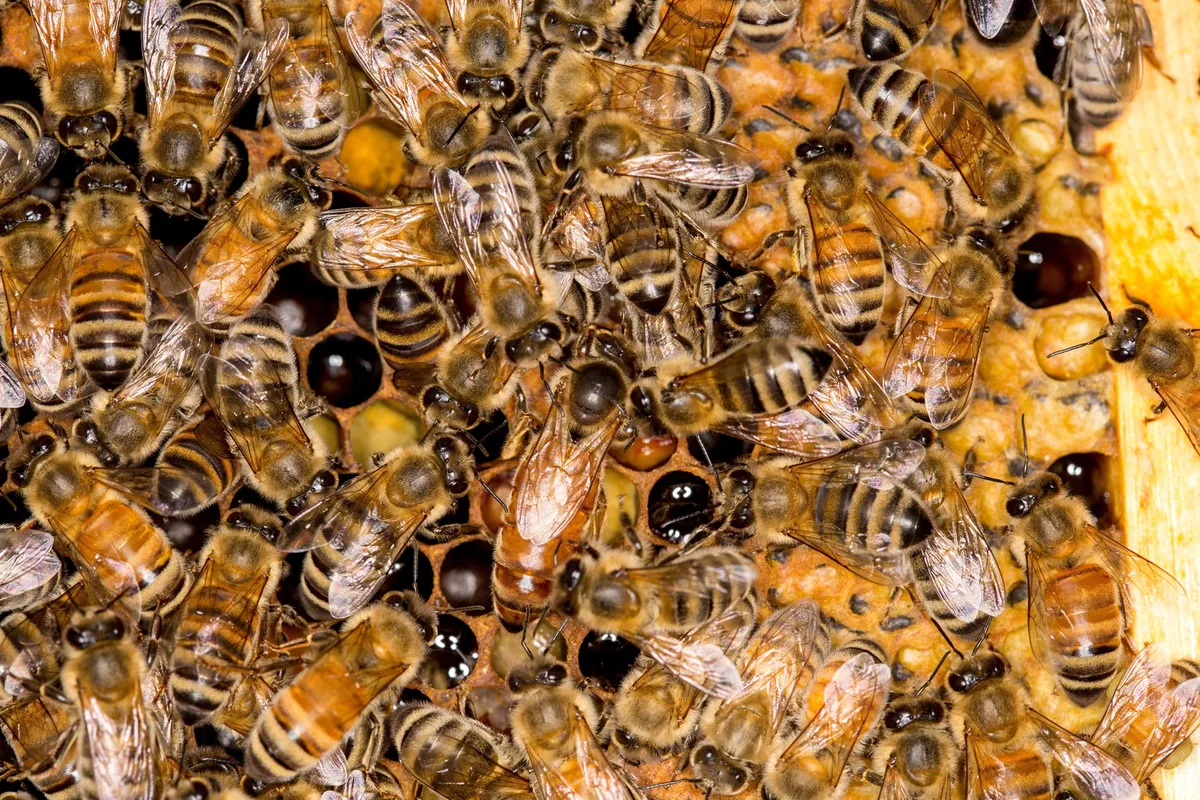
Honey bees are master engineers of their own climate. Deep inside a hive, they maintain precise temperatures—around 34-36°C—through a coordinated dance of wing-fanning and body positioning that would impress any HVAC technician. But new research from Arizona shows that when the thermometer climbs high enough, even this biological precision breaks down.
A study tracking nine honey bee colonies through an unusually brutal Arizona summer found that outdoor temperatures regularly exceeded 40°C (104°F). The bees managed to keep the center of their brood at safe temperatures most of the time. But the margins told a different story. At the edges of the brood, developing bees spent nearly eight hours each day outside the safe temperature range—roughly 1.7 hours too cold, 1.6 hours too hot, repeated daily. For the smallest colonies, temperature swings hit 11°C in a single day.
These weren't minor fluctuations. The stress added up. Colonies exposed to the highest peak temperatures and the widest internal swings saw their populations drop noticeably. The researchers concluded that "excessive heat can reduce colony populations by impairing the thermoregulation of brood or by exposing adults to temperatures that shorten their lifespans."
We're a new kind of news feed.
Regular news is designed to drain you. We're a non-profit built to restore you. Every story we publish is scored for impact, progress, and hope.
Start Your News DetoxThe Size Advantage
One pattern emerged clearly: bigger colonies weathered the heat better. Larger hives maintained more stable internal temperatures, while smaller ones swung wildly. This matters because a colony's ability to buffer against heat stress depends on sheer numbers—more bees mean more fanning, more distributed effort, more resilience. The smallest colonies had no such buffer.
What happens next is where the concern deepens. Climate models suggest global temperatures could rise 2.7°C by century's end, with some scenarios reaching 4°C higher. That means the conditions observed in Arizona—once unusual—may become routine across much of the world. And humidity adds another layer of trouble. When the air is already saturated, bees can't rely on evaporative cooling, their primary temperature-management tool. The heat just sits there.
For beekeepers, this isn't theoretical. Strategies like providing supplemental water, shading hives, improving insulation, and ensuring access to quality forage are shifting from nice-to-have to necessary. Some operations are already experimenting with these measures. The question is whether adaptation can keep pace with the warming—and whether the economic pressure on beekeeping means smaller operations get left behind.
The stakes extend beyond the hive. Roughly one-third of global food production depends on pollination, much of it by honey bees. A world where only the largest, best-resourced apiaries survive is a world with fewer pollinators and higher costs for the crops that depend on them. The research doesn't offer a solution, only a clearer picture of the problem taking shape.