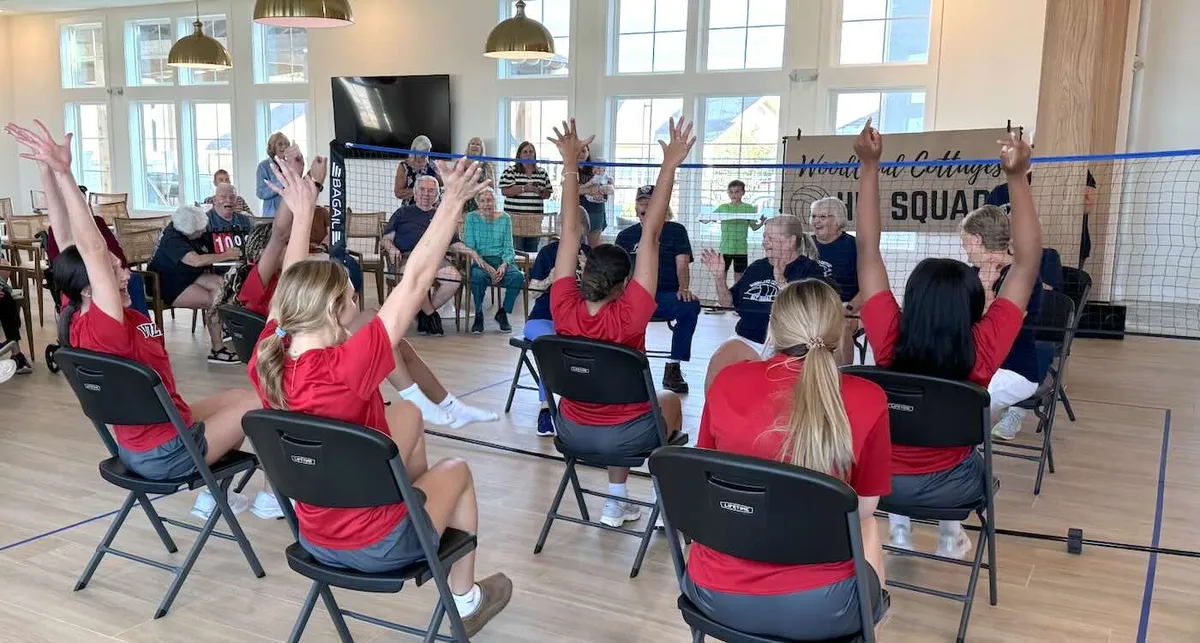
Charlotte Wheeler laughs so hard during practice that she can barely hit the ball over the net. She's 80-something, sitting in a chair, playing against teenagers who are a fraction of her age. This is what The Hit Squad does now—a group of residents at Woodland Cottages in Belton, Texas, who decided that competitive volleyball from a seated position was exactly the kind of chaos they needed.
It started simple enough. The Lake Belton High School volleyball team showed up for a friendly match. Then another. Then the games became something neither group expected: a reason to see each other regularly, to compete hard, to laugh until their sides hurt.
Thia Allison, a high schooler on the Lady Broncos, put it plainly: "I'm ready to get some wisdom and skills from those who know more than I do." She wasn't just talking about volleyball.
We're a new kind of news feed.
Regular news is designed to drain you. We're a non-profit built to restore you. Every story we publish is scored for impact, progress, and hope.
Start Your News DetoxWhen a Game Becomes Something More
The friendship has spilled off the court in ways that matter. The Hit Squad traveled to watch the high school team play, then showed up at Senior Night with personalized goodie bags for eight graduating athletes. It was the kind of gesture that catches people off guard—not because it's complicated, but because it's genuine.
Word spread across campus. The undefeated Lady Broncos basketball team asked if they could play too. Students started visiting more often, not because they had to, but because they wanted to. The energy shifted from "nice intergenerational program" to something that felt like actual friendship.
For the residents, the impact has been measurable. Staff report increased physical activity, stronger social engagement, and a sense of purpose that wasn't there before. For the students, it's harder to quantify—but it shows up in the way they talk about the seniors, the way they listen, the way they come back.
There's something about a volleyball match that cuts through the noise of age difference. You're competing. You're trying to win. You're on the same side of the net, literally and otherwise. The court becomes a place where an 82-year-old and a 17-year-old are just two people trying to make the other team miss.
The matches keep happening. The cheering continues. And somewhere in Belton, Texas, a group of teenagers and seniors have figured out something that doesn't require a program coordinator or a mission statement: how to actually see each other.