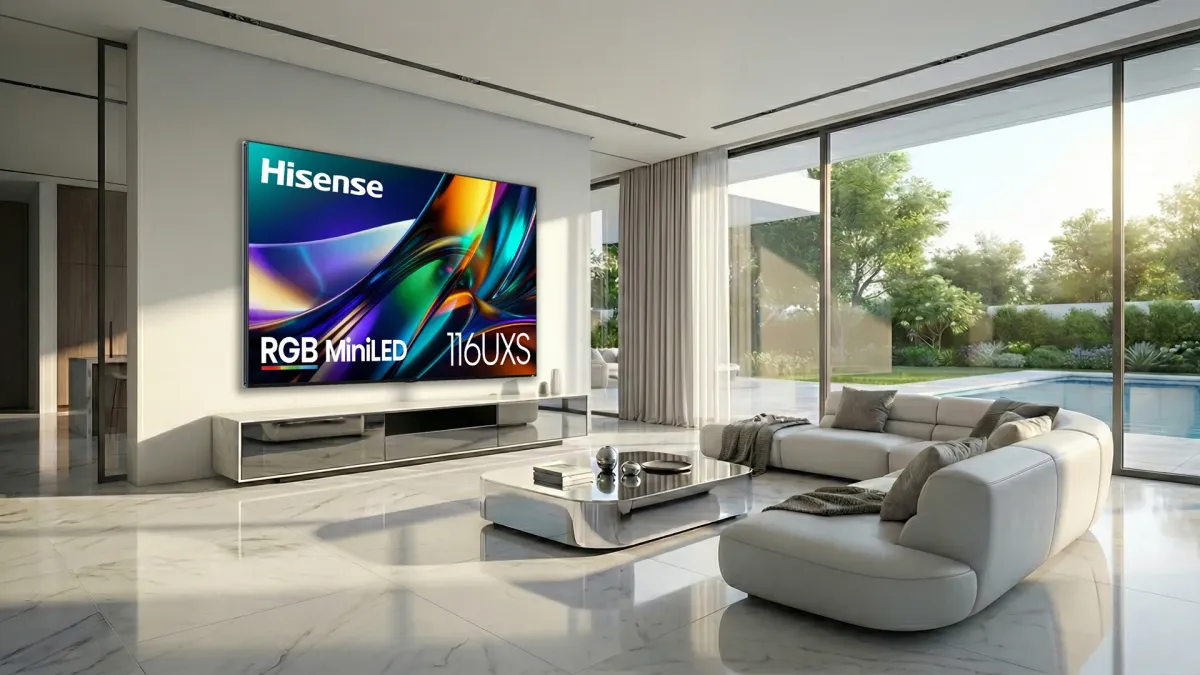
At CES 2026, Hisense showed off two tweaks to how tiny LED displays work — and they're quietly significant for anyone who cares about what they're actually seeing on screen.
The shift is small in concept but meaningful in practice. Traditional MiniLED displays use four types of subpixels: red, green, blue, and white (RGBW). Hisense's new RGB MiniLED strips out the white pixel and optimizes the red, green, and blue instead. The result: a wider range of colors and sharper contrast without sacrificing brightness.
But the real move is the RGBY MicroLED — which adds yellow to the standard RGB mix. This sounds like a minor detail until you think about how your eye actually processes color. Yellow sits between red and green on the spectrum. By giving displays a dedicated yellow subpixel, Hisense expands the color space the screen can produce, especially in the warm tones that dominate photography, film, and skin tones.
We're a new kind of news feed.
Regular news is designed to drain you. We're a non-profit built to restore you. Every story we publish is scored for impact, progress, and hope.
Start Your News DetoxWhy this matters beyond the spec sheet
MicroLED technology itself is already a step up from traditional LCD and even most OLED displays — the individual pixels emit their own light, which means perfect blacks and no backlight bleed. Adding that yellow subpixel is less about revolution and more about refinement: displays that show you what filmmakers and photographers actually intended, rather than what the hardware forces them to compromise on.
The energy efficiency gains matter too. Displays that need fewer backlights or less power to hit the same brightness level mean longer battery life on phones, lower electricity costs in commercial settings, and less heat generation — which is increasingly relevant as displays get brighter and more densely packed.
Hisense isn't the only company working on this problem. Samsung, LG, and others have been iterating on micro-LED and mini-LED for years. But the RGBY configuration is a specific engineering choice that suggests where the industry is heading: not just brighter or thinner displays, but smarter ones that work with how human vision actually works.
The technology won't hit consumer products immediately — these are still in the demonstration phase. But if the color accuracy and efficiency gains hold up in real-world testing, expect to see RGBY configurations show up in premium TVs, monitors, and phones within the next few years.