Epoxy: the superhero of modern materials, binding everything into impossibly strong composites. But like any good superhero, it has a fatal flaw — once cured, it's virtually impossible to unbind, making recycling a nightmare.
That means all those expensive, high-performance materials it glues together, like the carbon fiber in an airplane wing or the aramid honeycomb in a cabin floor, usually end up in a landfill. Or worse, burned. Which, for something as energy-intensive as carbon fiber, feels a bit like throwing money into a bonfire.
But a team of Swiss researchers at Empa, teaming up with chemical company Elantas, just cracked the code. They've cooked up a new epoxy composite that not only holds everything together but also knows when to let go. Because apparently, even super-strong bonds need to be a little flexible.
We're a new kind of news feed.
Regular news is designed to drain you. We're a non-profit built to restore you. Every story we publish is scored for impact, progress, and hope.
Start Your News DetoxThe Not-So-Sticky Solution
The secret ingredient? A special phosphorus additive from Empa. This isn't just for show; it does double duty. First, it makes the cured epoxy incredibly flame-retardant — a non-negotiable for anything flying through the sky. Second, and this is the real magic, it allows the material to soften and break apart under specific, controlled conditions.
Think about it: aircraft and train interiors need to be light (to save fuel), strong (to not fall apart), durable (for decades of abuse), and fire-safe (for obvious reasons). Combining all those properties is a material science tightrope walk. Empa researcher Sabyasachi Gaan noted that flame retardants often mess with a material's other crucial features.
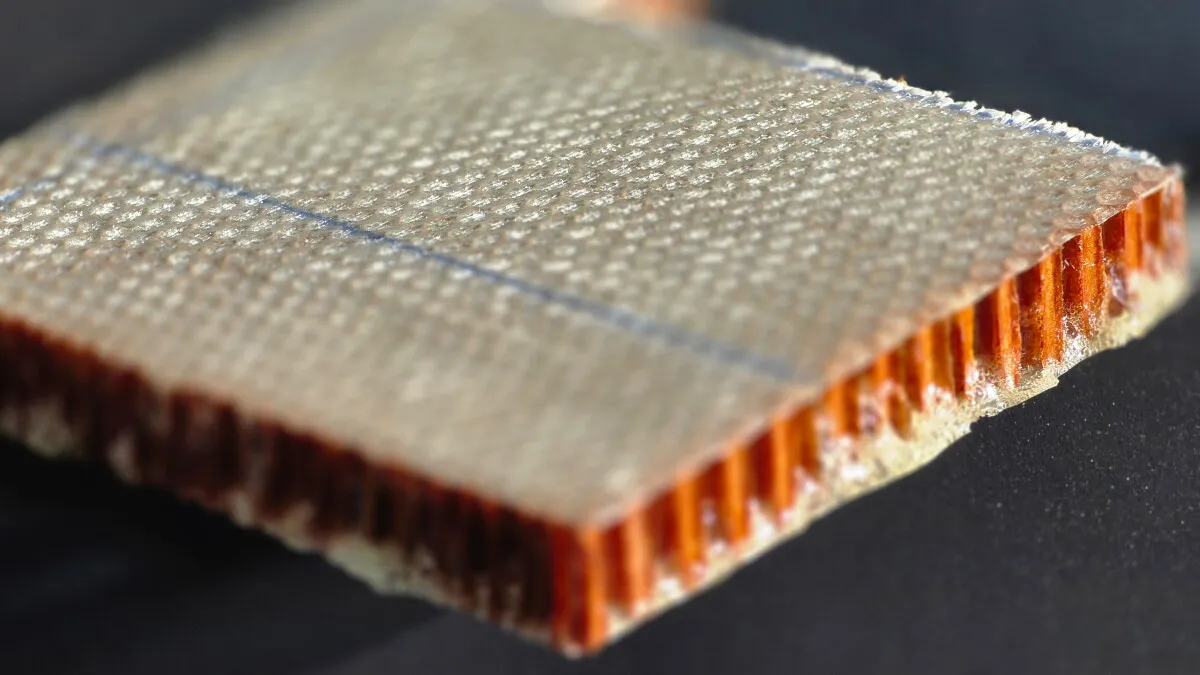
Engineers typically use "sandwich composites" for this balancing act. Picture a light, heat-resistant aramid honeycomb (like Kevlar) sandwiched between layers of glass or carbon fiber. The epoxy then glues this whole delicious-sounding structure into one stiff, lightweight panel. Perfect for cabin floors.
Traditional epoxy is a "thermoset" polymer. It forms a permanent, molecularly locked network when it cures. Great for strength; terrible for recycling. Unlike thermoplastics that melt and reshape when heated, thermosets just hold their ground until they degrade. They don't soften; they just give up the ghost, taking all those valuable fibers and honeycombs with them.
But with the new phosphorus-infused epoxy, those molecular bonds become dynamic. Under the right heat and a specific solvent, parts of that network can actually swap bonds, letting the material rearrange instead of staying stubbornly locked. This means the cured epoxy can be softened, reshaped, and most importantly, un-stuck.
In tests, the team successfully broke down an aerospace-style sandwich composite, separating the aramid honeycomb and the reinforcing fibers. The goal now is to recover the resin itself, turning what was once trash into raw material.
Fire Safety and Future Flights
And that flame retardancy? It's not just a bonus; it's a game-changer. Earlier studies showed that adding just 2.5% phosphorus reduced the peak heat release rate by 75% and cut total smoke production by 72.5% in fire tests. More than 5% phosphorus gave it the recyclability.
This means manufacturers can build components that meet stringent fire safety regulations and are recyclable, all while maintaining nearly identical mechanical properties to traditional epoxy. Which, if you think about it, is both impressive and slightly terrifying. Imagine an airplane that's not only safer but also doesn't leave a mountain of waste when it retires.
The implications stretch far beyond aviation. Fiber-reinforced epoxy composites are everywhere: cars, trains, ships, wind turbines, even construction. Giving these industries a way to reverse the strength of epoxy at the end of a product's life could dramatically cut down on waste and make expensive materials infinitely more sustainable. The next step is scaling this up, turning lab magic into industrial reality. Someone's going to be very busy.