A.I. in Radiology: A Partnership, Not a Replacement
In 2016, A.I. pioneer Geoffrey Hinton predicted that computers would replace radiologists within five years. That hasn't happened. In fact, the number of radiologists is expected to grow by 26% or more over the next three decades.
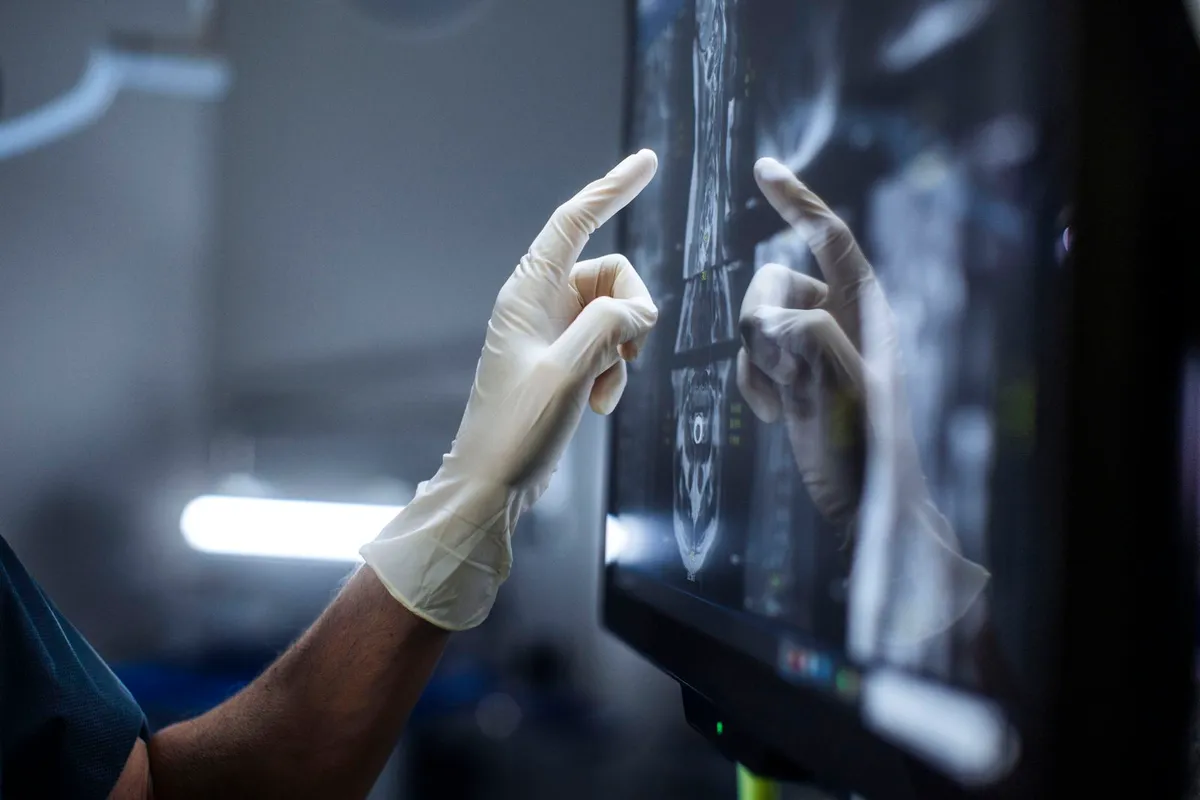
Hinton was right about one thing: A.I. is now a powerful tool in radiology. It can match or even exceed human performance in some tasks. Radiology is a leader in using A.I. in medicine. About three-quarters of the 1,400 A.I.-enabled medical devices approved by the FDA are for radiology.
These A.I. tools help doctors in several ways. Some make radiologists more efficient by writing reports or highlighting urgent images. Others can find abnormalities that humans might miss. They can also interpret images as well as, or better than, trained radiologists. For example, A.I.-assisted colonoscopies find more polyps than traditional ones.
We're a new kind of news feed.
Regular news is designed to drain you. We're a non-profit built to restore you. Every story we publish is scored for impact, progress, and hope.
Start Your News DetoxImproving accuracy is key. Human error rates in diagnostic images are about 3% to 5%. This leads to around 40 million errors globally each year. The challenge is not to replace humans, but to combine A.I.'s precision with human experience. This partnership aims to improve accuracy for patients.
The Human-A.I. Team
Designing a good collaborative system between humans and A.I. is complex. A.I. might be more reliable on average, but it still makes mistakes that humans wouldn't. Radiologists must evaluate A.I. decisions, most of which are correct, and spot the rare errors.
This requires a new way of thinking for radiologists. Doctors are used to overriding computer warnings, but A.I. is different. Traditional alerts are based on rules that doctors can easily understand. A.I. image analysis often uses "black box" systems like neural networks. These systems don't explain how they reach a decision, making it harder for radiologists to know when to disagree.
For example, an A.I. tool might detect 95% of lung nodules on a CT scan, while radiologists detect 90%. Stanford's Curtis Langlotz explains that human and machine intelligence are different. A radiologist might catch some of the 5% the A.I. missed. A.I. can examine every pixel without getting tired. Radiologists use their understanding of disease to interpret images in ways A.I. cannot.
The goal is to ensure radiologists accept correct A.I. findings and dismiss incorrect ones. This means dealing with unconscious biases. Doctors might rely on A.I. too much (automation bias) or dismiss it unfairly (A.I. distrust).
A Swedish study in 2026 found that A.I.-assisted mammography screenings led to fewer early cancer detections and diagnoses between screenings. This suggests A.I. can improve testing and reduce doctor workloads.
Overcoming Biases and Training for Success
Automation bias happens when doctors trust A.I. too much, ignoring their own judgment. Automation complacency occurs when working with reliable A.I. reduces a doctor's vigilance for rare errors. For instance, an A.I. might miss blood in the brain on a scan. Trusting this oversight is automation complacency. Studies show that incorrect A.I. predictions can significantly lower the accuracy of mammography interpretations by experienced radiologists.
A.I. distrust is also common. People are naturally suspicious of new technology, especially if they fear it might take their jobs. A.I. can also make obvious, "silly" mistakes that differ from human errors, which can lead doctors to dismiss it.
To address these biases, Nina Kottler of Mosaic Clinical Technologies suggests monitoring how often radiologists agree with A.I. If a radiologist accepts A.I. results 99% of the time, but the A.I. is only 95% accurate, further discussion is needed.
Training is crucial. Radiologists need to understand how A.I. systems work and when they might be wrong. For example, an A.I. tool might be wrong on 30% of scans if the patient moved. However, a 2026 American Medical Association survey found that over a quarter of physicians received no A.I. training. Only 11% received a lot of training.
Kottler also recommends that A.I. tools provide a confidence estimate for each evaluation, rather than just a yes/no answer. This helps radiologists, who can't be expected to know the details of many different A.I. systems.
The partnership between humans and A.I. is still evolving. As Langlotz notes, "It’s not that A.I. will replace radiologists. Radiologists who use A.I. will replace radiologists who don’t."
Deep Dive & References
The report of my death was an exaggeration - Radiology Business Radiology's ranks are in fact growing steadily, with the number of practitioners expected to expand by 26 percent or more - Academic Radiology, 2024 Food and Drug Administration - FDA analysis of 43 clinical trials - Annals of Internal Medicine, 2024 40 million errors worldwide each year - Radiographics, 2018 replacing humans with machines - Knowable Magazine, 2025 design such a collaborative system - Knowable Magazine, 2026 Swedish study - The Lancet Oncology, 2026 “black box” systems - European Journal of Radiology, 2024 unconscious biases - Annual Review of Biomedical Data Science, 2024 rely on A.I. too much - Human Factors, 2010 drops in the accuracy of their mammography - Radiology, 2022 no training about A.I. - American Medical Association, 2026 Radiologists who use A.I. will replace radiologists who don’t. - Journal of the American College of Radiology, 2021