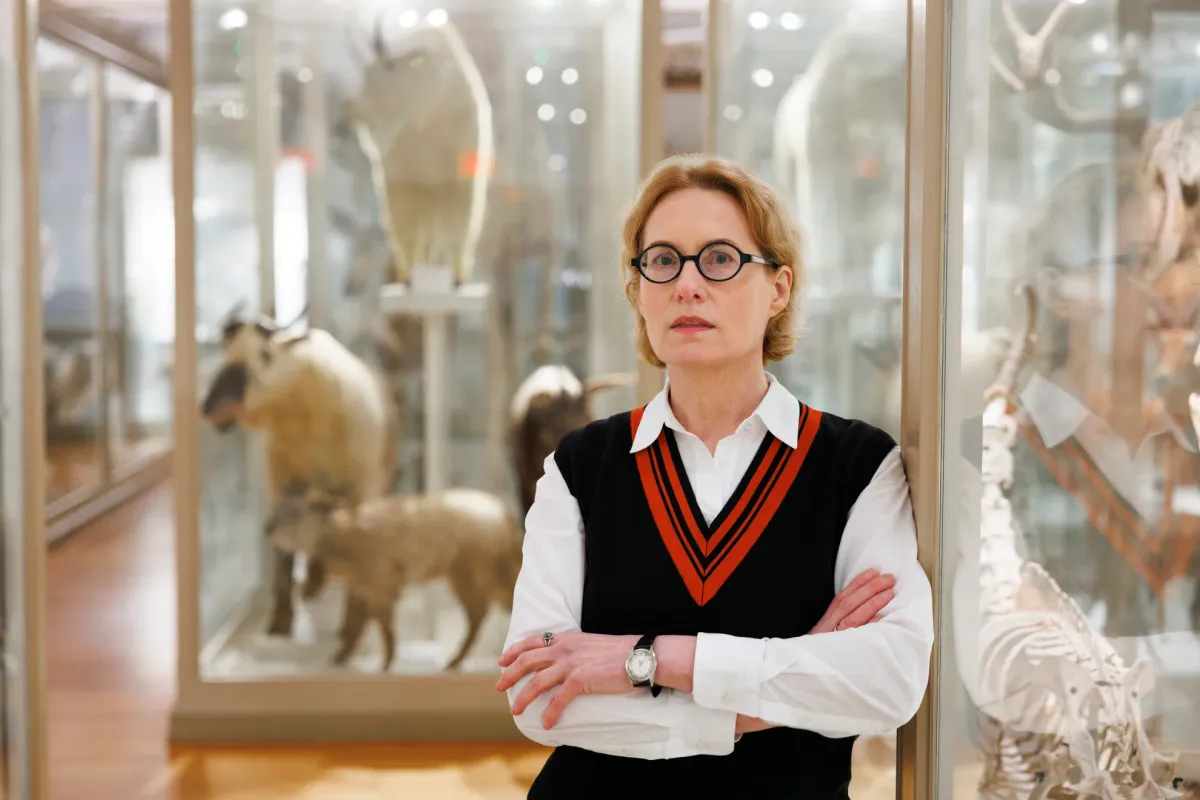
Benjamin Franklin is known as a key figure in the American Revolution. He was a diplomat, printer, publisher, and inventor. But his role as a scientist was central to his life and to American independence, according to Joyce Chaplin. Chaplin is the James Duncan Phillips Professor of Early American History at Harvard.
Science became very important in the 1700s as Europe embraced new ideas. Franklin became one of the most famous scientists of his time. His reputation, boosted by his 1751 pamphlet "Experiments and Observations on Electricity," helped him during the Revolution and beyond.
Chaplin explained that Franklin's experiments offered the first clear explanations of electricity, including lightning. This was very important during a time when people were excited about science. His scientific work gave Franklin great authority to challenge a king who seemed like a tyrant. This helped spark the first political revolution in an era of many revolutions.
We're a new kind of news feed.
Regular news is designed to drain you. We're a non-profit built to restore you. Every story we publish is scored for impact, progress, and hope.
Start Your News DetoxThe event celebrated the 250th anniversary of the Declaration of Independence. It was sponsored by Harvard's Collection of Historical Scientific Instruments, the Peabody Museum of Archaeology & Ethnology, and the Harvard Museums of Science and Culture.
"Franklin was interested in science because he was ambitious and knew he needed some extraordinary accomplishment to achieve any kind of prominence." Joyce Chaplin
Franklin's Path to Scientific Prominence
Franklin was born in Boston in 1706. After an apprenticeship, he moved to Philadelphia at age 17 to become a printer. A year later, he went to London. There, he not only mastered printing but also became fascinated with science. He desperately wanted to meet Isaac Newton, Chaplin noted. Newton had published his laws of motion and gravity in 1687. London was a center for new discoveries.
Chaplin said that in those days, many people participated in science, and it wasn't specialized. In London, Franklin learned how a scientific reputation could benefit him. He was ambitious and knew he needed a major achievement to gain fame.
When Franklin returned to Philadelphia, he quickly became a successful printer. In 1729, he bought "The Pennsylvania Gazette." In 1732, he published "Poor Richard’s Almanack" to share his interest in science, including weather forecasts and new discoveries.
Inspired by the Royal Society of London, Franklin created the Library Company of Philadelphia in 1731. This company collected scientific tools and sponsored science lectures. He also helped start the American Philosophical Society and the Academy of Philadelphia, which later became the University of Philadelphia.
The Impact of His Scientific Fame
Franklin's work with electricity, including his famous kite experiment, made him well-known first in Philadelphia and then across Europe. He was respected and admired. His fame eventually spread to Russia and throughout the Americas, including Spanish and Portuguese colonies.
Immanuel Kant called Franklin a "modern Prometheus" for "having drawn fire or electricity from the heavens." Chaplin explained that this implied a similar defiance of the natural and supernatural order. Mary Shelley might have thought of Franklin when she wrote "Frankenstein: or, The Modern Prometheus" in 1818. Shelley's novel offered a "darker vision of the man of science" and a "dire warning about scientific prowess."
Chaplin believes Franklin was a major inspiration for Shelley's character. She noted that if asked how Franklin differed from other American founders, she would say, "Well, he’s the subtitle to Frankenstein."
As Franklin's scientific fame grew, so did his political power. In 1753, he became deputy postmaster general of North America. The next year, he was chosen to represent Pennsylvania at the Albany Congress. Chaplin pointed out this never would have happened when he was just a printer. Franklin also served as an agent for the Pennsylvania assembly in London from 1757 to 1762.
During the Revolution, Franklin's scientific reputation helped him greatly in his diplomatic efforts. He secured France's support for the American colonies. He was crucial in forming the new republic, helping to draft the Declaration of Independence and the Constitution. Chaplin emphasized that all his political power came from his scientific skill.
Chaplin believes the United States would have formed even without Franklin. However, she noted that most Americans today don't realize how much Franklin's reputation as a famous scientist helped the United States from 1776 onward. Science played a powerful role in establishing the new nation.