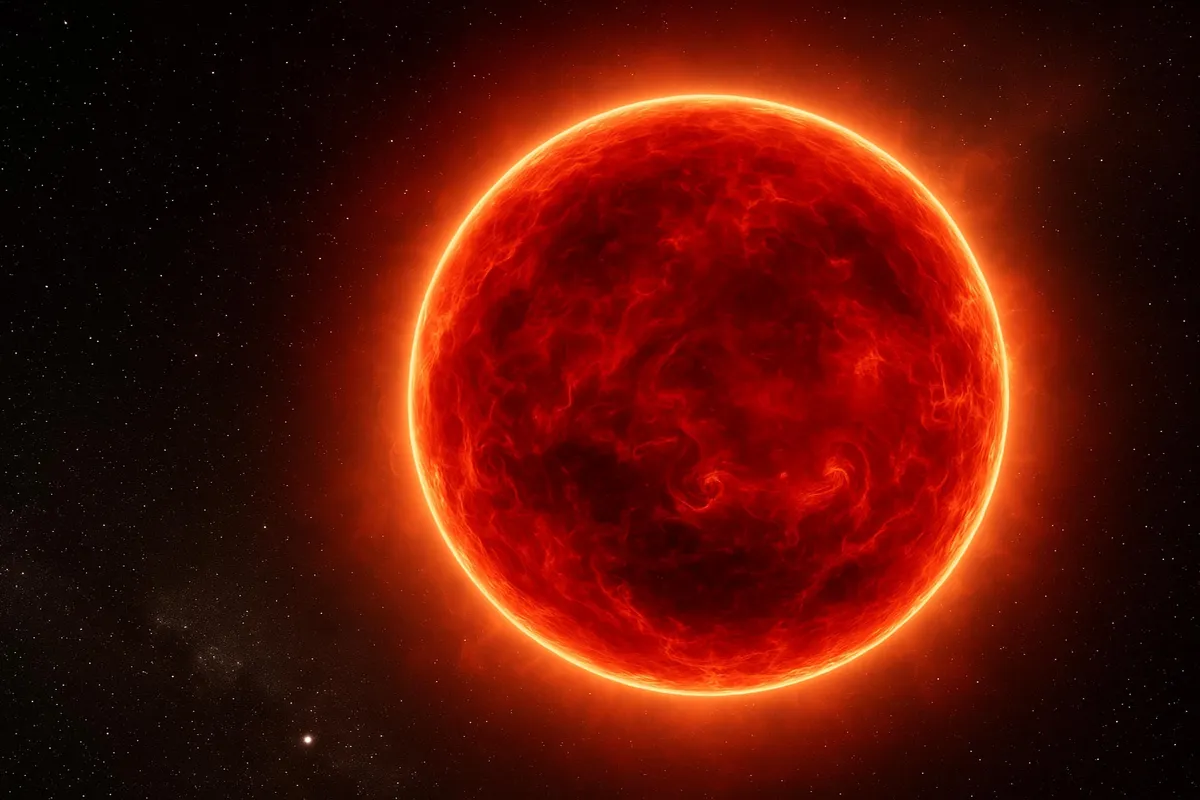
Astronomers have been puzzled for decades by something strange: as red giant stars age and balloon to enormous sizes, their surface chemistry shifts in ways that shouldn't be possible. Material from deep inside the star somehow reaches the surface, but a stable barrier layer sits between them like an impenetrable wall. Until now, no one could explain how elements make that journey.
A new study published in Nature Astronomy finally has an answer, and it comes down to something simple: the stars are spinning.
Using some of the world's most powerful supercomputers, researchers from the University of Victoria and University of Minnesota ran 3D simulations detailed enough to watch material move inside these distant stars. What they found was that stellar rotation dramatically amplifies the movement of material across that supposedly impenetrable barrier—by more than 100 times in some cases.
We're a new kind of news feed.
Regular news is designed to drain you. We're a non-profit built to restore you. Every story we publish is scored for impact, progress, and hope.
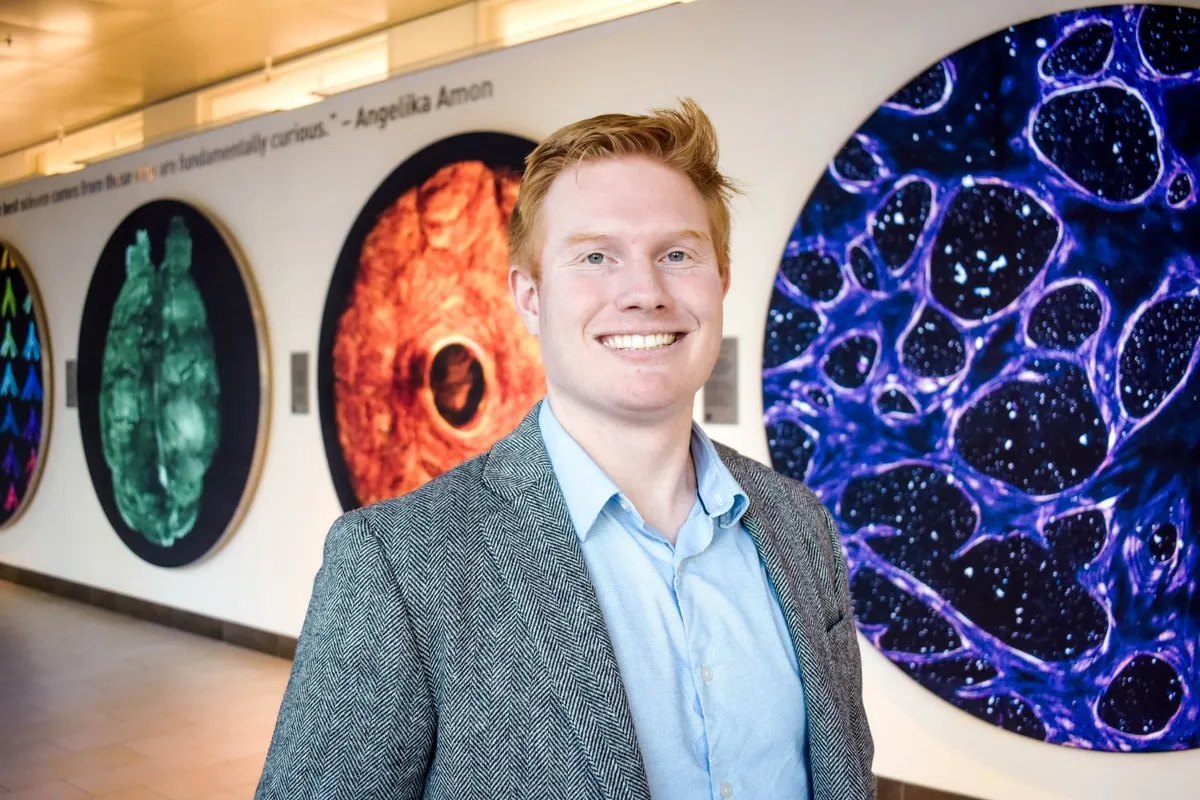
Start Your News Detox"Stellar rotation is crucial and provides a natural explanation for the observed chemical signatures in typical red giants," says Simon Blouin, the lead researcher. "This discovery is another step forward in understanding how stars evolve."
Why this matters for our Sun
When Sun-like stars run out of hydrogen fuel in their cores—something that will happen to our Sun in about 5 billion years—they expand dramatically. A red giant can grow to 100 times its original size. Since the 1970s, astronomers have detected clear shifts in surface chemistry as this happens. Carbon-12 ratios drop compared to carbon-13, a signature that material from the core is somehow bubbling up to the surface.
The mystery was how. The star's interior generates internal waves that can pass through the barrier layer, but previous simulations showed these waves carried almost no material. Blouin's team discovered something crucial: rotation changes everything. As the star spins, it amplifies how effectively these waves can mix material across the barrier, creating the exact chemical signatures astronomers observe.
"Until recently, while stellar rotation was thought to be part of solving this conundrum, limited computing abilities prevented us from quantitatively testing the hypothesis," explains Falk Herwig, director of the Astronomy Research Centre. "These simulations allow us to tease out small effects to determine what actually happens."
The computing breakthrough
None of this would have been possible even a few years ago. The team used two supercomputing systems: one at the University of Texas at Austin and a newer machine called Trillium, which launched in August 2025 at the University of Toronto. Trillium is among Canada's most powerful supercomputers, capable of running the kind of massive 3D simulations that track how material moves inside stars.
"We were able to discover a new stellar mixing process only because of the immense computing power of the new Trillium machine," Herwig notes. "These are the computationally most intensive stellar convection and internal gravity wave simulations performed to date."
The techniques developed for this research extend far beyond astronomy. The same methods for simulating flows inside stars apply to understanding ocean currents, atmospheric dynamics, and even blood flow through the body. Herwig is already collaborating with researchers across these fields to develop shared approaches for large-scale flow simulations.
Blouin plans to keep investigating. This study focused on one particular type of star, but he's curious about what happens in others—whether different rotation profiles affect mixing efficiency, and whether rotation enhances wave mixing in other stellar types and evolutionary phases. Each answer brings us closer to understanding not just the distant cosmos, but the eventual fate of our own Sun.