A team at Hebrew University just pulled off something that sounds impossible: they've figured out how to squeeze light from 222 separate laser modes into a single optical fiber without losing brightness along the way.
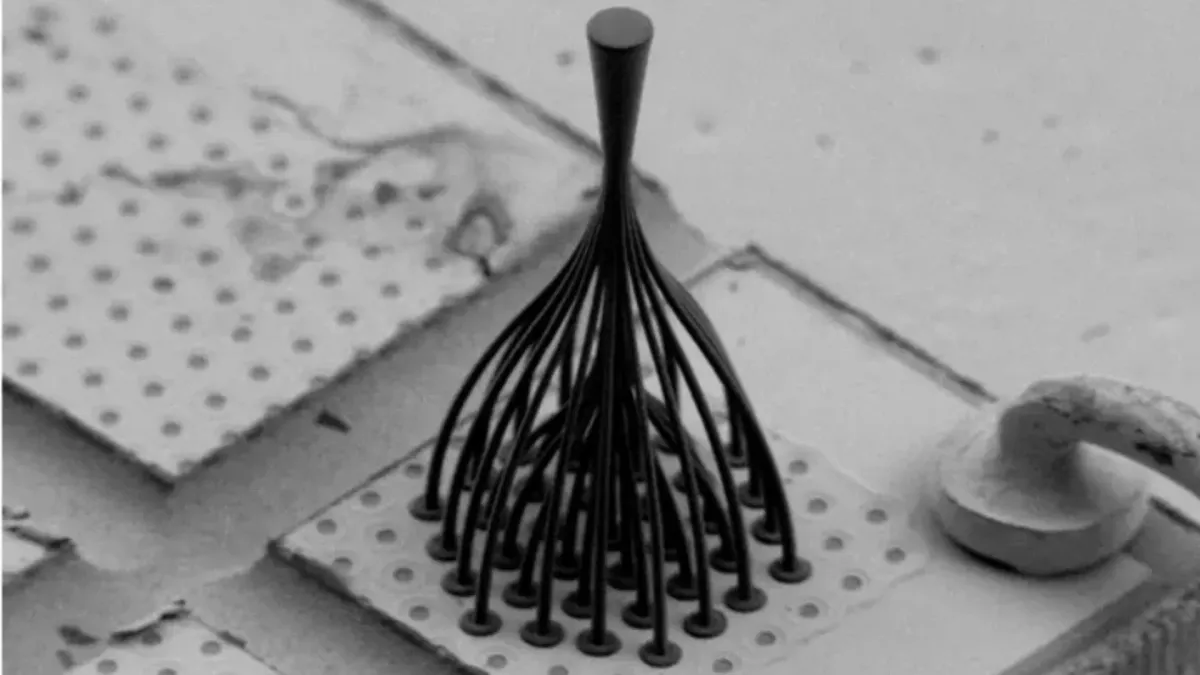
The trick is a device smaller than a grain of rice called a photonic lantern. Think of it less like a funnel and more like a perfectly designed traffic pattern—it guides dozens of laser beams into one channel while keeping them organized enough that none of their energy gets wasted.
Yoav Dana, a Ph.D. student working under Professor Dan M. Marom at the Hebrew University's Institute of Applied Physics, led the research with support from Civan Lasers. The team's work just landed in Nature Communications, and the implications are pretty serious for anyone building powerful laser systems.
We're a new kind of news feed.
Regular news is designed to drain you. We're a non-profit built to restore you. Every story we publish is scored for impact, progress, and hope.
Start Your News DetoxWhy this matters
Here's the problem they solved: Most semiconductor lasers—the kind used in manufacturing, telecommunications, and defense—naturally emit light in multiple spatial modes. Older photonic lanterns were designed to combine single-mode lasers, which created a mismatch. It's like trying to merge six highway lanes into one without traffic jams.
The Hebrew University team redesigned the whole thing. Their new N-MM photonic lantern lets multiple multimode lasers feed directly into one fiber. They tested it with 7, 19, and 37 lasers, each operating across six spatial modes. The 37-laser version? That's 222 modes total flowing through a single fiber.
What makes this genuinely clever is that the lantern doesn't force the lasers to synchronize—they don't need to match phases or anything fancy. It just merges them efficiently, which is way simpler than older relay-lens systems that often degraded beam quality or demanded millimeter-perfect alignment.
The engineering move
The whole device is 3D-printed and smaller than half a millimeter. The largest version measures just 470 micrometers—about the width of a human hair. Despite the tiny footprint, the efficiency numbers are impressive: coupling losses as low as 0.6 decibels for the 19-laser setup, around 0.8 for the 37-laser version. For context, that's the difference between a perfect transfer and one where you lose almost nothing.
Inside, the lantern uses an adiabatic optical transition—a gradual shift that converts multiple laser inputs into one smooth multimode channel. This preserves the system's optical capacity while minimizing power loss. When you're combining dozens of sources, even tiny inefficiencies add up fast, so this design choice is critical.
The real potential here is scaling. If this approach works for 222 modes, it could eventually handle hundreds of semiconductor lasers feeding into a single fiber. That means dramatically more power delivered through fiber-based systems—think cutting-edge manufacturing tools, long-distance communications networks, or advanced sensing tech—all in a package small enough to fit in your hand.
The next phase will be watching whether manufacturers can actually build these at scale and integrate them into real systems. For now, the research proves the concept works.