Snakes are amazing creatures. They don't have arms or legs, but some can stand almost perfectly straight up. They can hold long parts of their bodies vertically, like a flagpole.
Scientists have now figured out how snakes do this. Their discoveries could even help improve robot designs in the future.
How Snakes Defy Gravity
Snakes don't use muscles all over their bodies to stand upright. Instead, they focus muscle activity near their base. This method is efficient and stable. It helps them save energy when crossing gaps between tree branches. Researchers shared these findings in the Journal of the Royal Society Interface.
We're a new kind of news feed.
Regular news is designed to drain you. We're a non-profit built to restore you. Every story we publish is scored for impact, progress, and hope.
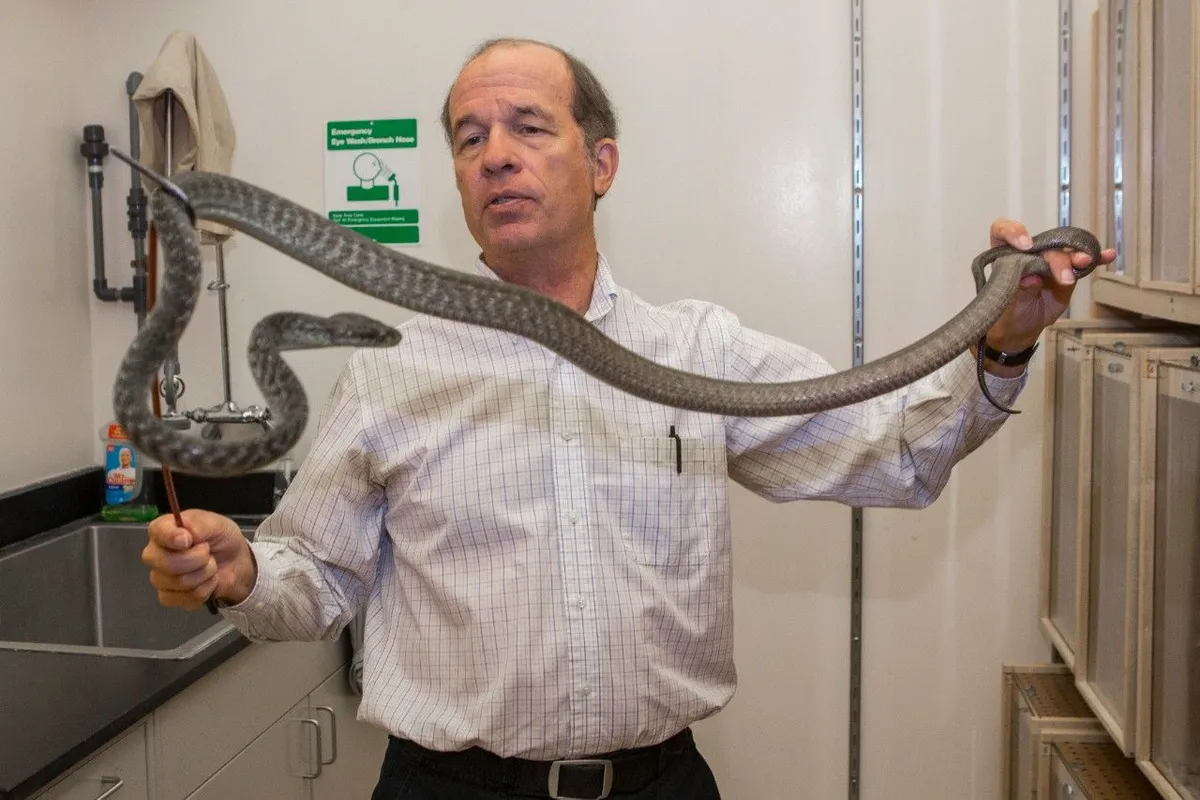
Start Your News DetoxDavid Hu, a bioengineer at Georgia Tech, explained that snakes are like "muscular ropes." He said they can do "magic tricks" by flexing their bodies to avoid falling.
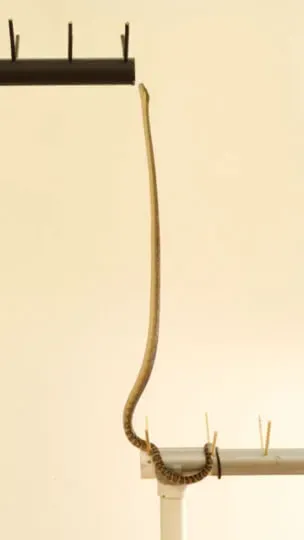
For the study, scientists observed four snakes: three brown tree snakes and one scrub python. They set up an obstacle course with two horizontal pipes. One pipe was higher than the other. The pipes had pegs to mimic tree branches.
The snakes started on the lower pipe and tried to reach the higher one. Researchers slowly increased the vertical distance between the pipes. They recorded videos of the snakes climbing.
Brown tree snakes could reach the upper pipe even when the gap was more than 50% of their body length. The scrub python did even better, reaching over 70% of its body length.
The Mechanics of Standing
All four snakes used similar tactics. They curved their bodies into an S-shape, mostly bending near the bottom pipe. The upper part of their bodies extended almost straight up.
Scientists used math to understand this. They found that snakes likely focus muscle activity on a "boundary layer" at their base. This is the part near the lower pipe where the snake starts to turn upward. The part of the body above this layer stays straight. Gravity has less power to pull the snake down in this position.
The researchers noted that large muscle activity happens near the lower perch. But where the snake is vertical, almost no muscle force is needed. This is because gravity's pulling force is canceled out there.
Getting into this vertical pose doesn't take much energy. But holding it seems to be harder. This is probably why snakes sway a little when they are upright. The small wobbles show that they are using a lot of muscle force to stay stable.
Broader Implications
These findings could explain other biological feats. For example, garden eels stay vertical in strong ocean currents to eat. Elephants can also stretch their trunks very long. The research might even apply to the human spine or the long necks of birds like ostriches.
The study also has potential uses for robotics. Engineers are developing snake-like robots for medical procedures, space exploration, and disaster rescue.
Learning from snakes could help engineers build soft, flexible robots. These robots might be easier to control and use less electricity. Ludwig Hoffmann, a mathematician at Harvard, said that by focusing control where it matters, engineers can build efficient and strong machines.
Deep Dive & References
- How snakes defy gravity to stand tall - Science News
- Snakes on a plane: How they stand upright - Harvard University
- The mechanics of vertical climbing in snakes - Journal of the Royal Society Interface, 2025