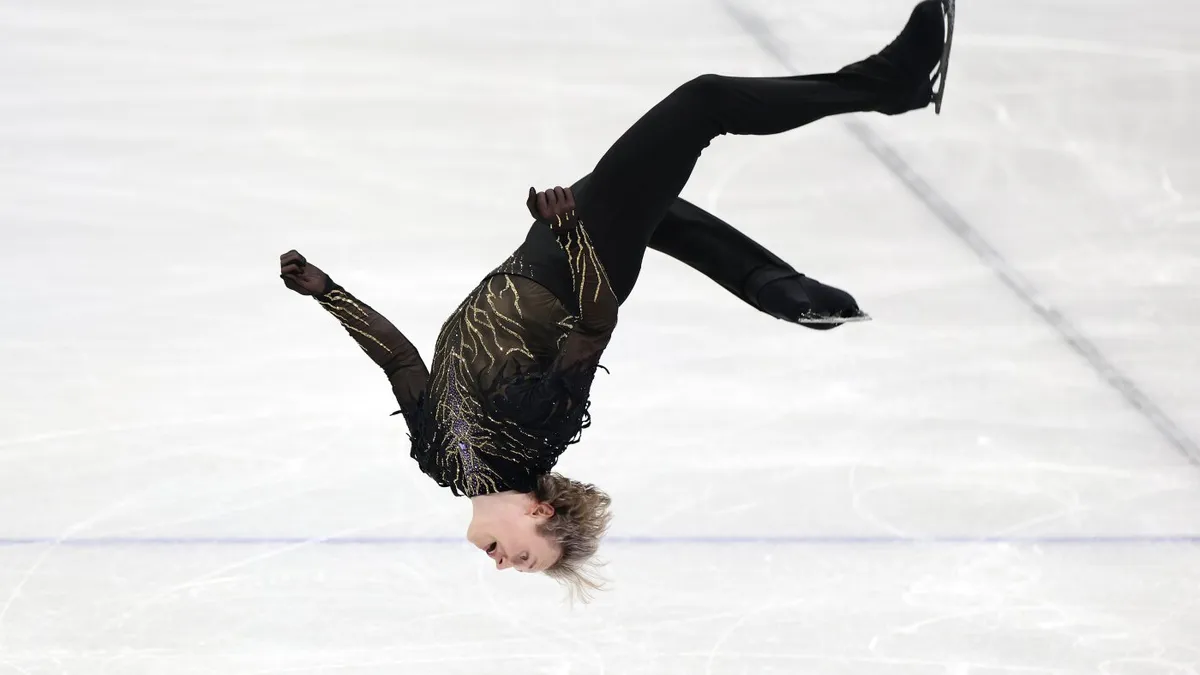

Ilia Malinin landed a backflip on Olympic ice, and the arena lost it. Not because backflips are new to figure skating — they're not — but because for nearly 50 years, they were illegal.
Malinin, a U.S. skater who trained in gymnastics as a kid, performed the move in his first two Olympic programs this year. What made it historic wasn't the athleticism (though landing a backflip on a single blade is genuinely difficult). It was that he became the first person to legally do it at the Olympics since 1976.
We're a new kind of news feed.
Regular news is designed to drain you. We're a non-profit built to restore you. Every story we publish is scored for impact, progress, and hope.
Start Your News Detox"It's honestly such an incredible roar-feeling in the environment," Malinin said after his performance. "Once I do that backflip everyone is like screaming for joy. I think a lot of people know the basics of a backflip, so it brings in the non-figure skating crowd as well."
He's right about one thing: the crowd goes feral. But the real story isn't about Malinin's moment — it's about why a move so crowd-pleasing was banned in the first place, and what changed.
The 50-year ban
Terry Kubicka, also American, landed the first competitive backflip at the 1976 Innsbruck Olympics. It was controversial immediately. "There was a lot of controversy leading up to the Olympics, because I did it for the first time a month before at the U.S. Championships," Kubicka said decades later. "At the time, there was no ruling on how it would be scored and the feedback that I got was that judges did not really see it as a pro or con because they didn't know how to judge it."
The International Skating Union banned the move the following year. The official reasoning: it was too dangerous and violated the principle that jumps should land on one skate. But the ban didn't kill the backflip entirely. Elite skaters like 1984 gold medalist Scott Hamilton kept performing it in exhibition shows, where the rules didn't apply.
Then came 1998. Surya Bonaly, a French skater competing while injured at the Nagano Olympics, landed a backflip on one blade — knowingly breaking the rules. She couldn't win the medal she needed, so she decided to make history instead. The move cost her points but cemented her legacy as someone willing to defy a system she saw as flawed. As a Black athlete in a sport with limited diversity, her act of defiance resonated far beyond figure skating.
"I appreciate more and I feel more proud of myself now, today, than years ago for when I did it," Bonaly said in 2020.
The quiet comeback
The backflip never fully disappeared. In recent years, skaters began performing it again at exhibitions and galas. Nathan Chen, the defending Olympic champion, landed one. Then, in 2024, French skater Adam Siao Him Fa did it at the European Championships during his free skate program — with enough of a lead that the penalty wouldn't matter. He did it again at Worlds the same year and won bronze.
Something shifted. The move was no longer whispered about; it was celebrated. And the sport's governing body finally noticed.
Later in 2024, the International Skating Union officially reversed the ban, effective immediately for the 2024-2025 season. Their reasoning: "Somersault type jumps are very spectacular and nowadays it is not logical anymore to include them as illegal movements." The backflip still doesn't count toward a skater's technical score, but it no longer costs them points. More importantly, it can boost their artistic score and, as Malinin noted, the crowd's energy.
Will Annis, a 21-year-old U.S. competitive skater, learned the backflip after watching Siao Him Fa's defiant performance. "Every time the crowd goes crazy for it, and it's actually easier than everything else I do, so it's really fun," Annis said after landing his at the U.S. Championships in January. By the time he tried it in competition, the ban was already lifted.
What took 48 years to reverse happened quietly, without fanfare. No dramatic protest needed. Just enough skaters willing to push the boundaries until the sport caught up.