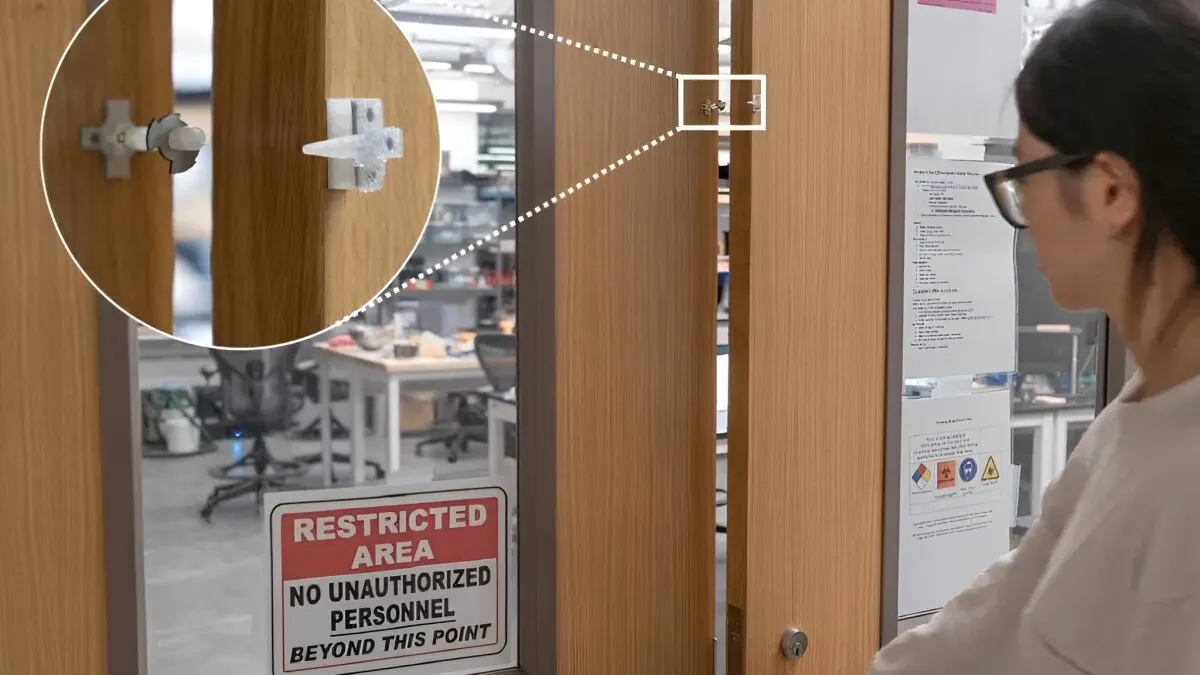
Imagine a motion sensor that never needs batteries, never needs plugging in, and is smaller than a penny. That’s not a sci-fi dream; it’s a tiny metal tag developed by researchers at Georgia Tech, and it’s about to make your smart home a whole lot smarter (and less power-hungry).
Most smart home sensors are constantly begging for attention – either tethered to an outlet or draining a battery that you’ll inevitably forget to replace. These new tags, however, are gloriously self-sufficient. They detect movement using only sound, like a tiny, metallic whisper in the ultrasonic range.
The Secret Life of a Really Smart Ring
The magic lies in a small, flat, lightweight metal tag that looks like a hollow ring with some very specific cuts around its edge. These aren't just any cuts; they're precisely engineered to make a unique ultrasonic sound when struck. Think of it like a tiny, silent bell only dogs (or, in this case, a nearby microphone) can hear.
We're a new kind of news feed.
Regular news is designed to drain you. We're a non-profit built to restore you. Every story we publish is scored for impact, progress, and hope.
Start Your News DetoxThe researchers even built a tool to model these shapes, letting them design over a thousand unique tags, each with its own distinct ultrasonic "fingerprint." When a tag gets a tap, a nearby device – say, your smartwatch or phone – picks up the sound. Software then instantly identifies which tag was struck, telling you exactly what just moved.
Yibo Fu, a PhD student leading the research, explains that these unique signatures are perfect for "activity recognition" in a smart home. Even better? They keep their signal clear, even in a noisy house. Because apparently that’s where we are now.
So, how does it work in practice? The complete sensor has three parts: the metal tag, a plastic base for it, and a small plastic tab that does the striking. You’d attach the base to, say, a door frame, and the tab to the door itself. Open the door, the tab hits the tag, and voila – a unique ultrasonic ping tells you that door just opened.
This system isn't just for doors. Think windows, toilet seats (yes, really), faucets, drawers, or even counting reps at the gym. One person on Instagram, where Fu's video showing the tags went viral with nearly 2 million views, suggested using them in archiving systems to track exactly which box was opened. Another floated the idea of monitoring thousands of garbage and recycling bins.
It’s not high-tech in the flashy sense, but it's incredibly clever. These tiny, maintenance-free tags could lead to vast networks of low-cost sensors in homes, warehouses, and public buildings, all without adding to our growing mountains of battery waste. Because sometimes the smartest solution is the one that barely sips power at all.