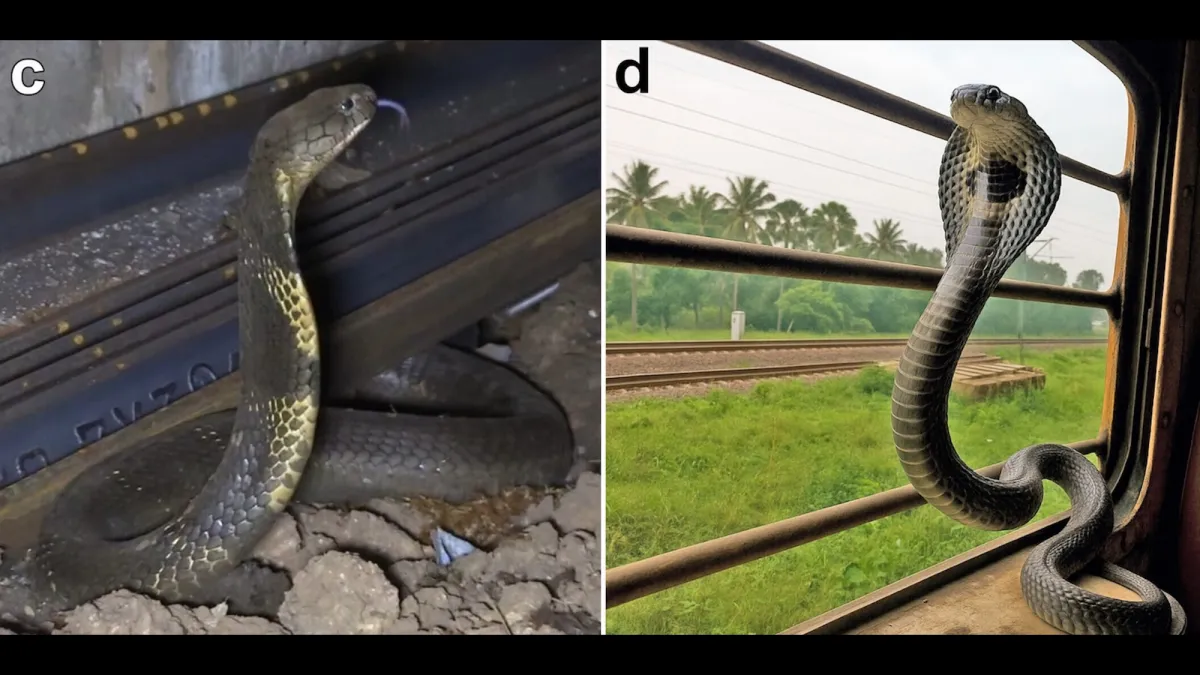
India's Western Ghats king cobra—a vulnerable species that can stretch over 13 feet—has found an unlikely travel companion: the railway system. Researchers tracking 47 sightings of these snakes across Goa between 2002 and 2024 discovered something unexpected: the cobras aren't native to the region, yet they keep turning up in villages, forests, and along train tracks.
Herpetologist Dikansh Parmar, who has spent years rescuing king cobras, was part of a team from the Museum Liebnitz in Bonn analyzing local rescue records and resident reports. They found five documented cases of cobras spotted on or near trains—snakes that seemed to be using railway cars as mobile corridors between habitats. The theory makes sense: trains offer shelter, attract rodents for food, and create secure spaces where a 13-foot predator can rest undisturbed.
The catch: trains aren't delivering these snakes to ideal destinations. The researchers mapped where Western Ghats cobras actually thrive—river valleys deep in forested interiors where prey is abundant. Instead, the snakes are ending up near railway yards: drier, more exposed, with fewer rodents and less natural cover. It's like being dropped off at the wrong stop on a long journey.
We're a new kind of news feed.
Regular news is designed to drain you. We're a non-profit built to restore you. Every story we publish is scored for impact, progress, and hope.
Start Your News DetoxWhat makes this finding significant is how invisible the problem has been. Train-mediated animal dispersal—snakes, insects, small mammals traveling hundreds of kilometers on freight cars and cargo—is vastly underreported in conservation research. Most wildlife monitoring focuses on deliberate human-caused habitat loss or direct poaching, not on the accidental relocation of vulnerable species. Yet every time a train departs a station, it may be carrying hitchhikers into unfamiliar terrain where they struggle to find food or suitable shelter.
For the Western Ghats king cobra, a species already facing habitat pressure, these unplanned journeys add another layer of uncertainty. Some snakes may adapt and establish new populations. Others will simply disappear into unsuitable environments. Meanwhile, the humans living near railway yards face their own concerns—a 13-foot venomous snake in a rail depot is a genuine safety risk, even if encounters remain rare.
The research suggests that better understanding train corridors as animal pathways could help conservationists design targeted interventions—from railway design changes to coordinated rescue protocols across regions. It's a reminder that infrastructure moves more than cargo and people.