
Researchers have found a way to turn natural leather into flexible energy devices. This new method could lead to more sustainable wearable electronics.
The technique uses a CO2 laser to draw conductive patterns directly onto vegetable-tanned leather. This process changes the leather's surface into carbon, which can store and manage electricity. The result is a tiny supercapacitor built into a soft, wearable material.

Dong-Dong Han from Jilin University led the work. Han said this approach makes manufacturing simpler and better for the environment.
We're a new kind of news feed.
Regular news is designed to drain you. We're a non-profit built to restore you. Every story we publish is scored for impact, progress, and hope.
Start Your News DetoxLaser Creates Energy Circuits
This method uses a natural material and a single step to create energy storage devices. Traditional devices often use synthetic materials and many chemicals.
The laser changes the leather's surface into a conductive and porous structure. This removes the need for complex manufacturing steps. Researchers can adjust the laser settings to control how the carbon forms, which helps them fine-tune the device's performance.
The conductive patterns act like electrodes. They allow ions to gather and release quickly when the device charges and discharges. The laser also creates a porous carbon layer, which increases the surface area for storing charge and improves efficiency.
These microsupercapacitors can store energy and stabilize electrical output. This reduces power fluctuations that can affect how devices work. This dual function makes them useful for small, low-power wearable systems.
The team showed off the technique by making patterned microsupercapacitors shaped like a tiger, dragon, and rabbit. This highlights how flexible the process is.

Flexible Power for Wearables
Han noted that these microsupercapacitors are great for flexible and comfortable wearable electronics. They are built on soft materials, can be shaped freely, and can be put directly into products.
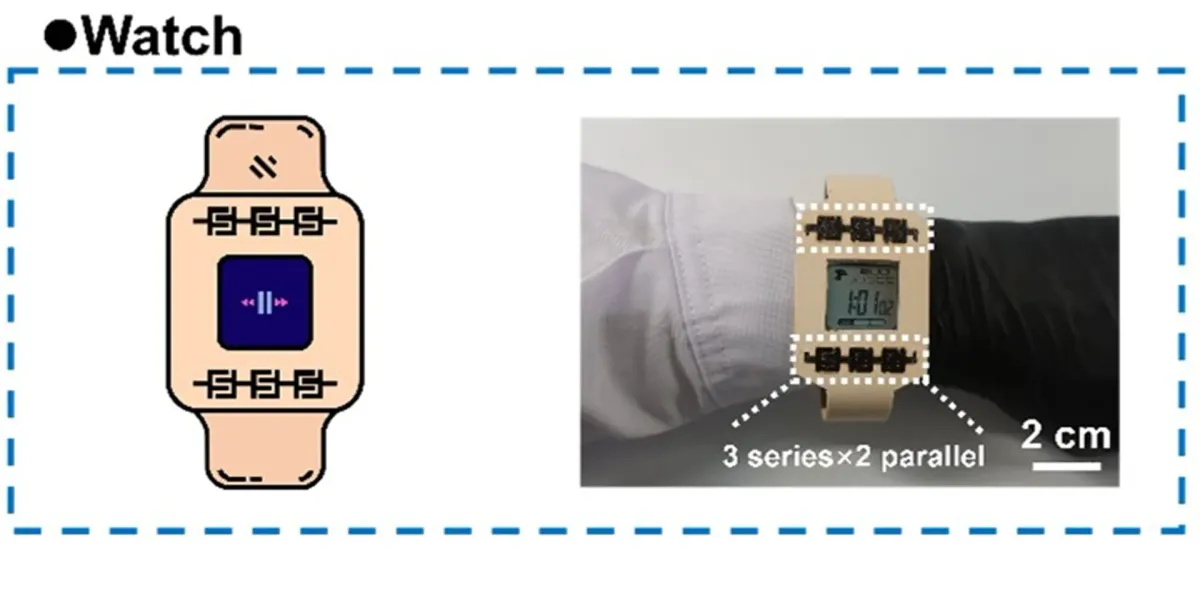
The devices performed well over many charge cycles. They also worked effectively at 60 Hz, a common frequency for everyday electronics. In tests, they powered LEDs and even a small electronic watch.
Researchers believe this technology could replace rigid batteries in devices like smartwatch bands. This would allow for thinner and more comfortable designs. It could also be used in smart clothing, skin sensors, and other wearable systems.
Han explained that their method replaces plastic with a renewable material. It also simplifies manufacturing into one laser step, without chemicals or cleanroom processes. Plus, it combines energy storage with signal filtering in one device.
Future work will focus on making the devices more durable and improving their performance. This includes testing them in real-world conditions like sweat, humidity, and repeated bending. The team is also looking into using them in self-powered health-monitoring systems.
Deep Dive & References
Laser-induced carbonization of vegetable-tanned leather for flexible microsupercapacitors with integrated signal filtering - Optics Letters, 2024