Environmental carbon coatings determine how electric charge moves between identical insulating materials. This helps control static electricity in nature and experiments.
When tiny particles bump into each other, they can create a small spark. This simple action might have provided the energy needed for life to begin on Earth. But when two identical materials touch, what decides which way the electric charge goes? A new study in Nature found an unexpected answer: carbon-based molecules from the environment that stick to material surfaces.
This type of charge transfer happens in many natural events. These include Saharan dust storms, volcanic lightning, and the swirling matter around stars. In all these cases, small electrical sparks are important. Scientists have long thought these sparks could power chemical reactions.
We're a new kind of news feed.
Regular news is designed to drain you. We're a non-profit built to restore you. Every story we publish is scored for impact, progress, and hope.
Start Your News DetoxAs far back as the 1950s, researchers suggested that lightning in volcanoes might have helped form amino acids. These are the basic building blocks of proteins. More recently, NASA's Perseverance rover found signs that similar electrical activity might happen in Martian dust storms.
Unraveling the Mystery of Charge Direction
Even though these interactions are common, scientists have struggled to explain why charge always moves in one direction when two insulating materials touch. Researchers led by Scott Waitukaitis at the Institute of Science and Technology Austria (ISTA) aimed to solve this. Their work showed that thin layers of environmental carbon on material surfaces are key.

Lead author Galien Grosjean studied silica, a material found widely in the universe. It was hard to study charge transfer because even a tiny touch, like with tweezers, could change the results.
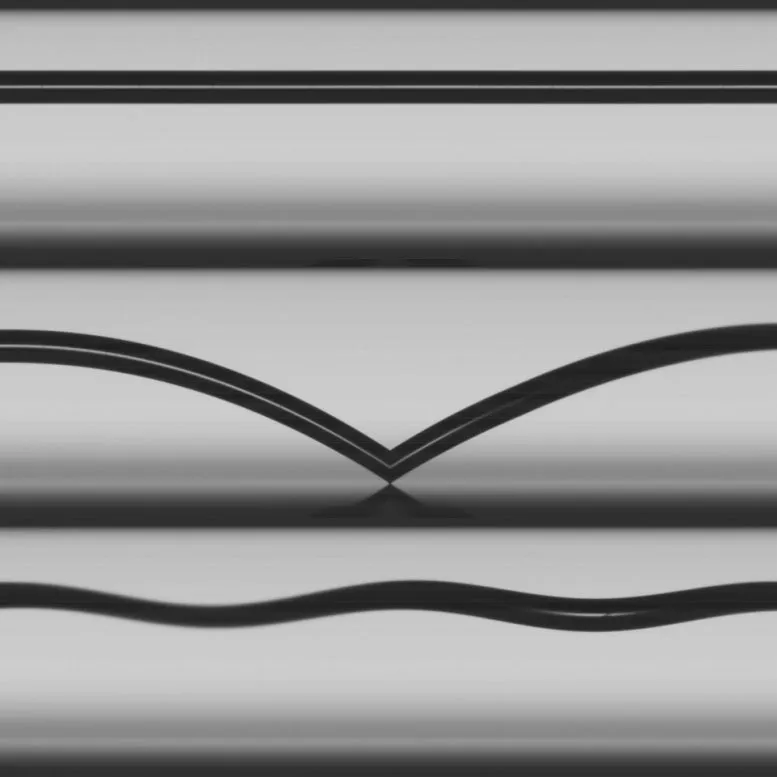
To avoid this, the team used acoustic levitation. This method suspends a single grain without physical contact. They repeatedly bounced the grain against a plate made of the same material. Then, they measured how the charge changed after each collision. Some samples consistently gained a positive charge, while others became negative.
Testing Theories and Finding a Breakthrough
The big question was: why would identical materials act differently? And could this effect be reversed? Older theories suggested that surfaces had random patches with different properties.
Grosjean explained that scientists imagined a "dairy cow pattern" model. Waitukaitis added that he expected this model to be right, with random changes balancing out as grains rotated.
However, the experiments showed a consistent charging pattern, which went against this idea. The team also checked if water molecules on the surface could explain it.
"We focused too much on water for a long time, which led us down many wrong turns," Waitukaitis said. "We took those leading theories for granted, and they led us astray. We needed time to be confident enough to see that reality was different."
A major discovery happened when researchers heated some samples. These treated samples consistently developed a negative charge after contact.
"Quartz glass resists heat well, so heat doesn't change the material itself," he said. "We thought any change must be due to molecules stuck to the surface."
They saw a similar effect when they used plasma to clean the surface.
Carbon: The Secret Ingredient
"At this point, we started contacting other groups who study material surfaces," Grosjean said. "They can precisely measure surface compositions to compare samples before and after baking. That's when we found that treating the materials removed their natural coating of environmental carbon."
Plasma cleaning, a common method in surface science, is known to remove carbon layers.
"We knew carbon mattered, but it wasn't the full answer yet," he noted.
To confirm the link, researchers watched how the effect changed over time. After treatment, the charge behavior slowly weakened over about a day.
Contact electrification. A video narrated by the study’s first author and former ISTA postdoc Galien Grosjean. Credit: Galien Grosjean/Scott Waitukaitis
"Our collaborators showed that carbon also returned to the materials' surface over the same period," Grosjean added. "This made the connection much stronger."
Water molecules returned much faster, ruling them out as the main cause. These results confirmed that environmental carbon was responsible.
Reversing Charge Trends
The ISTA scientists then looked at other insulating oxides besides silica, like alumina, spinel, and zirconia. After standard cleaning, these materials naturally form a triboelectric series. This series ranks them from most positive to most negative after contact.

This suggests materials have their own tendencies. However, the team suspected the carbon coating also played a part. They examined each pair of materials. By stripping the carbon from the one that naturally charged more positively, while leaving the other intact, they could reverse the entire series. This imbalance in carbon coating showed that the carbon effect can be stronger than the materials' natural tendencies.
Waitukaitis stressed how challenging these experiments were.
"These experiments are really hard," Waitukaitis said. "The carbon coating is never stable. Even a single layer of carbon makes a difference, and the materials are sensitive to the slightest touch. That's why the phenomenon remained unexplained for so long."

Using acoustic levitation helped the team avoid unwanted contact. It also allowed them to measure charge with high precision, down to about 500 electrons.
In related work, the group found that the contact history between soft silicon-based polymers also affects charge direction. Both studies started by testing older models. They ultimately showed that different materials follow different rules.
"It's tempting to think any finding must apply to all materials," Grosjean said. "But we stopped making this mistake."
Implications for Life and Planets
These findings go beyond the lab. Static electricity between tiny particles is common in nature. It may have played a role in the origin of life and even how planets form.
"Most materials in nature are tiny particles, smaller than one millimeter," Waitukaitis said. "They charge by colliding, rubbing, and rolling. That's why desert sand, volcanic ash clouds, and dust particles get charged."
Understanding this mechanism could also help scientists study protoplanetary disks, where planets are born.
"Some current models of planetary formation rely heavily on charge," Waitukaitis concluded. "Our research might have just shed light on the mechanism behind the sparks of creation."
Deep Dive & References
Adventitious carbon breaks symmetry in oxide contact electrification - Nature, 2026