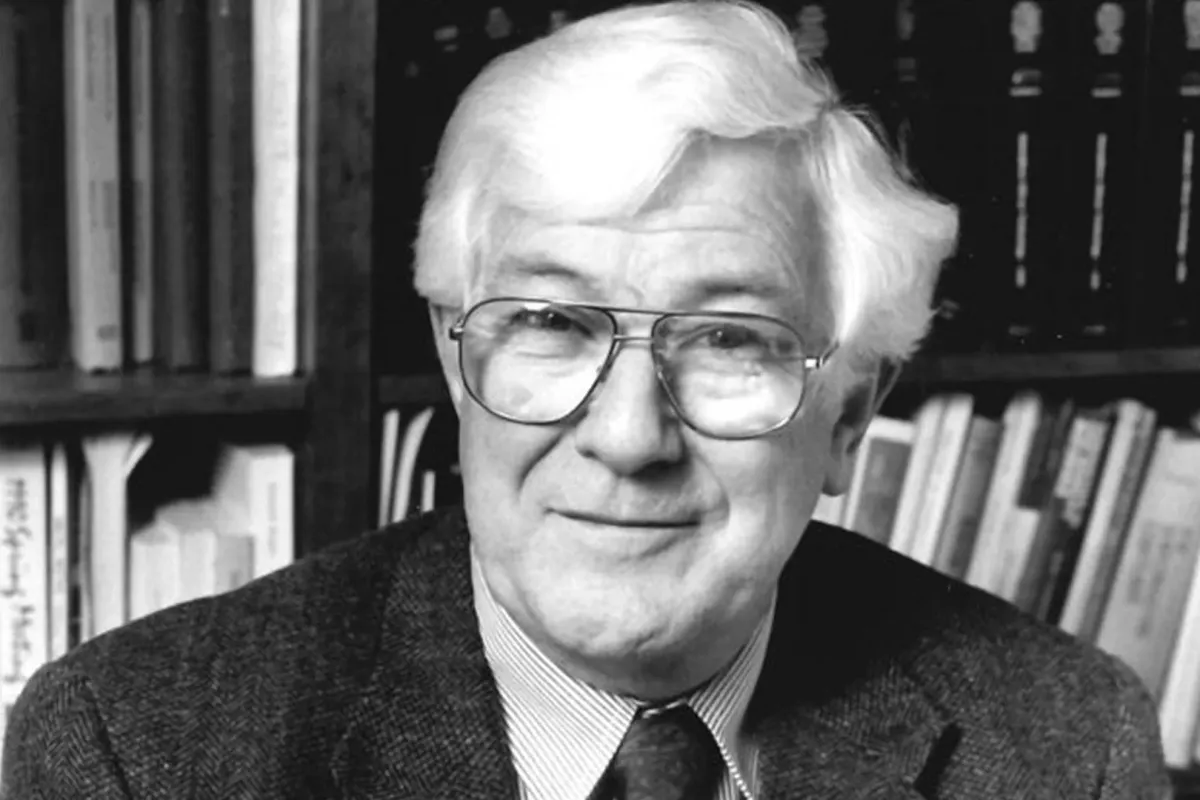
William Paul, a physicist who spent nearly his entire career at Harvard, passed away in 2020 at the ripe old age of 94. And while most of us might dabble in high-pressure situations only when our in-laws visit, Paul built a legacy out of it. He was a pioneer in experimental solid-state physics, making contributions that still echo through our semiconductor-driven world.
Born in Scotland in 1926, Paul arrived at Harvard in 1952, drawn by the siren song of Nobelist P.W. Bridgman's high-pressure lab. He wasn't just there for the free coffee; he had a burning desire to see how squishing crystals would mess with their electronic and optical properties. Which, if you think about it, is a pretty specific thing to be curious about, but thankfully for us, he was.
His knack for applying extreme force to tiny things earned him a string of promotions, culminating in becoming the Gordon McKay Professor of Applied Physics. Later, he held the rather grand title of Mallinckrodt Professor of Applied Physics and Professor of Physics until his retirement in 2000.
We're a new kind of news feed.
Regular news is designed to drain you. We're a non-profit built to restore you. Every story we publish is scored for impact, progress, and hope.
Start Your News DetoxPaul's Law and the Art of Squeezing
Paul wasn't just good at doing high-pressure experiments; he was good at improving them. He invented stronger, more flexible steel tubing that could snake pressurized fluid into cells, allowing them to fit into tight spots like low-temperature dewars. Because apparently, even science experiments need to be space-efficient.
His 1963 book, Solids Under Pressure, became a classic. But perhaps his most famous contribution is "Paul's Law," which sounds like something you'd hear in a courtroom drama, but is actually about semiconductors. It describes how the energy gap between electronic states in different semiconductors behaves consistently under pressure. Because even tiny electrons follow the rules, especially when squeezed.

Making Amorphous Semiconductors Behave
In the early 1970s, Paul shifted his focus to amorphous semiconductors like silicon and germanium. These materials were the wild west of photovoltaics: cheap, easy to make into thin films, but also a bit... unruly. The main concerns were that you couldn't dope them properly and that "dangling bonds" (think of them as tiny, unsatisfied electron hands) would create too many unwanted states.
Paul, ever the problem-solver, was among the first to figure out how to tame these materials. By adding hydrogen during deposition, those pesky dangling bonds could be tied up. And by adding enough dopants, he showed they could be incorporated correctly. Suddenly, the unruly became useful.
Beyond the lab, Paul was instrumental in building Harvard's Division of Engineering and Applied Physics (DEAP), advising over 40 Ph.D. students and shaping the graduate curriculum. He was known for his articulate, precise arguments, often speaking up at faculty meetings, always with facts to back his points. Because when you've spent a lifetime putting things under pressure, you learn to be firm and precise. In retirement, he even rekindled an interest in theater, directing plays. Because a life of applied physics clearly prepares you for the drama of the stage.