For decades, the Standard Model has been the universe's instruction manual — a tidy explanation for all the fundamental particles and forces we know. It's been remarkably resilient, a scientific rock, but now, it seems, that rock might be developing a few cracks. And it's all thanks to some incredibly rare particle transformations that scientists affectionately call "penguin decays."
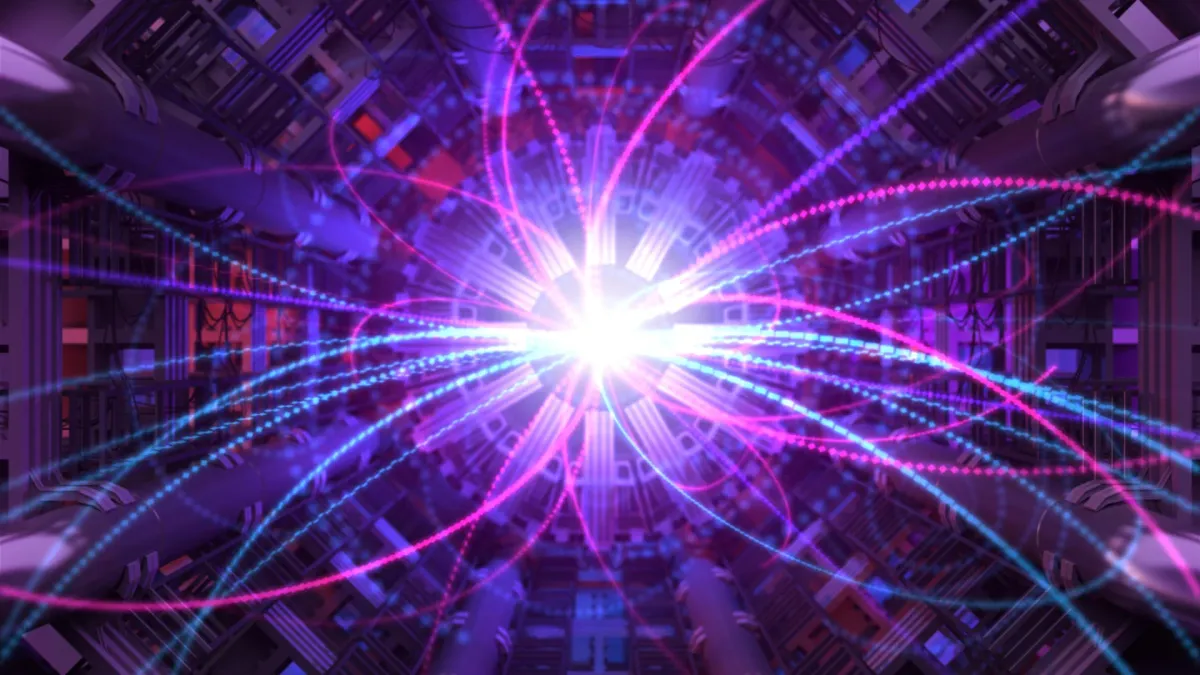
At CERN's colossal Large Hadron Collider (LHC), a 27-kilometer underground ring designed to smash protons together and poke holes in our understanding, researchers have found strong hints that something is amiss. They've been meticulously studying these "penguin decays," and what they've observed just doesn't quite line up with what the Standard Model predicted. Which means, of course, that there might be entirely new, undiscovered particles or forces lurking just out of sight.
Cracks in the Universe's Instruction Manual
Think of the Standard Model as our best guess at how everything works down at the subatomic level. It's brilliant, incorporating quantum mechanics and Einstein's special relativity, and it's held up for over 50 years. But it's also famously incomplete. It can't explain gravity, for example, or the 25% of the universe we call dark matter — the invisible stuff that holds galaxies together but doesn't interact with light.
We're a new kind of news feed.
Regular news is designed to drain you. We're a non-profit built to restore you. Every story we publish is scored for impact, progress, and hope.
Start Your News DetoxSo, the LHC's main gig is to find its flaws. And it seems to be doing just that. The latest data comes from the LHCb experiment, which analyzed the decay of B mesons, tiny subatomic particles. These B mesons, it turns out, are decaying in a way that just isn't playing by the Standard Model's rules. It's like finding a chess piece moving like a knight, but the rulebook says it should only move like a rook.
How off are we talking? The new measurement shows a "tension" of four standard deviations from the Standard Model's expectations. For the non-statisticians among us, that's a one in 16,000 chance that this extreme fluctuation would occur if the Standard Model were perfectly correct. While it's not the coveted "five sigma" gold standard (a one in 1.7 million chance of a fluke), the evidence is certainly piling up. Another independent LHC experiment, CMS, even published similar results in 2025, which, if you think about it, is both impressive and slightly terrifying for the old guard.
The Mystery of the Electroweak Penguins
So, what exactly are these "electroweak penguin decays"? The "penguin" part refers to a specific, incredibly rare type of particle transformation where a B meson decays into four other subatomic particles: a kaon, a pion, and two muons. This particular decay allows scientists to observe a beauty quark transforming into a strange quark, a process that happens only once for every million B mesons. Let that satisfyingly rare number sink in.
By carefully analyzing the angles and energies of these resulting particles, researchers found their measurements simply didn't agree with the Standard Model's predictions. It's like predicting a perfect pool break, then watching the balls scatter in a completely unexpected pattern.
Why focus on such rare events? Because these processes are incredibly sensitive to the effects of new, potentially very heavy particles that the LHC isn't powerful enough to create directly. These unknown particles could still influence these rare decays, much like radioactivity was discovered 80 years before the W bosons responsible for it were actually observed. It's a cosmic game of indirect observation.
Future particle colliders are planned for the 2070s (yes, the 2070s), but these rare processes give us a sneak peek into nature's secrets now. Theories abound to explain these findings, from "leptoquarks" (new particles that unite leptons and quarks) to heavier versions of particles we already know. The current work studied about 650 billion B meson decays recorded between 2011 and 2018. Since then, the LHCb experiment has recorded three times as many B mesons. Further upgrades in the 2030s will increase that dataset 15 times more. So, expect more definitive claims soon. And perhaps, a whole new understanding of the universe.